Satay and the Smoke That Carries Indonesia to the World
· 10 min read
Satay, Indonesia's skewered and charcoal-grilled national dish, began on the streets of Java and now travels the world. This is the story of a stick, some smoke, and a sauce worth arguing about.
Some dishes need a table, a menu, and a reservation. Satay needs a stick, a handful of charcoal, and a corner of pavement. The smoke finds you before the stall does, and by the time you follow it, a vendor is already fanning the coals and turning ten skewers at once. That is the whole promise of satay, Indonesia's most travelled dish: small pieces of meat, seasoned, skewered, and grilled over fire, served with a sauce that people argue about for fun.
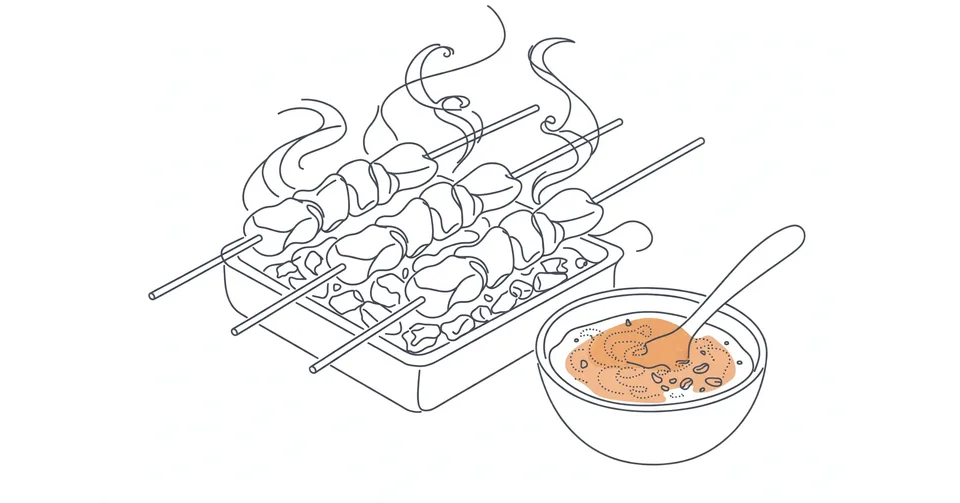
Satay is one of the rare dishes that a whole country agrees on. In 2011, readers of CNN Go voted it number 14 on a list of the world's 50 most delicious foods, ahead of dishes with far bigger budgets and far longer menus. It sits beside rendang at the top of Indonesia's culinary exports, and like rendang it travels well, because the idea is simple enough to survive any kitchen and flexible enough to belong to every region it touches. Ask ten Indonesians for the best version and you will get ten different answers, and every one of them will be defended like family.
Where satay began
Satay began in Java, though the exact moment is lost to street history. The widely held account is that Javanese street vendors adapted the kebab brought by Muslim traders, and the dish took shape as Indian and Arab traders and immigrants arrived in the ports of Java starting in the 18th century. The English word satay traces back through Malay and Indonesian satai to the Tamil word catai, meaning flesh, a small clue to how far the idea travelled before it became Indonesian.
One local account traces the word sate to the Javanese phrase sak beteng, meaning one stick, and places the dish's earliest form in Ponorogo, East Java, as early as the 15th century. Sate Ponorogo, chicken skewers served with peanut sauce and sweet soy sauce, is still believed by many Indonesians to be the earliest form of the dish, created under the first regent of Ponorogo. The claim is hard to prove with documents, because street food rarely leaves a paper trail, but the story itself tells you something true about the dish. It was never a palace dish. It was food made by vendors, for ordinary people, with whatever meat was at hand.
From Java, it spread through the whole archipelago, and every region bent it to local taste. Chicken and goat became the standards in Java, marinated in sweet soy sauce and served with peanut sauce or sliced shallots. In Sumatra, Minangkabau cooks built sate Padang around a thick, spicy, turmeric based sauce. In Bali, cooks wrapped minced meat around lemongrass stalks. The stick stayed the same. Almost everything else changed.
The anatomy of a good satay
A good batch starts before the fire. The meat is cut into small, even cubes so every piece cooks at the same speed, then marinated in a mix that usually includes garlic, coriander, turmeric, and kecap manis, Indonesia's thick sweet soy sauce. The cubes are threaded onto bamboo skewers, which are soaked in water first so they do not burn over the coals. This is not decoration. A skewer that catches fire ruins the batch.
The grill matters as much as the marinade. Traditional vendors grill over coconut shell charcoal in a long, narrow grill, fanning the coals by hand. The fire is hot and close, so the meat chars at the edges while staying juicy inside, and the vendor turns each skewer constantly, brushing it with leftover marinade. The smoke is part of the flavour. One cooked on a flat electric grill can be fine, but it will never taste like one cooked over live charcoal on a street corner at dusk.
Then comes the sauce. The classic is bumbu kacang, peanut sauce made from freshly roasted peanuts ground with aromatics, palm sugar, lime, and chilli. A good one balances four things at once: nutty, sweet, salty, and hot. Vendors serve it thick enough to coat the meat, with sliced cucumber and raw shallot on the side to cut through the richness. The rice cake that usually comes with it, ketupat or lontong, is there to soak up whatever sauce is left. Nothing on the plate is wasted, and nothing is there by accident.
A tour of regional satay
Indonesia has dozens of regional satay styles, and the differences are not small details. The meat, the marinade, and the sauce all change from one island to the next. These eight are the ones worth knowing first.
| Variety | Meat | Sauce | Home |
|---|---|---|---|
| Sate Madura | Chicken or goat | Peanut sauce, sweet soy | Madura, East Java |
| Sate Ponorogo | Chicken | Peanut sauce with sweet soy | Ponorogo, East Java |
| Sate Padang | Beef, tongue, offal | Thick turmeric curry sauce | West Sumatra |
| Sate Maranggi | Beef | Sweet soy with kecombrang | Purwakarta, West Java |
| Sate Lilit | Minced fish or chicken | Wrapped on lemongrass | Bali |
| Sate Buntel | Minced goat in fat | Sweet soy, shallots | Solo, Central Java |
| Sate Klatak | Goat | Salt only, no peanut sauce | Yogyakarta |
| Sate Makassar | Beef or offal | Sour tamarind marinade | South Sulawesi |
Sate Madura is the most famous of them all, sold from boat shaped carts all over Indonesia, and it is the version most people outside the country meet first. Sate Padang is the great exception to the peanut sauce rule, drowned in a yellow brown curry gravy thickened with rice flour. Sate klatak is the purest of the set, goat seasoned with almost nothing but salt, grilled over charcoal, and served with a clear broth. Sate lilit does away with the bamboo stick entirely and wraps the meat around a stalk of lemongrass, so the herb perfumes the meat as it grills.
Peanut sauce is not the whole story
Outside Indonesia, satay means peanut sauce. Inside Indonesia, that is only the beginning. In Central Java, goat satay often comes with sambal kecap, a light, fiery dip of sweet soy sauce, sliced raw shallots, green chillies, and fresh tomato. In Aceh, sate matang is served with a broth instead of a thick sauce. In South Sulawesi, a sour tamarind marinade does the work that peanuts do elsewhere. The point is not that peanut sauce is wrong. The point is that it is one answer among many, and Indonesians enjoy arguing about which answer is best.
This is what I like most about the dish. It refuses to be one recipe. A dish with a single correct version can be perfected and then frozen in place. Satay stayed open, so every region, every town, and every vendor could leave a mark on it. The result is not chaos. It is a map of Indonesia you can eat, one skewer at a time.
Satay beyond Indonesia
The dish did not stay in Indonesia. It travelled with traders, migrants, and cooks across Southeast Asia, and today it is a street food staple in Malaysia, Singapore, Thailand, the Philippines, and Brunei. Malaysia and Thailand both have strong claims on their own versions, and the friendly argument over who owns it has run for decades. The widely held account still gives the origin to Java, but the dish itself belongs to the whole region now, and that is probably the fairest outcome.
Each country bent the dish to its own pantry. The Malaysian version, especially from Kajang, leans on a sweeter peanut sauce and is often eaten with ketupat and cucumber. The Thai version comes with a cucumber relish that cuts the richness with vinegar and sugar. Singapore's satay stalls, gathered in places like Lau Pa Sat, turn the dish into a late night ritual. The stick, the smoke, and the grill survive every border crossing. Only the sauce changes its accent.
How to eat satay like a local
Eating it well is mostly about not overthinking it. Pick up the skewer with your hands, pull the meat off with your teeth or slide it off onto the plate, and dip generously. The rice cake goes on the side, not under the meat, so it stays firm enough to mop up sauce. Cucumber and shallot are not garnish. Eat them between skewers to reset your palate, especially when the sauce is sweet.
At a street stall, you pay per skewer, and the vendor counts the empty sticks at the end, so there is no menu to study and no bill to dispute. Ten skewers is a snack. Twenty is a meal. Go in the evening, when the charcoal is hottest and the crowd is thickest, and look for the stall with the longest queue. In Indonesia, a queue at a satay cart is the most reliable review a dish can get. I have eaten satay from restaurants with white tablecloths, and I have eaten it standing on a pavement in Magelang with smoke in my eyes, and the pavement version wins every time. The dish was built for the street, and the street is where it tastes most like itself.
Trying satay at home
Satay is forgiving to cook at home, as long as you respect the fire. Soak bamboo skewers for at least 30 minutes so they do not burn. Cut the meat into even, bite sized cubes and marinate for at least two hours, overnight if you can. Grill over the hottest charcoal you can manage, turning often and brushing with marinade, and take the skewers off just before you think they are done, because they keep cooking for a minute on the plate. Serve the peanut sauce warm, not cold from the fridge, with cucumber, shallot, and rice cakes on the side.
If you cannot grill over charcoal, a very hot grill pan still works, though you will miss the smoke. What you should not do is drown the meat in sauce before it hits the heat. The sauce is for the table, not the grill. The grill is for the meat, the smoke, and the char at the edges. That char is not a mistake. It is the flavour that tells you the satay was cooked by fire, not by an oven.
Satay proves a quiet point about Indonesian food. It does not need rare ingredients, long cooking times, or a famous chef to be world class. It needs a stick, a fire, and a cook who knows when to turn the skewer. Nasi goreng makes the same point with a wok, and rendang makes it with a pot, but satay makes it with the least of all, and that is why it travelled furthest. A dish that simple can be cooked anywhere, and once people taste it, they want it again. For the full history of the dish, the Satay entry on Wikipedia lays out the origins and the regional varieties in detail, and this guide to Indonesian sate walks through the same story from the grill up. Both agree on the main point, and so do I: satay is Indonesia's most generous export, because it asks for so little and gives back so much.
More in Food & Travel
- Tumpeng Is the Rice Cone Java Serves When It Wants to Say Thanks
- Japan's Winter Illuminations Turn Dark Nights Into Light
- Lake Toba and the Supervolcano That Made the World's Largest Volcanic Lake
- Raja Ampat and the Coral Kingdom at the Edge of Indonesia
- Tokyo Skytree and How Japan Built the World's Tallest Tower
- Tokyo Tower and the Orange Giant That Refused to Be Replaced
Latest posts
- Barong Is the Lion Bali Calls Out When the Village Needs Protection
- Onsen Etiquette and the Unwritten Rules of Japan's Hot Springs
- Setsubun, the Bean Throwing Festival That Chases Winter Away
- Karate, the Empty Hand That Became Japan's Most Exported Martial Art
- Kemari Is the Ball Game Japan Played Without Trying to Win
- Chagama Is the Kettle That Never Leaves the Tea Room
- Judo, the Gentle Way Japan Gave the World
- Matsumoto Temari Turns Mountain Cocoons Into Wishes You Can Hold
- Nambu Tekki Is the Iron That Outlasted the Lords Who Ordered It
- Forest Bathing in Japan, the Quiet Science of Shinrin-Yoku
- Emoji, the Tiny Pictures Japan Gave the World
- Temari Is the Embroidered Ball Japan Gives for Good Luck
- A Tetsubin Turns Iron and Fire Into Japan's Slowest Kettle
- Hakone and the Hot Spring Town Below Mount Fuji
- Ninja, the Shadow Warriors of Feudal Japan