Fuji Ko, the Pilgrim Societies That Climbed Mount Fuji Together
· 8 min read
For two centuries the fuji ko, pilgrim societies of ordinary townspeople, saved together all year so their members could climb Mount Fuji in white, turning a forbidding sacred peak into a journey a whole neighbourhood could share.
Three centuries ago, almost nobody climbed Mount Fuji alone. The mountain belonged to the fuji ko, pilgrim societies of shopkeepers, carpenters, porters and labourers who worshipped the peak together, saved for it together, and every summer sent their people up its slopes in white clothes, chanting as they climbed.
A ko is a confraternity, a circle bound by shared devotion and shared obligation. To join a fuji ko was to accept duties as much as beliefs: meetings through the year, money paid into a common purse, and a turn, when your lot came up, to climb on behalf of everyone who had paid in and stayed home.
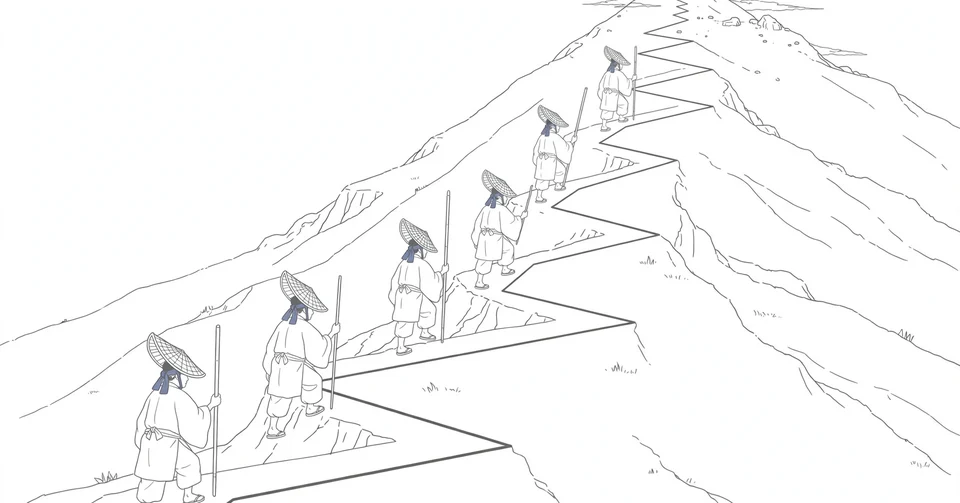
It is hard to picture now, when climbing Mount Fuji mostly means booking a permit online and joining a slow night time line of headlamps. The fuji ko used the same mountain in almost the opposite spirit. For them the summit was not a personal achievement to collect. It was an errand of faith, run on behalf of the whole street back home.
How the fuji ko turned faith into a savings club
The network centred on Edo, the city now called Tokyo, and spread across the surrounding Kanto region. People of the time liked to say there was a fuji ko for each of the city's 808 neighbourhoods. The Japan Tourism Agency's account of the pilgrimage circuits notes that this was probably an exaggeration, but there were certainly hundreds of them, meeting regularly in the capital alone.
Most groups grew out of ordinary life. Many were organised by and for workmates, fellow traders on one street or labourers in one trade, so the fuji ko doubled as a way of cementing social ties. Members contributed money through the year, and the group also collected support from neighbours who wanted a share in the merit of the climb. In a period when commoners could not travel freely, a pilgrimage was one of the few journeys anyone was allowed to make, and the societies made the most of that opening.
When the climbing season came, each fuji ko sent a few representative members up the mountain. The rest stayed home, and in a real sense climbed by proxy, since the prayers at the summit were said for the whole membership. Each group also kept a standing arrangement with an oshi, a priest and innkeeper at the mountain's foot, who lodged the party, supplied the climb and guided its prayers. To my eye the arrangement looks like a travel club, a savings circle and a parish rolled into one, and there is something quietly modern about it.
Kakugyo, the ascetic behind it all
Behind the societies stood one stubborn man. Hasegawa Kakugyo, who lived from 1541 to 1646, was a mountain ascetic who practised severe austerities in and around the Hitoana cave on Fuji's western slopes. Legend credits him with climbing the mountain more than a hundred times, and his example drew ordinary townspeople into a worship that had previously belonged to professional ascetics.
The teaching that grew from Kakugyo treated Fuji not as a backdrop but as a living source of life, a deity to be approached with the whole body. His followers formed the first fuji ko, and after his death the fuji ko multiplied along the roads out of Edo. The Tokugawa authorities were never entirely comfortable with crowds organised outside their control, and bans and proclamations against the movement came more than once. It kept coming back anyway, which tells you how deep the need it answered ran among working people.
Jikigyo Miroku and the fast of 1733
If Kakugyo founded the faith, a merchant gave it its most unforgettable story. Jikigyo Miroku, who lived from 1671 to 1733, was an Edo tradesman who rose to become one of the movement's sixth generation leaders. He preached the faith of the fuji ko in plain terms the official Yamanashi guide still quotes: not feats of spiritual power, but honesty, mercy and diligence in daily behaviour were what could reach the deity of the mountain.
In 1732 famine struck Japan. The following summer, Jikigyo had a small shrine like hut carried up to Eboshi-iwa, a rock above the seventh station, and settled there to fast. By the usual account he took little more than a cup of snow water a day and dictated his final visions to a disciple as the fast went on. He died after thirty one days, having asked to be united with the mountain forever, and his body was left there under piled stones.
I cannot admire the method, and nothing in the record suggests the harvest was saved by it. But the act landed on a hungry country like a bell. Yamanashi's own historical tourism site notes that the popularity of the fuji ko surged after his death, and for the next century the confraternities were one of the great popular movements of the capital.
The climb itself, in white
When the season opened, a party from a fuji ko first made its way to Fujiyoshida, on the mountain's north side. There the group spent a night at the house of its oshi, who fed and housed the climbers and prayed with them before the ascent, a ritual preparation as much as a lodging. Each pilgrim carried an ofuda, a paper talisman stamped with the seal of his own congregation, along with rice balls and a flint tied at the waist.
They climbed in white, with staffs in hand and straw sandals on their feet, chanting rokkon shojo, the purification of the six senses, as they went. The climb was broken by a short night in one of the shelters on the mountain, ancestors of today's mountain huts, before the final push to the crater. At the top the prayers were never only for the men standing there. They were said for the members who had paid, waited and stayed behind, which was rather the point of the whole system.
The women the mountain refused
For most of this history, the world of the fuji ko was a male one, because the mountain itself was closed to women. Under the doctrine called nyonin kinsei, the no women rule, women were held to be ritually impure, a threat to the sanctity of the peak, even though the deity of Fuji was a goddess. Guards and checkpoints on the trails turned women back, and those caught on the upper slopes could be punished.
Women belonged to the fuji ko all the same. They prayed at shrines around the base, sent their wishes up with the men, and climbed the miniature Fujis described below. Then, in the autumn of 1832, one of them went further. Takayama Tatsu, a fuji ko member of twenty four, cut her hair, dressed as a man and climbed through early snow with the quiet help of an elderly priest of her own movement. She reached the summit, the first woman known to have done so, as National Geographic's account of her climb recounts in detail. The rule outlived her by forty years. Only in 1872 did the Meiji government lift the ban on women entering sacred mountains, as one more piece of old order cleared away in the name of modernisation.
The little Fujis of Edo
For everyone who could not make the real climb, through age, health or gender, the fuji ko built an answer close to home: the fujizuka, small replica mountains of lava rock raised in shrine grounds across the city. Climbing one, past copies of the real mountain's station markers and shrines, counted as a symbolic ascent.
The famous early example was built in 1780 by Takada Toshiro, the leader of a local branch, whose mound of genuine Fuji stone took more than nine years to finish. By the early nineteenth century, when the movement stood at its height, Edo held some eight hundred of these little mountains. Around sixty survive in Tokyo today, and some are still opened for climbing on the days when the real mountain's season begins. They are easy to walk past without noticing, which seems a shame. Each one is a receipt for money pooled by people who mostly never saw the summit themselves.
What the societies left behind
The fuji ko faded as Japan changed around them. Once travel no longer needed a religious excuse, and trains made the mountain a weekend trip, the slow machinery of saving, meeting and sending representatives lost its purpose, though a few confraternities never stopped meeting and climbing. What remains is the mark they left on the mountain itself: the oshi houses of Fujiyoshida, the mounds in Tokyo shrine grounds, and the very idea of Fuji as a place ordinary people go.
Reading about them from Shizuoka, with the real mountain sitting on the horizon, I find their version of the climb hard to beat. Today's ascent is freer, cheaper to arrange and open to everyone, and that is plainly better. But the fuji ko understood something the solo summit photograph forgets: that a hard journey goes better when a community prepares it, pays for it and waits for you to bring it home.
More in Culture & Society
Latest posts
- Kecap Manis and the Sweet Soy Sauce of Indonesia
- In Mamoiada, Two Hundred Families Still Make Wine at Home
- Shochu and the Quiet Spirit of Japan
- A Dried Shiitake Is Louder Than a Fresh One
- Loma Linda's Long Lives Run on Saturdays
- Maruten Numazu and the Towering Kakiage Bowl of the Port
- The Three Sisters Grow Better Together
- Tatamiishi Terraces Filter a River Through Stone
- Wasabi-Zuke Puts the Whole Plant in Sake Lees
- Konyoku Is Still Out There, Past the Last Train Station
- Dry January Lasts a Month on Purpose
- Ikaria Runs on Island Time
- Why Nicoya Cooks Its Corn in Lime
- Nobody Eats the Daidai, and That Is the Point
- There Are Only 105 Toshiyori Shares in All of Sumo