Kintsugi, the Japanese Art of Repairing Broken Things
· 9 min read
Kintsugi repairs broken pottery with lacquer mixed with gold, so the cracks become the most beautiful part of the bowl. This is how a 15th century craft turned damage into decoration.
In Japan, when a ceramic bowl breaks, the answer is not always to throw it away. Sometimes the answer is to repair it with gold. That is kintsugi, the Japanese art of mending broken pottery with lacquer mixed with powdered gold, silver, or platinum, so the seams shine instead of hiding. A bowl that has been through kintsugi does not pretend it was never broken. It wears its history in bright lines, and it is often more valued afterwards than it was before.
The idea sounds simple, but it is the opposite of how most of the world treats broken things. We hide the damage, or we replace the object and forget it. Kintsugi does neither. It treats the break as part of the story, and it takes the time to make that story visible.
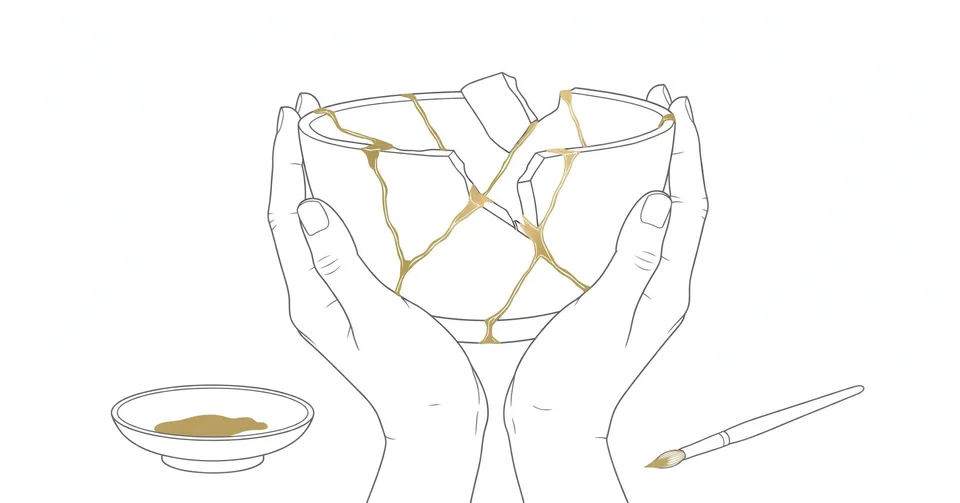
That is why kintsugi has travelled far beyond the pottery studio. People who have never held a tea bowl know the word now. They use it as a picture of healing: something broken can be put back together, and the repair can make it stronger and more beautiful.
The shogun's broken tea bowl
Kintsugi dates to the 15th century, and its best known origin story belongs to the shogun Ashikaga Yoshimasa. According to the story, Yoshimasa broke one of his favourite tea bowls and sent it back to Ming China, where it had been made, for repair. The bowl came back held together with ugly metal staples. It worked, but it looked terrible. Japanese craftsmen, unhappy with the result, set out to find a more beautiful way to mend it, and the method they developed became kintsugi.
Historians argue about how much of that story is literally true. What is not in doubt is that by the late 15th century, repairing ceramics with lacquer and gold was an established practice in Japan, and it was closely tied to the tea ceremony. Tea bowls were not just cups. They were objects of attention, used slowly and looked at closely. A chip or a crack in a tea bowl was noticed, and the question of what to do about it mattered.
The timing makes sense. The tea ceremony was developing into an art of quiet attention, and its masters were beginning to value objects that showed age and use. A bowl with a visible repair fitted that taste better than a bowl that pretended to be perfect. Kintsugi gave the repair a dignity of its own.
How kintsugi is actually done
Real kintsugi is slow work. It is not a tube of glue and a sprinkle of glitter, though that is what many quick kits suggest. The traditional method starts with urushi, a lacquer made from the sap of the urushi tree. The broken pieces are cleaned, and the edges are joined with a mixture of urushi and a fine powder made from rice flour or clay. The join is left to cure, sometimes for days, because urushi hardens slowly and only in the right humidity.
Once the pieces hold, the craftsman builds up the repair in layers. More lacquer is applied, each layer thinner than the last, and each layer must cure before the next one goes on. The seam is then painted with lacquer and dusted with powdered gold, silver, or platinum while the lacquer is still wet. When the final layer hardens, the seam shines. A full repair can take weeks. Some pieces take more than a month.
The cost reflects that time. A proper kintsugi repair is skilled labour, and the materials are not cheap. Real urushi can also irritate the skin, so the craftsman works carefully, with experience that takes years to build. This is part of why a repaired bowl can be more valued than a new one. The gold lines are not decoration added for show. They are the record of weeks of attention, and anyone who looks at the bowl can see it.
There are simpler modern versions. Epoxy resin and gold-coloured powder can hold a broken mug together in an afternoon, and for a beginner learning the idea, that is a fine place to start. Traditionalists will say it is not kintsugi, and strictly speaking they are right. But the modern shortcut proves how strong the idea is. People want the gold seams even when they cannot wait for the urushi to cure.
Wabi-sabi, the idea behind the gold
Kintsugi makes little sense without wabi-sabi, the Japanese way of seeing beauty in imperfection, impermanence, and the marks of use. A new bowl is perfect and untested. A repaired bowl has been dropped, broken, and brought back. Its gold lines are proof that it survived something. In the logic of wabi-sabi, that survival is what makes it beautiful.
The idea runs through much of Japanese culture. It is there in the rough texture of a handmade tea bowl, in the moss of an old garden, and in the way a wooden building is allowed to weather. It is also close to ikigai, the Japanese idea of a reason to live, which is not about chasing perfection either. Ikigai is about finding meaning in the small, ordinary, and unfinished parts of daily life. Kintsugi is that attitude made visible in an object: the bowl does not need to be flawless to be worth keeping.
This is also why kintsugi feels so different from the way we usually fix things. Most repairs aim for invisibility. A good repair, in the usual sense, is one you cannot see. Kintsugi reverses the goal. The repair is meant to be seen, and the object is judged by how honestly it shows what happened to it.
Why a repaired bowl can cost more than a new one
One of the most surprising facts about kintsugi is that a repaired piece is often worth more than an identical new one. Collectors pay for the gold, for the craftsman's time, and for the history the seams record. A famous tea bowl with a well-known repair can be more prized than a flawless bowl from the same kiln. The break, in other words, added value.
This is not only a collector's quirk. It follows from what the object is for. A tea bowl is used in a ceremony built around attention, and a bowl with a visible past gives the drinker more to pay attention to. The gold lines invite a question: what happened here? A new bowl invites no question at all.
There is a practical lesson tucked inside that, and it is one that makers of other crafts understand well. A handmade batik cloth, for instance, carries the small unevenness of the hand that drew it, and that unevenness is part of why it is valued over a printed copy. The mark of the maker, like the mark of the repair, is not a flaw to be corrected. It is the signature that proves the thing was made, and used, by someone.
Kintsugi beyond the pottery wheel
In the last twenty years, kintsugi has escaped the pottery studio and become a global metaphor. Therapists mention it. Writers quote it. Workshops from London to Los Angeles teach it to beginners who have never touched a tea bowl. Kits with resin and gold powder sell in museum shops and online stores, and social media is full of before and after photos of repaired mugs and plates.
The metaphor is attractive because it offers hope without pretending that damage never happened. It says that a break is not the end of the story, and that healing does not have to mean returning to how things were before. The repaired thing is different, and the difference is the point.
That is a fair reading, as far as it goes. But it is worth remembering that the metaphor borrows from a real craft with real costs. A kintsugi repair takes weeks, uses materials that demand skill, and leaves the object changed forever. The metaphor is most honest when it keeps some of that weight: putting things back together takes time, and the result will not look like the original. It will look like something that was broken and then cared for.
There is also a quieter, less quoted lesson in kintsugi, and it is about consumption. We live in a world that makes it easy to replace almost anything. A chipped mug goes in the bin, and a new one arrives the next day. Kintsugi comes from a time and a place where objects were kept, repaired, and used for decades, and where the labour of repair was respected. The gold seams are a reminder that throwing things away is a choice, not a law of nature. Repairing something, slowly and visibly, is also a choice, and it can be the more beautiful one.
A short guide to the materials
The table below gives the basic vocabulary of kintsugi, so the terms mean something when you meet them in a workshop or a museum label.
| Term | What it is |
|---|---|
| Urushi | Natural lacquer from the sap of the urushi tree, used as the glue and the base of the repair |
| Kintsugi | The art of repairing broken pottery with lacquer and powdered metal, literally golden joinery |
| Wabi-sabi | The Japanese aesthetic of beauty in imperfection, impermanence, and the marks of use |
| Maki-e | The technique of sprinkling powdered gold or silver onto wet lacquer, used to finish the seams |
The gold is the part everyone remembers, but the urushi is the part that does the work. Without it, there is no repair at all. That is a useful thing to keep in mind when the metaphor feels too easy. The beauty is real, but it sits on top of patience and skill, and it cannot be rushed.
Kintsugi began with a broken tea bowl and a shogun who was unhappy with a clumsy repair. Five centuries later, it is still answering the same question: what do you do with something that is broken? The answer it gives is simple, and it is worth carrying outside the pottery studio. You do not hide the break, and you do not throw the thing away. You take your time, you repair it with care, and you let the repair show. The bowl will never be what it was before. If you do the work well, it will be something better: an object that remembers what happened to it, and is more beautiful for it.
More in Culture & Society
- Numazu Imperial Villa and Japan's Seaside Imperial Retreat
- Wabi-Sabi and the Japanese Beauty of Imperfect Things
- Women Only Train Cars in Japan and the Problem They Answer
- Maneki Neko and Japan's Beckoning Lucky Cat
- The Baduy People and Life Without Modern Technology
- The Obon Festival, Japan's Week for Honouring Ancestors
Latest posts
- Love Live Sunshine and How Anime Changed Numazu
- Numazu Deep Sea Aquarium and the Creatures of Suruga Bay
- Numazu Himono and the Art of Dried Fish
- Numazu Port and the Freshest Seafood in Shizuoka
- Disaster Vending Machines in Japan That Give Their Drinks Away
- The E33G Remote Worker Visa and How to Legally Work from Bali
- Bullet Climbing Mount Fuji, the Overnight Ascent Japan Is Trying to Stop
- Climbing Mount Semeru, Java's Highest Volcano
- Tamago Sando and Japan's Konbini Egg Sandwich
- The Salaryman and Japan's Loyal Office Culture
- Onsen Tattoo Rules in Japan and How They Are Slowly Changing
- Key Money in Japan and Why Renting Costs Four Months Up Front
- Sento, Japan's Everyday Public Bathhouse
- The Fuji Five Lakes and the Best Views of Mount Fuji
- Visiting the Ghibli Museum and Ghibli Park in Japan