Urashima Opened the Tamatebako and Time Came to Collect
· 12 min read
The tamatebako was the jeweled box the sea princess Otohime gave Urashima Taro with one condition, that he never open it. He opened it, and the white smoke inside turned out to be three hundred years of his own life, waiting to be paid back all at once.
Every forbidden object in folklore makes the same quiet promise. Leave it alone, and you are safe. The tamatebako, the jeweled hand box that the sea princess Otohime gave the fisherman Urashima Taro, honoured that promise in the cruelest way imaginable. It did not explode. It did not curse him or call down a storm. It simply handed him back his own years, all three hundred of them, in a single breath of white smoke.
Urashima had spent what felt like a few days as an honoured guest in the Dragon Palace beneath the sea. Homesick, he asked to go home, and Otohime let him go with the box and a warning. He came back to a village that no longer knew his name, sat down with the tamatebako in his hands, and lifted the lid. By the time the smoke cleared, he was an old man, white haired and bent, and the young life he thought he was returning to was gone for good.
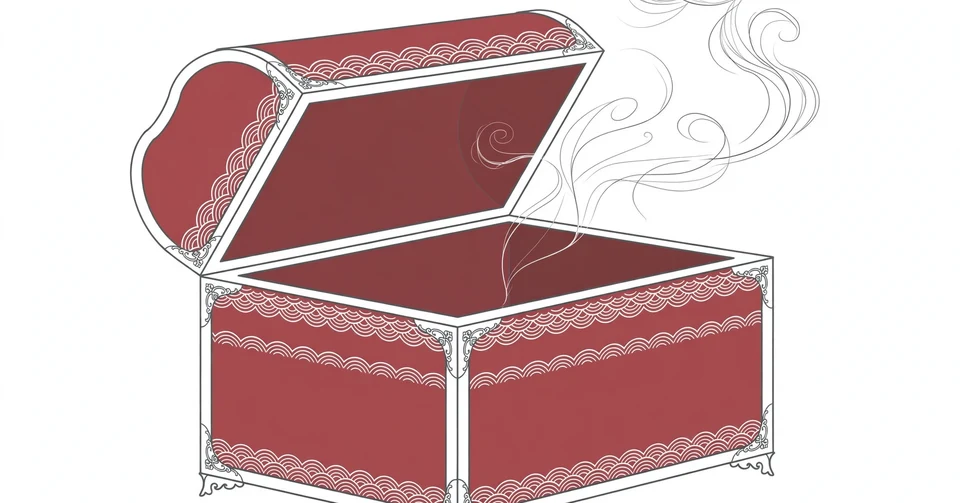
The box is the hinge of the whole tale, and it deserves a story of its own. Japan has been retelling this story for some thirteen centuries, and across that time the tamatebako has been a comb box, a memento, a storehouse of old age, an ordinary object on a woman's dressing table, and finally a word the language still reaches for whenever something precious arrives with a warning attached.
The parting gift of Otohime
The version most Japanese children learn runs like this. Urashima Taro, a kind young fisherman, rescues a sea turtle from children who are tormenting it, and the next day a great turtle carries him down to the Dragon Palace as thanks. The turtle is connected to Otohime, daughter of the Dragon King, and the palace delights him with a garden of four seasons at once, one on each side. I have told the full story of Urashima Taro and the Dragon Palace elsewhere on this site. Here, the fisherman matters less than what he carried home.
After a few days, or a few years, depending on the telling, Urashima grows homesick for his village and his ageing mother. Otohime tries gently to keep him, then gives in. As a parting gift she hands him the tamatebako, a beautiful lacquered casket, and tells him it will protect him from harm, but that he must never, under any circumstances, open it.
He returns to shore and finds everything changed. His house is gone. His mother is long dead. Strangers tell him that a man named Urashima Taro vanished at sea three hundred years ago. Distraught, absent minded with grief, he does the one thing he was told not to do. White smoke pours out of the tamatebako and wraps around him. His beard grows long and white, his back bends, and from the sea comes the sad voice of the princess: "I told you not to open that box. In it was your old age."
It is worth pausing on how gentle the mechanism is. No god strikes him down. No trap springs. The tamatebako is not a punishment device at all. It is a container, and what it contains is simply his, delivered the moment he asks for it.
What was inside the tamatebako
The standard reading, the one Japanese schoolchildren absorb with the story, is that Otohime had packed Urashima's old age into the box. While he feasted under the sea, time in the world above kept flowing, but his share of it was not spent. It was stored. The tamatebako was a kind of vault where three hundred years sat waiting, politely, for their owner to come and claim them.
Seen this way, the gift was both mercy and sentence. As long as the lid stayed shut, Urashima could live in the present he had returned to, young in a world that had moved on without him. The box could not give him back his mother or his village, but it held the debt at bay. Opening it did not create the three hundred years. It only collected them.
There is a wordplay buried in the name that Japanese readers have long enjoyed. The first element, tama, can mean a jewel, and it can also mean a soul or spirit. A tamatebako, then, is a jewel box, and it is also, almost, a soul box. Folklore scholars writing on the tamatebako point out that the double meaning suits the object perfectly, because what Urashima really kept in that casket was the life he had not lived.
I find this reading hard to improve on. The box is the story's bookkeeping. Urashima was never cheated of his years and never granted extra ones. He was offered a deferral, and the whole tragedy is that a deferral feels, from the inside, exactly like an escape, right up until the moment it ends.
The box in the oldest records
The tale is far older than its famous box's name. The earliest surviving account appears in the Fudoki of Tango Province, a regional gazetteer compiled around 713 that now survives only in excerpts quoted by later writers. There the hero is not yet Urashima Taro but Urashimako of Mizunoe, a fisherman who catches a five coloured turtle that turns into a beautiful woman from the household of the immortals. She takes him to the timeless land, and after three years he longs for home. At parting she gives him a jeweled comb box, called a tamakushige, and forbids him to open it if he ever wishes to return to her.
What happens next differs sharply from the schoolbook version. Urashimako finds his home gone and learns he would be more than three hundred years old, and in his confusion he opens the box. No smoke of old age rises. Instead, something beautiful, like a fragrant orchid, is carried away on the clouds to the heavens, and he understands that he has lost the princess and the way back to her forever. In the oldest telling, in other words, the tamatebako does not hold his old age at all. It holds his road home, and opening it costs him her, not his youth. The couple are still somehow able to exchange poems, which the record preserves.
The legend also surfaces in the Manyoshu, the great eighth century anthology of poetry, where a long poem attributed to Takahashi no Mushimaro reflects on Urashima of Mizunoe and his jewel casket, received from the daughter of the Sea God. The Nihon Shoki chronicle mentions the voyage itself under a date that converts to the year 478, though the box plays no part there. The bones of the story, a man, a turtle woman, a timeless country, a forbidden container, were already in place more than twelve hundred years ago.
How the ending kept changing
The tale was standardised much later, in the otogi-zoshi, the illustrated popular storybooks of the Muromachi and Edo periods. More than fifty otogi-zoshi texts of Urashima survive, and they do not agree with each other. In the widely read Otogi Bunko version, Urashima stays three years at the palace and comes home to find seven hundred years gone. He opens the memento box, three wisps of purple cloud rise, and he becomes an old man. Then the story goes further than any schoolbook dares: he transforms into a crane, his wife returns to the form of a turtle, and the two are worshipped as gods.
Other endings are bleaker or stranger. In some versions the sudden ageing kills him on the spot, and his body crumbles to dust, on the reasonable ground that no one can actually live three hundred years. In the version retold in English by Basil Hall Chamberlain in 1886, the absence lasts four hundred years, and opening the box leaves Urashima white haired, wrinkled, and dead. In a variant collected by the folklorist Keigo Seki in Kagawa, the tamatebako is a stacked box of three tiers, and Otohime actually encourages him to use it in his hour of need. The top tier holds a crane's feather, the second releases the ageing smoke, the third holds a mirror so he can see what he has become, and then the feather fastens to his back and he flies away as a crane, circling his mother's grave.
Even the shrine tradition has its own arithmetic. Urashima Jinja, on the Tango Peninsula in northern Kyoto Prefecture, preserves a document claiming that Urashimako left home in 478, visited the land where people never die, and returned in 825 carrying a tamatebako. Ten days later he opened it, the white smoke escaped, and he became an old man. The emperor of the day is said to have ordered the shrine built to house both the box and his spirit.
The numbers never settle: one hundred years in some summaries, three hundred in the textbook, four hundred for Chamberlain, seven hundred in the Otogi Bunko. Folklorists cataloguing the history of the Urashima Taro tale treat that disagreement as normal, and so should readers. A story retold for thirteen centuries is less a single text than a family of texts, and the tamatebako is the one member of the family that never changes its job. Whatever the century, whatever the count of years, there is always a box, and it is always opened.
A real box before it was a magic one
One reason the image landed so deeply is that the object itself was familiar. A tebako was a small hand box of lacquered wood that sat on a Japanese woman's dressing table, holding combs, cosmetics, letters, and small treasures. The older name in the Fudoki, tamakushige, means precisely a comb box. Aristocratic women used such boxes in the etiquette of gift giving, placing a present inside and sending it by messenger. In later centuries, fine lacquered boxes for letters and toilet articles became part of the furnishings a bride brought to her new household, decorated with crests and gold work, made to be kept for a lifetime.
The legendary name grew out of the furniture. The word tamatebako itself, tama joined to tebako, jewel hand box, is first attached to this tale in a poem inserted into an otogi-zoshi text, and the poem's wistful phrase about opening the box to one's regret passed into the language. The object on the dressing table and the object in the story fused: a beautiful, private, lacquered box that obviously held something important, and that no one but its owner should ever lift.
The fusion still has physical traces. Urashima Jinja counts a Muromachi period comb box among its treasures, presented as a tamatebako in its own right. A temple in Yokohama once claimed to keep the very casket from the story, along with Urashima's fishing line, though when foreign visitors went to look in 1880 they found the relics gone and only a statue remaining. People wanted the box to be real, and in a sense it always had been. It was sitting in their houses.
The tamatebako in modern Japanese
The word escaped the tale long ago. Japanese dictionaries list tamatebako both as Otohime's box and, figuratively, as something precious that must not be opened carelessly, which is a fine summary of the whole story in a single entry. An old stock phrase, akete kuyashiki tamatebako, "the tamatebako opened to one's regret", was already being used in Chikamatsu's puppet plays in the Edo period. Modern Japanese adds a lighter cousin, akete bikkuri tamatebako, a box opened to a delightful surprise, the phrase reached for when a gift or a reveal lands better than expected.
The giver of the box has had a second career of her own. Otohime's name now sits on bathroom fixtures across Japan, where the Otohime sound device plays its masking melody, a very different kind of discretion from a sealed casket, but discretion all the same.
Even physics borrowed from the tale. In Japan, the time dilation of relativity, the fact that a traveller moving fast or sitting deep in gravity ages more slowly than those left behind, is sometimes nicknamed the Urashima effect. It is the tamatebako translated into mathematics: go somewhere the clocks run differently, come home, and discover that the years you skipped were never cancelled, only deferred.
Living in Japan, I notice how naturally the metaphor gets used. A sealed file, an unopened letter from the tax office, a result nobody wants to read yet, a savings account holding a bill everyone suspects is large: anything whose contents are known to be consequential and suspected to be unpleasant can earn the name. The story has become the language's shorthand for deferred reality.
What the box is really about
It would be easy to file the tamatebako beside Pandora's box, and the comparison is not wrong, but it is not quite right either. Pandora releases evils into the world. Urashima releases nothing into the world at all. Everything in his box was his: his years, his ageing, his one mortal life, carefully stored by someone who loved him and who told him, plainly, how the arrangement worked.
That, I think, is why the image has survived thirteen centuries of retelling while the plot around it kept changing shape. The tamatebako is not really about curiosity, and it is not really about disobedience. It is about the discovery that time does not stop for anyone, not even for a kind man whom the sea itself tried to protect. It only waits, patient and beautifully lacquered, for the lid to lift.
More in Culture & Society
Latest posts
- Kombu Is the Quiet Half of Dashi
- Manza Onsen Bathes at 1,800 Metres
- Every Prefecture Argues About What Goes in Ozoni
- KRL Commuterline and the Trains That Move Jakarta
- Kecap Manis and the Sweet Soy Sauce of Indonesia
- In Mamoiada, Two Hundred Families Still Make Wine at Home
- Shochu and the Quiet Spirit of Japan
- A Dried Shiitake Is Louder Than a Fresh One
- Loma Linda's Long Lives Run on Saturdays
- Maruten Numazu and the Towering Kakiage Bowl of the Port
- The Three Sisters Grow Better Together
- Tatamiishi Terraces Filter a River Through Stone
- Wasabi-Zuke Puts the Whole Plant in Sake Lees
- Konyoku Is Still Out There, Past the Last Train Station
- Dry January Lasts a Month on Purpose