The Empu Spends Months on a Blade You May Never See
· 13 min read
An empu is the master smith behind the keris, a title earned through decades of forging, fasting, and ritual. This is what the work actually costs.
A keris can sit in a museum case for a hundred years and never be held. It can hang in a family shrine, oiled and wrapped, and be seen by almost no one outside the house. And yet someone spent weeks or months making it, hammering iron and nickel into a pattern that may never be examined closely by anyone but its owner. That someone is the empu.
The word empu means, literally, possessor. In Java the title belongs only to the smiths who can forge a keris, and it is not a job description. It is a rank, earned slowly, and it carries a second demand that no ordinary blacksmith faces. According to Javanese belief, a keris has a physical and a spiritual presence, so the empu who makes one needs technical skill and spiritual knowledge in equal measure.
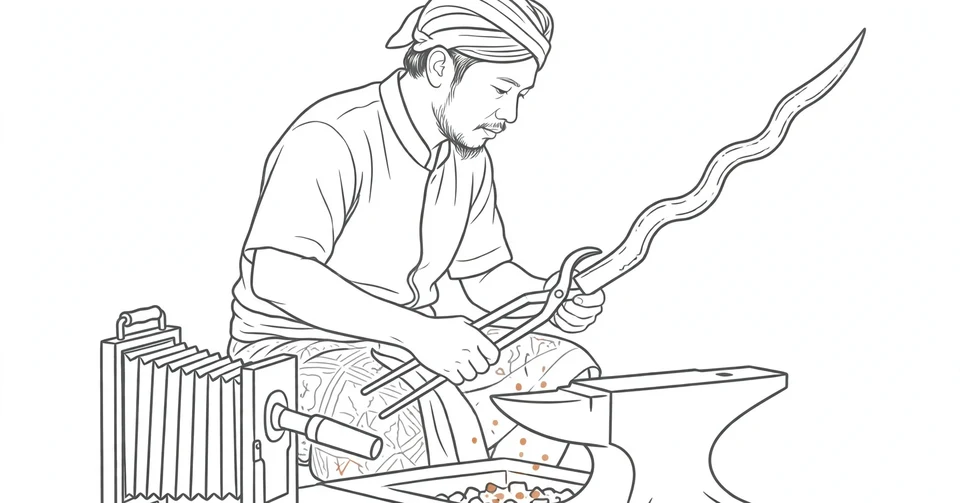
UNESCO puts it plainly. A bladesmith, or empu, makes the blade in layers of different iron ores and meteorite nickel, and in high quality blades the metal is folded dozens or hundreds of times and handled with the utmost precision. Empus are highly respected craftsmen with additional knowledge in literature, history and occult sciences. That is the whole job in one paragraph, and it is a strange job to hold in the modern world.
What an empu actually is
The first thing to understand is that an empu is not a blacksmith who happens to make keris. The Javanese word for a general ironsmith is pandai besi, and a pandai besi makes tools, hoes, parang, golok, the useful iron of daily life. An empu is something narrower and heavier. The title marks a smith who possesses the special skill of forging the keris, and by tradition that skill includes knowledge of literature, history, and the occult, because the blade is believed to be alive in a way a hoe is not.
That belief is old. The earliest known keris go back to the tenth century, and the word itself appears in Javanese inscriptions from 875 CE. A bas-relief at Candi Sukuh, from the fifteenth century Majapahit era, shows a keris forge in action, with Bhima as the blacksmith and Arjuna working the bellows. The oldest surviving keris in the world, the Kris of Knaud, carries the date 1342 in its blade. So the empu has been at the forge for more than a thousand years, and the work has barely changed its shape.
The title is not inherited the way a surname is. Ki Empu Sungkowo Harumbrodjo of Yogyakarta is the seventeenth descendant of Empu Supodriyo, a smith of the fourteenth century Majapahit kingdom, yet his own title of empu was not passed down from his father, the famous Empu Djeno Harumbrojo. He earned it through more than thirty years of making keris. That is the rule, not the exception. The empu is made by the work, and the work takes decades.
In Bali the same line runs through the Pande clan, the caste of smiths who were historically the only group allowed to make keris. Jero Mangku Pande Ketut Mudra of Klungkung is the ninth generation of his family of blacksmiths, and today he is the last traditional keris maker in the whole Klungkung regency. His son Komang Oka works beside him at the forge, which is how the line continues, one pair of hands at a time.
The months inside one blade
A keris blade is not cast. It is built, layer by layer, from a sandwich of metals called saton, usually iron, steel, and nickel-rich pamor material. The smith heats the stack to a yellow heat, around 1,200 degrees Celsius, and folds it. Each fold doubles the layers. A typical blade ends up with dozens to hundreds of layers, and some accounts put the count in the thousands. A hard steel core, the slongon, is set inside the sandwich so the finished blade can hold an edge.
The temperature is part of the craft. Students from the Bandung Institute of Technology once measured the forge of Empu Sungkowo Harumbrodjo at 1,300 to 1,350 degrees Celsius. The workshop is deliberately kept dim so the smith can read the colour of the hot metal, and the best forging colour is a bright yellow-orange. The empu directs the work and his assistant, the panjak, does the heavy hammering, stopping to pump the ububan, the bamboo bellows, to keep the heat steady.
How long does all this take? The honest answer is that it depends on the blade. Some blades can be made in a relatively short time, while more intricate weapons take years to complete. Empu Harumbrodjo usually spends 40 days on a keris, and on days considered taboo he does not work at all. If he absolutely must work on such a day, he starts after four in the afternoon. Other accounts put the forging at weeks or months, and the finest blades stretch longer still. The number that matters is not the calendar but the folding. You cannot hurry a hundred folds, and you cannot fold a blade twice as fast by hitting it twice as hard.
After the forging comes the shaping of the luk, the waves of the blade. The number of waves is always odd, commonly three to thirteen, though some blades carry as many as 29. Then comes filing, tempering, and the long polishing that prepares the blade for the wash that reveals its pattern. That wash is warangan, an arsenic and citrus solution that darkens the iron and leaves the nickel bright, and it is the subject of its own story. The pattern it reveals, the pamor, is the fingerprint of the blade, and the empu has been steering it from the first fold.
There is a detail in the work that I find quietly moving. The empu asks the customer for their weton, the day, date, month and year of birth in the Javanese calendar, so the blade can be made in harmony with its owner. A keris is not a standard product. It is matched to a person the way a horoscope is matched to a birth, and that matching is part of the job. The empu is not only shaping metal. He is shaping a relationship between a person and an object that will outlive them both.
An empu works with more than fire
Before the first hammer falls, the empu prepares himself. The stages of making a keris begin with spiritual practice according to Javanese custom: fasting, asceticism, a selamatan ceremonial meal, the selection of materials, and the avoidance of taboo days. Academic accounts describe the preparation in plainer terms. A few days before forging begins, the empu performs asceticism, namely not sleeping, fasting, and not touching the opposite sex at certain times. Prayers, spells, ceremonies and offerings accompany the making throughout.
In Bali the ritual has its own choreography. The empu must find an auspicious day to begin forging, and on that day he performs napak, a rite in which the deities are understood to step onto the earth. He strikes the metal in a series of nine blows, symbolic of the directions of the wind, in three intervals of Ang, Ung, Mang, the syllables that form Om. Through those nine strikes he is believed to imbue the sacred symbols and powers into the metals and into the keris. When the blade is finished it undergoes pasupati, a sacralisation that gives the keris its power, and it is blessed every 210 days on Tumpek Landep, the day dedicated to Sang Hyang Pasupati.
It would be easy to treat all this as decoration, and it would be wrong. The empu and the people who commission his work believe the blade carries tuah, a kind of potency or fortune, and that the way it is made decides what kind of potency it carries. Ketut Mudra told NOW! Bali that a keris pajenengan, the good keris, is made for protection, prayer and connecting to deities. Other keris, made with negative intentions through rituals to the lower world, are said to grant powers of a darker kind, to fly, to kill, to make their handlers invisible, or to work as a love charm. As Mudra puts it, a positive keris is spiritual, a negative keris is ritual. Whether or not you share the belief, the empu takes it seriously enough to fast for it, and that seriousness is part of what the customer is paying for.
The three metals of the blade carry the same philosophy. They are read as the three spirits of being, bayu, life and energy, sabda, voice, and idep, thought. They are also read as the trimurti gods Brahma, Wisnu and Siwa, and as fire, water and air. Nothing in the forge is only material. The fire is a god, the water that cools the blade is an element, and the wind from the bellows is a spirit. An empu who did not know these correspondences would be, in the eyes of his community, only half a smith.
Empu Gandring and the blade that was never finished
The most famous empu in Javanese history never finished his most famous blade, and the story is still told eight centuries later. It comes from the Pararaton, the Book of Kings, and it concerns a bladesmith called Mpu Gandring, or Empu Gandring, and his impatient customer Ken Arok, in the last days of the Kediri kingdom in the thirteenth century.
Ken Arok ordered a powerful kris to kill Tunggul Ametung, the chieftain of Tumapel. The old smith worked slowly, and Ken Arok, who wanted the weapon on his own schedule, grew angry at the delay. He stabbed Empu Gandring to death with the unfinished blade. Dying, the smith cursed the kris, prophesying that the incomplete blade would kill seven men, including Ken Arok himself.
The prophecy, as the chronicle tells it, came true. Ken Arok used the cursed kris to assassinate Tunggul Ametung, blamed Kebo Ijo for the killing, and built the new kingdom of Singhasari. The blade's first death roll counted four men, Empu Gandring himself, Tunggul Ametung, Kebo Ijo, to whom Ken Arok had lent the weapon, and finally Ken Arok. Then the unfinished kris disappeared.
I do not think the story survives because people believe every word of it. It survives because it says something true about the work. An empu cannot be rushed, and a blade that is rushed is a blade that is wrong. Ken Arok treated the smith like a servant with a deadline, and the legend answers that the blade itself will collect the debt. Every empu since has had the story behind him when a customer asks why a keris takes so long. The answer is in the legend. It takes so long because it is not a product. It is a process, and the process has its own time.
The empu is running out of successors
Here is the part of the story that is not a legend. UNESCO inscribed the Indonesian kris on the Representative List of the Intangible Cultural Heritage of Humanity in 2008, originally proclaimed in 2005, and its own assessment is blunt. Over the past three decades, kris have lost some of their prominent social and spiritual meaning. Active and honoured empus who produce high-quality kris in the traditional way can still be found on many islands, but their number is dramatically decreasing, and it is more difficult for them to find people to whom they can transmit their skills.
The decline has a history. In the nineteenth century, the Dutch colonial powers banned the forging of weapons, and in Klungkung the ban followed the Kusamba War of 1849. The pande of Kusamba, once the centre of keris making for the regency, faded over 150 years until the knowledge was nearly gone. Ketut Mudra's own family lost the trade and became jewellers. The revival came only in 1987, when a German mariner named Dietrich Drescher, searching for Kusamba's keris history, sent Mudra's grandfather to train in Central Java with Empu Subandi Suponingrat. Mudra himself was sent in 2000, and in a month he mastered the creation of the sacred blade. He remains the only empu in Klungkung.
The threat now is quieter than a ban. Cheap keris flood the market, and they lack the three-metal pamor and the napak and pasupati rites that make a real blade. Mudra understands why people buy them, but he is clear about what they are. If the buyer understands what a keris is supposed to be, they will truly value it, he says. The knock-offs do not only take his sales. They take the idea that a keris is worth months of work in the first place.
There is also the simple arithmetic of apprenticeship. A title that takes thirty years to earn needs a young person willing to spend thirty years earning it, and the forge is hot, the pay is uncertain, and the customers are few. Ketut Mudra has taught his son, and over his career he has made thousands of keris, but one family line is not a guarantee. The revival of the 1990s, when concerned experts pulled kris making back from a near standstill in Java, shows that the tradition can come back. It also shows that it can nearly go.
And yet the blade itself argues for patience. A keris is washed every year in the jamasan rite, usually in the month of Suro, and each washing dissolves a little of the surface, which is why heirloom blades grow thinner over the centuries. A blade that an empu spent months on is expected to be washed, oiled, and handed down through generations, seen by few people and carried by fewer. That is not a failure of the work. That is the point of it. The empu is not making a display object. He is making a pusaka, a sacred heirloom, and a pusaka does its work quietly, in a shrine, in a family, in the dark.
The next time you see a keris behind glass, think of the months you cannot see. Somewhere there was a forge kept dim so the smith could read the colour of the metal, a panjak pumping bamboo bellows, an empu who had fasted before he began, and nine strikes laid down in the rhythm of Ang, Ung, Mang. The blade on display is the smallest part of that story. The rest of it is time, belief, and a man who refused to hurry.
More in Culture & Society
- Suka Duka Means the Banjar Shows Up for Joy and Grief Alike
- Tabuh Rah Spills Blood So the Ground Stays Calm
- The Bendesa Adat Speaks for a Village That Has Two Governments
- Catur Brata Is Four Silences Kept at the Same Time
- Your Weton Is the Day You Were Born, Counted Two Ways
- Rahu and Ketu Still Chase the Sun and Moon Across the Sky
Latest posts
- On Koyasan the Founder Is Said to Be Still Meditating
- Hiwatari Asks You to Walk Across the Fire
- Ngembak Geni Is the Morning Bali Starts Talking Again
- Karang Ayahan Is the Plot of Land a Village Trusts You With
- On Tumpek Landep Bali Blesses Everything Made of Metal
- Sudachi Is the Sharpest of Japan's Sour Citrus
- Shugendo Turns a Mountain Into a Place of Testing
- A Canang Sari Is Made Fresh Every Morning and Gone by Night
- The Aling-Aling Wall Exists Because Spirits Walk in Straight Lines
- Oi-Nishin Sent Tohoku Farmers Chasing Herring Every Spring
- The Nishin Goten Were Palaces Paid for by Fish
- The Tobi Were Edo's Daredevils Before They Were Its Firemen
- Kabosu Is Oita's Gentle Answer to Yuzu
- A Yamabushi Trains Where the Mountain Is the Temple
- Tri Hita Karana Holds a Village in Three Balances