The Doomsday Fish Only Visits Before the Ground Moves
· 9 min read
The doomsday fish is the oarfish under its darkest nickname, a messenger from the dragon palace in Japanese folklore and a headline omen in California in 2024. A proper count of fish and earthquakes says the warning is an illusion, and the name is more interesting than the fear.
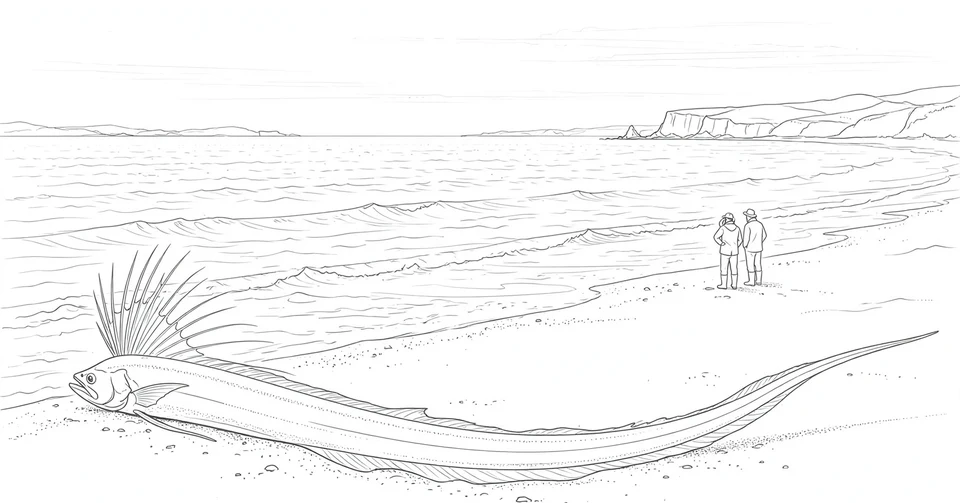
In August 2024, kayakers at La Jolla Cove in California found a dead oarfish floating on water it had no business being in, a twelve foot ribbon of silver that normally lives hundreds of metres below the surface. Within hours the headlines had given it the name it always gets now: a doomsday fish. Two days later, a magnitude 4.4 earthquake rattled Los Angeles, and the story wrote itself. It usually does, wherever a doomsday fish appears.
Here is the honest part, before anything else. The doomsday fish does not predict earthquakes. That has been tested properly, with records and statistics, and the answer came back no. What the doomsday fish does predict, reliably, is a wave of headlines, and that turns out to be the more interesting story: how a nickname attaches itself to an animal, crosses an ocean, and survives every attempt to disprove it.
California gave the name a full workout in 2024. The La Jolla fish was only the twentieth oarfish recorded on the state's beaches since 1901. Another, badly decomposed, came ashore in September, and in early November a third was found on Grandview Beach in Encinitas, spotted by a doctoral candidate from the Scripps Institution of Oceanography. Three strandings in a few months, in a place that had seen about twenty in more than a century. Each arrival restarted the same cycle of wonder and worry, the same two questions about whether the doomsday fish was telling us something, and the same quiet correction from scientists a few paragraphs down.
The messenger from the dragon palace
The name is a translation, and something was lost in it. In Japan the fish is ryugu no tsukai, the messenger from the sea god's palace, a servant of the dragon king sent up from Ryugu, the palace beneath the waves. A messenger is never just a fish. When something that lives in the dark rises into the light, the old logic says it has been sent, and what it has been sent to say is rarely good. Deep sea fish appearing in shallow water were read as advance notice of earthquakes and tsunamis, and the oarfish, the largest and strangest of them, carried the strongest version of the warning. Every doomsday fish headline in English is a descendant of that older idea.
When Western media picked the story up, the messenger became the doomsday fish. The translation lost the palace and kept the dread. A messenger implies a sender, and a message that can be read and perhaps acted on. A doomsday fish implies only the ending. I find the Japanese version the more generous story, because it at least imagines the fish has a reason for being here.
The fish behind the doomsday fish label
Strip the name away and the animal underneath is remarkable enough without it. Oarfish are a small family of just three species, and the giant oarfish is the longest bony fish alive, reliably measured at about eight metres, with longer reports that have never been verified. It lives in the quiet middle depths of the open ocean, roughly 250 to 1,000 metres down, where there are almost no currents. It has no swim bladder, builds very little muscle, and feeds by straining tiny crustaceans from the water. A red crest of fin rays rises from its head and runs along its back, which is why so many old beachings were written up as sea serpents. I have written about the oarfish and its dragon palace name before, and the biology keeps being the best part of the story. The oarfish repays reading about on its own terms, from its self amputating tail to the vertical posture it holds while feeding.
The same body that makes it magnificent in the deep makes it helpless at the surface. An oarfish is built for still, dark, pressurised water. In shallow turbulent water it cannot really swim, cannot feed, and usually cannot get back down. Researchers who examine stranded specimens keep arriving at the same unglamorous shortlist: the fish was sick, injured, disoriented or dying, and the currents did the rest. The necropsy on the La Jolla fish found no clear cause of death at all. A doomsday fish, in other words, is most likely just a fish in trouble, and none of this has slowed the doomsday fish down.
The winter everyone remembers
Every telling of this story eventually reaches the same winter. From December 2009 to March 2010, unusual numbers of slender oarfish appeared in Japanese waters and on Japanese beaches, around twenty of them. A year later, in March 2011, the Tohoku earthquake and tsunami devastated the coast. Afterwards the strandings were remembered, counted and retold as a warning that had been there all along, and the doomsday fish legend gained its strongest modern evidence. Ask what a doomsday fish is, almost anywhere in the world now, and someone will tell you about that winter.
The problem is the direction of the remembering. Nobody tallied those fish as a warning during that winter, because there was nothing yet to warn about. Orihara, the researcher who later tested the claim, has pointed out that many oarfish were found in the Sea of Japan in the winter of 2009 and nothing happened, which describes most of that winter, right up until something eventually did. Japan has large earthquakes often enough that almost any rare event, looked at backwards, can be placed in front of one of them. Retrospective warnings are the cheapest kind. They are never wrong, because they are only ever issued after the fact.
Living in Shizuoka, I understand the pull of the other reading. When the ground moves under your house, you want the world to have sent a sign first. A sign means the disaster had an author and perhaps a schedule. It feels safer than the alternative, which is that the ground simply moves, on its own timetable, without sending anything ahead of it.
Someone finally counted
What makes this story different from most folklore is that a scientist took it seriously enough to test it. Yoshiaki Orihara of Tokai University and his colleagues reasoned that if the doomsday fish belief were true, it would be genuinely useful, because a working animal warning system could feed into disaster planning. So they built the dataset that had never existed. From newspapers, academic papers and museum records they catalogued 336 appearances of deep sea fish in Japan between November 1928 and March 2011, and set them against 221 earthquakes of magnitude 6.0 or larger, checking whether fish appeared within 10 or 30 days before a quake and within 50 or 100 kilometres of one.
The result, published in the Bulletin of the Seismological Society of America in 2019, was about as clear as statistics gets. Exactly one fish appearance could plausibly be paired with an earthquake, roughly what pure chance would produce on its own. No deep sea fish appeared at all before any earthquake of magnitude 7.0 or larger. No earthquake above magnitude 6.0 occurred within ten days of any sighting. The authors concluded that the folklore is a superstition built on an illusory correlation, and the Seismological Society's own summary of the study states the finding in its plainest form: the appearance of these fish does not signal an upcoming earthquake. That should have retired the doomsday fish. Instead the story keeps coming back, because the trial was reported once and the legend is reported every time.
Why the doomsday fish name refuses to die
Part of the reason is arithmetic that nobody sees. A doomsday fish followed by an earthquake is a story. A doomsday fish followed by an ordinary month is a dead fish, forgotten by everyone except the museum that preserves it. The hundreds of strandings with no sequel never enter the record, so the handful with a sequel look like a pattern. Orihara's study is, at heart, a count of all the times nothing happened, and nothing is very hard to turn into news.
Part of it is that the fear is not foolish. In early 2019, about a dozen oarfish sightings in Japan raised public anxiety enough that experts and officials publicly reassured people there was no link to disaster. Those people were not being silly. They were pattern matching in a country where the ground genuinely is dangerous, using the oldest warning system humans have, which is watching animals. The system does not work, but the instinct behind it is the same instinct that eventually built the seismograph.
And part of it, honestly, is the name itself. Doomsday fish is a superb piece of language, short, dark and impossible to forget, and I doubt any correction will ever outrun it. Newsrooms reach for it because readers click on it, and readers click on it because some part of us still lives in the world where the sea sends messengers. The scientists can win the argument and lose the headline, every single time.
The next one that washes up
There will be a next one. Somewhere, some winter or some quiet summer, another long silver fish will come up from the deep and die in the shallows, and within a day it will be a doomsday fish again. Somewhere in the coverage a small earthquake will be found standing next to it, because around the Pacific there is almost always a small earthquake standing next to anything. When that happens, it is worth remembering what the fish actually is: not a warning, but a rare piece of the deep ocean delivered to the surface, worth a necropsy, a museum drawer and a moment of wonder.
The old Japanese name had it better, in a way. A messenger can be questioned. A doomsday fish can only be feared. The science says the fish carries no message about earthquakes at all, and I find that oddly comforting. The deep ocean is not sending us warnings. It is just there, vast and mostly unseen, and every so often it lets us look at one of its strangest residents for a day. That is enough.
More in Culture & Society
Latest posts
- Shimekasu Was Herring You Never Ate
- A Hana Donko Wears Its Cracks Like Flowers
- A Lembaga Perkreditan Desa Is a Bank the Village Owns
- Kaburiyu Is How You Talk Your Body Into the Bath
- Kuki Is the Spring the Sea Turned White
- Tatsuko Wished for Beauty and Became a Statue
- Warangan Is the Wash That Reveals the Pattern
- Ganbanyoku Is Bathing Without Water
- The Obuki Throws Out Nine Thousand Litres a Minute
- Every Village Writes Its Own Awig-Awig
- Sainokawara Is a Bath You Share With a Hundred Strangers
- Umaji Refused to Disappear
- Rwa Bhineda Keeps Opposites From Going to War
- Kasepekang Is Exile Without Leaving Home
- Jamasan Washes a Blade Thinner Every Year