The Ogoh-Ogoh Burn the Night Before the Silence
· 9 min read
On the night before Nyepi, Bali's streets fill with ogoh-ogoh, giant demon effigies built by village youth groups over weeks and months and burned in a single evening. It is the island's loudest night, staged to clear the way for its quietest day.
The loudest night in Bali comes immediately before its quietest day. On the eve of Nyepi, the Balinese day of silence, the streets belong to the ogoh-ogoh: giant demonic effigies, some of them eight metres tall, carried on bamboo platforms through crowds, gamelan music and torchlight. By the end of the night, almost every one of them will be in flames.
None of it is improvised. Each ogoh-ogoh has been under construction for weeks or months in a village hall, built by the young people of a single neighbourhood, and built deliberately to be destroyed. The burning is not the sad end of the festival. It is the entire point of it.
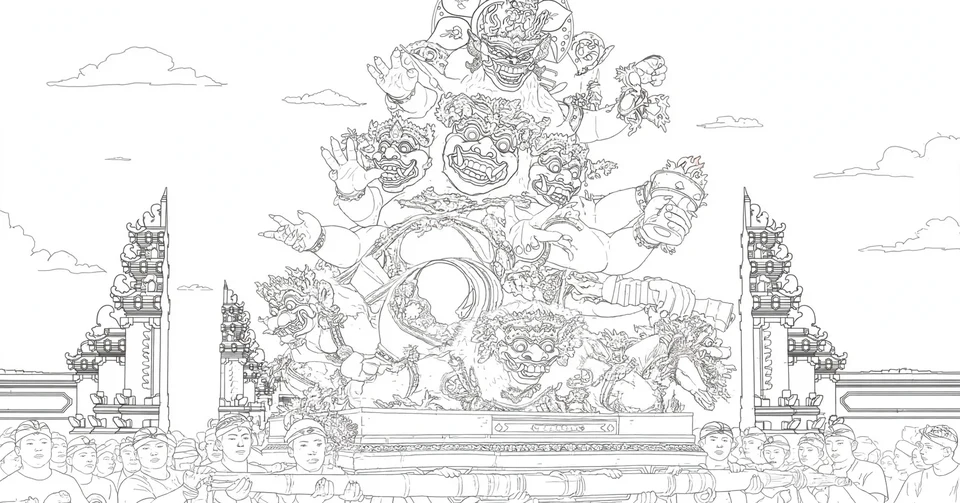
To feel the force of the night, it helps to hold the contrast in mind. Within hours of the last fire, the same streets will be empty and dark. The demons get one loud evening to be carried, shaken and burned, so that the island can start its new year in silence.
What the ogoh-ogoh are carrying
An ogoh-ogoh is a body built for everything a community wants to leave behind. The effigies embody the bhuta kala, the disruptive forces of Balinese Hindu belief, at once powers of nature and the darker corners of human character: greed, rage, arrogance, appetite without limit. The most common form is the Butakala itself, a fanged giant with bulging eyes and grasping hands, although the figures now also include mythological beasts, creatures from the epics and, increasingly, inventions of the moment.
The parade belongs to Tawur Kesanga, the great offering ceremony held on the eve of Nyepi to neutralise those forces before the Saka new year turns. The underlying idea, sometimes called nyomya butakala, is not simply to defeat the demons but to pacify and rebalance them, to take energies that disturb the world and settle them back into their proper place. The ogoh-ogoh gives that abstraction a face and a body. Whatever the village fears or dislikes about itself is loaded onto the platform, shown to everyone, and then, at the end of the procession, burned as a public act of destruction. The negativity is not denied. It is displayed first, and only then let go.
I find that sequence unusually honest. Plenty of new year rituals around the world promise a clean slate in the abstract. This one makes the dirt visible, at eight metres tall, before it is allowed to disappear.
Built by the young, judged by everyone
Almost every ogoh-ogoh is made by a sekaa teruna-teruni, the youth organisation of a banjar, the neighbourhood association that organises so much of Balinese communal life. Work starts weeks or months before the night. A frame of woven bamboo or rattan, sometimes strengthened with iron, is layered with paper until the figure has skin, then painted, dressed in cloth and fitted with accessories, claws, jewellery, crowns of flame. The finished ogoh-ogoh is mounted on its carrying platform and lifted onto the shoulders of a team of young men from the same streets.
The scale is serious. Recorded figures run from about 100 kilograms to a full ton in weight, and the tallest reach eight metres. Ambitious builds, some of them now fitted with moving parts, can cost tens of millions of rupiah, raised locally through contributions and fundraising. What the money buys, more than materials, is standing. An ogoh-ogoh is a source of pride and prestige for its banjar, and competitions are held at district and provincial level almost every year, judged on craft, concept and presence. A neighbourhood's young people are, in effect, presenting their annual report in public, written in bamboo and paint.
The building season matters as much as the night itself. Months of evenings in the banjar hall, arguing over a design, learning from older makers, feeding the crew, are where the community actually reproduces itself. The parade is the exam. The studying was the point.
A tradition younger than it looks
For all its ritual weight, the ogoh-ogoh parade is not ancient, and it is better for admitting it. The name comes from the Balinese word ogah, to shake: carriers shake each ogoh-ogoh as they walk, so the figure seems to stir, dance and resist on its platform. The word itself only entered print in 1984, in the Bali Post newspaper. Before that, the early figures were called onggokan, something lifted again and again.
The roots are older than the name. Village scarecrows called lelakut were once set up at intersections and burned after the eve of Nyepi rituals, and the towering statues carried in royal cremation processions, along with the giant Barong Landung puppets, showed what Balinese makers could do at scale. In the 1970s, youth groups in Denpasar began parading homemade figures before Nyepi, against some grumbling from their elders. The turning point came in 1983, when Nyepi was declared a national holiday and Bali's governor, Ida Bagus Mantra, encouraged people to mark it by building and parading ogoh-ogoh. Through the 1980s the custom spread across the island, and in 1990 it was formally included in the Bali Arts Festival, which carried it everywhere.
So the most famous image of Nyepi is younger than many of the people who carry it. Rather than weakening the tradition, I think its youth explains its energy. This is not a rite preserved under glass. It is something Bali invented within living memory, argued about, improved and chose to keep.
The night itself, from offerings to fire
Pengerupukan day begins with ceremony, not spectacle. Tawur Kesanga offerings, including the Mecaru rites, are made to settle the bhuta kala, and as dusk falls the ritual moves into homes and lanes. Families circle their compounds with torches and burning dried coconut leaves, beating slit drums and cymbals, scattering the noise through every corner to drive out negative influence. Only then does the parade take the streets.
The ogoh-ogoh move through the dark to baleganjur, the fast, interlocking gamelan of processions, whose volume is part of the cleansing. Denpasar has banned recorded sound systems as accompaniment and pushed groups back toward the live ensemble, and the night is better for it. At crossroads, the carriers spin and shake their ogoh-ogoh hard, a deliberate confusion performed at the meeting of roads: the bhuta kala are to be disoriented there, turned around and prevented from finding their way back into the houses they were carried out of. Watching the crowd work, the pecalang, Bali's customary guards in their checked cloth, keep the processions and spectators in order, the one calm element in a night designed to be anything but.
The route ends in fire. After the parading, the ogoh-ogoh are burned, traditionally on the village cemetery ground, and the flames are the full stop at the end of the ritual sentence. The thing that took months to build goes up in minutes, and everyone watches it happen together.
Demons with this year's faces
Since the 1990s, the faces on the platforms have not all come from mythology. Makers have built celebrities, disgraced politicians and the human shapes of fuel price rises, corruption cases and environmental fights; an ogoh-ogoh built around the battle over Benoa Bay reclamation in 2016 carried a whole development dispute through the streets. Indonesian commentators have long described the parade as a medium of social criticism, and that is its safety valve: once a year, a village may hold up a giant effigy of what angers it, in public, with official blessing, and then burn the anger rather than act on it.
There are guardrails. Authorities prohibit figures touching on ethnic, religious or racial provocation or partisan politics, and in tense political years parades have sometimes been suspended. Some religious voices have always been ambivalent, too. The respected priest Ida Pedanda Gede Made Gunung argued that parading the figures after Tawur Kesanga was a misconception, since the offerings have already pacified the butakala, and others note that the parade has no basis in scripture and simply enlivens the ritual. It is frankly admitted to be optional: the ceremonies of Nyepi stand complete without it.
The materials tell their own story of negotiation. In the early 2010s many groups switched to styrofoam because it was easy to carve, until Bali's government banned it in ogoh-ogoh in 2015, since a demon that must burn should not poison the smoke. Builders returned to bamboo, paper and, lately, bark and leaves. The parades even survived a full stop: cancelled through the pandemic years, they returned in 2023. And not every figure burns now. Some ogoh-ogoh are kept, displayed or entered into further competitions, and a small private museum in Mengwi preserves notable examples, months of work saved from the fire by their own quality.
Then the island goes quiet
By dawn, the contrast the whole night was built for arrives. The streets that held drums, torches and several thousand tons of collective misbehaviour stand empty, and Bali begins Nyepi, the day on which the entire island stops: no travel, no work, no fire, no noise. The pecalang who managed the crowds now patrol the silence, and the only evidence of the night before is ash on the cemetery ground.
I keep coming back to the bookkeeping of it. A community spends months giving its worst impulses a body, carries that body through the streets where nobody can pretend not to see it, argues about it, laughs at it, and then burns it in front of everyone. What remains in the morning is not innocence, exactly. It is something more believable: an island that has looked at its demons in the open, and can therefore be trusted when it asks for one day of quiet.
More in Culture & Society
Latest posts
- Shimekasu Was Herring You Never Ate
- A Hana Donko Wears Its Cracks Like Flowers
- A Lembaga Perkreditan Desa Is a Bank the Village Owns
- Kaburiyu Is How You Talk Your Body Into the Bath
- Kuki Is the Spring the Sea Turned White
- Tatsuko Wished for Beauty and Became a Statue
- Warangan Is the Wash That Reveals the Pattern
- Ganbanyoku Is Bathing Without Water
- The Obuki Throws Out Nine Thousand Litres a Minute
- Every Village Writes Its Own Awig-Awig
- Sainokawara Is a Bath You Share With a Hundred Strangers
- Umaji Refused to Disappear
- Rwa Bhineda Keeps Opposites From Going to War
- Kasepekang Is Exile Without Leaving Home
- Jamasan Washes a Blade Thinner Every Year