Tri Hita Karana Holds a Village in Three Balances
· 13 min read
Tri hita karana is the Balinese philosophy of three balances, with the divine, with other people, and with nature, and it shapes how a village is built, governed, and farmed.
Ask a Balinese villager what keeps a village together and the answer is unlikely to be a budget or a building. It is more likely to be a balance, kept three ways at once, and the Balinese have a name for it: tri hita karana. The village must stay right with the gods, right with its neighbours, and right with the land that feeds it. Lose one of the three and the other two start to wobble.
Tri hita karana means three causes of wellbeing. It is the philosophy underneath almost everything a visitor notices about Bali, from the small offering on a doorstep each morning to the green terraces that climb the hillsides in steps. It is also, less visibly, the philosophy underneath the village itself: its map, its laws, and its water.
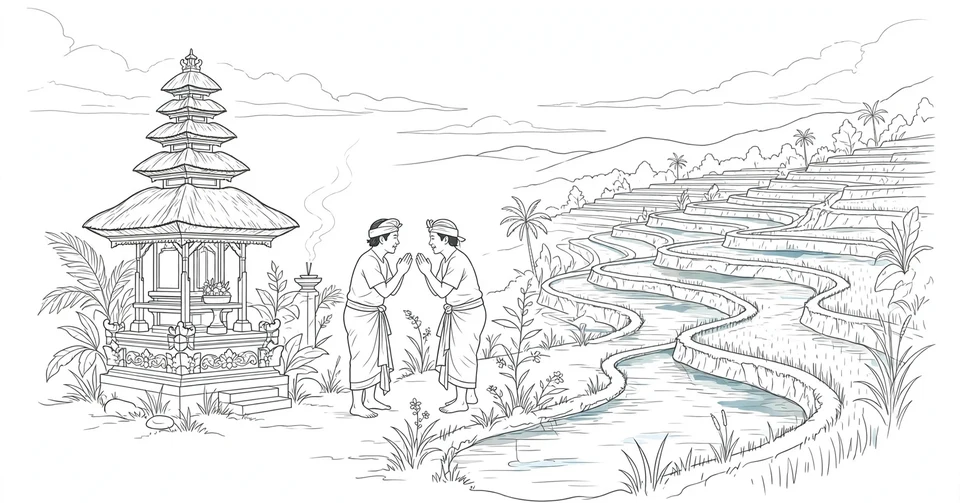
What makes tri hita karana worth a closer look is that it is not a slogan on a wall. It is a working system. The same three words explain where a temple stands, why a farmer gets water on one day and not another, and why a family that breaks the village rules can be cut off from the sound of the village drum. One idea does the work of a town plan, a legal code, and an ecology textbook at the same time.
What tri hita karana actually means
The phrase comes from Sanskrit derived words. Tri means three. Hita means wellbeing, prosperity, or happiness. Karana means cause or source. Put together, tri hita karana means the three causes of wellbeing, and the three causes are three relationships: harmony with God, harmony among people, and harmony with nature. The principle is central to Balinese Hinduism, the dominant religion of the island, and it is credited with much of the island's prosperity, its stable record of development, and the quality of life of its residents.
Each of the three has its own name. Parhyangan is the relationship between people and the divine. Pawongan is the relationship between people and each other. Palemahan is the relationship between people and the natural world. The point of tri hita karana is that the three are not separate departments of life. They depend on each other. When one relationship is neglected, the balance of the whole is affected, and when all three are nurtured together, individuals and communities are better able to thrive.
I find this the most useful part of the idea. Most philosophies of a good life pick one thing to protect, usually the soul, or the community, or the earth. Tri hita karana refuses to choose. It says a good life is a three legged stool, and it is honest about what happens when a leg goes missing. The stool does not lean. It falls.
The first balance is with the divine
Parhyangan is the most visible of the three balances to a visitor, because it is the one that fills the streets. Every morning, small offerings of flowers, rice, and incense appear on doorsteps, in shrines, and at crossroads. These are canang sari, daily acts of gratitude that remind the person making them that life is sustained by forces beyond themselves. Temples stay busy all year, not as monuments to a finished past but as working rooms where the village meets its gods.
Every desa adat, the customary village, keeps three principal temples of its own, a group known as the Kahyangan Tiga. The Pura Desa, the village temple, is dedicated to Brahma in his function as creator. The Pura Puseh, the temple of origin, is dedicated to Wisnu as preserver. The Pura Dalem, the temple of the dead, is dedicated to Siwa as dissolver. Together they cover the whole arc of a life, from beginning to end, and they give parhyangan a fixed address in every village. That is tri hita karana made visible: the first of its three balances given walls, a roof, and a place on the map. You can read more about the institution that keeps them standing in the story of the desa adat, the village that governs itself.
What strikes me about parhyangan is how ordinary it is. The offerings are small, the prayers are daily, and nobody treats them as a special occasion. That is the point. A relationship with the divine that only shows up at festivals would be a decoration. A relationship that shows up every morning before breakfast is a habit, and habits are what hold a village together when the festivals are over.
The second balance is with each other
Pawongan is the balance between people, and in Bali it is organised through the banjar, the neighbourhood community that runs almost everything a village does together. Residents of a banjar prepare ceremonies side by side, maintain public spaces, support families at weddings and funerals, and make collective decisions in meetings where every household has a voice. The spirit behind it is gotong royong, working together for the common good, and its practical form is ngayah, unpaid communal work that every member is expected to give. None of this is optional, and tri hita karana is clear about why: a village that cannot cooperate cannot worship or farm together either.
Pawongan is also where tri hita karana shows its teeth. A village that only celebrated togetherness would be a pleasant fiction. The real test of harmony among people is what happens when someone breaks it. Bali has an answer, and it is severe: a family under the sanction of kasepekang can be cut off from communal help and from the sound of the village drum, which no longer rings for them. The sanction works precisely because tri hita karana makes belonging something you can hear. Exile without leaving home only hurts if home means something, and in a banjar it means almost everything.
This is the balance I think outsiders understand least, because it looks like kindness from the outside and feels like obligation from the inside. A villager does not attend a neighbour's cremation because he is feeling generous that week. He attends because the village keeps a ledger of presence, and because his own family will one day need the same crowd. Pawongan turns mutual help into a system rather than a mood, and systems outlast moods.
The third balance is with the land
Palemahan is the balance with nature, and its clearest expression is the subak, Bali's cooperative irrigation system. Water from springs and rivers is channelled into canals and shared between farmers according to rules agreed in water temples, and the water flows through the temples themselves before it reaches the fields. Rice is treated as a gift of god, and the subak is treated as part of temple culture, so farming and worship share the same plumbing. The subak is tri hita karana at its most practical: the three balances sharing one canal. The system has shaped the landscape for about a thousand years, and since the 11th century the water temple networks have managed the ecology of rice terraces at the scale of whole watersheds.
In 2012, UNESCO inscribed the Cultural Landscape of Bali Province on the World Heritage List, and it did so specifically as a material embodiment of tri hita karana. The UNESCO listing describes how the subak system draws together the realms of the spirit, the human world, and nature, and how water temple rituals promote a harmonious relationship between people and their environment. The property covers five sites, including the Supreme Water Temple of Pura Ulun Danu Batur on the edge of Lake Batur, whose crater lake is regarded as the ultimate origin of every spring and river, and the terraces of Catur Angga Batukaru, mentioned in a 10th century inscription. In total, Bali has about 1,200 water collectives, and between 50 and 400 farmers manage the water supply from a single source. The listing matters because it recognises tri hita karana not as folklore but as infrastructure, something a landscape is built on.
Palemahan is not only about water. Mountains, rivers, forests, lakes, and the sea are all valued for their spiritual significance as well as their ecological importance, and sacred forests and springs are protected because healthy ecosystems are essential to cultural life as well as to farming. The idea is simple enough to state and hard enough to live by: nature is not a warehouse to empty but a partner to keep in balance.
Tri hita karana also draws the map of the village
The philosophy does not stop at behaviour. It draws the village itself. Balinese space is organised in three zones, a pattern called tri mandala. The utama mandala is the mountain zone, the realm of gods and ancestors. The madya mandala is the middle zone, the agricultural plains and the human domain. The nista mandala is the sea zone, the realm of decay and forces that must be kept at a distance. The same threefold pattern repeats at the scale of a single village, and it decides where buildings stand. The pattern is tri hita karana drawn as a map: the divine above, the people in the middle, and the land and the dead below.
The three village temples follow the pattern. The Pura Desa stands on the highest part of the village, the Pura Puseh in the middle, and the Pura Dalem, the temple of the dead, in the lowest ground, usually near the cemetery and facing the sea. The axis that runs through them is kaja-kelod, mountain to sea. Kaja, toward the mountain, is upstream, the source of pure water. Kelod, toward the sea, is downstream, the receiver of waste and ashes. People sleep with their heads toward the mountain, and the ashes of the dead are carried toward the sea. Walking from the mountain to the sea traces creation, life, and death in a single line.
You can see the pattern intact in Penglipuran, a customary village in Bangli that still organises its layout by tri mandala. Its upper zone holds the temples and a bamboo forest, its middle zone holds the houses and the banjar halls, and its lower zone holds the cemetery, the Pura Dalem, and the fields. A visitor walking through Penglipuran is walking through tri hita karana in physical form: the divine above, the people in the middle, and the land and the dead below, each in its proper place.
A young name for old habits
Here is the honest complication. Tri hita karana sounds ancient, and its practices are, but the name itself is young. Scholars trace the formulation to 1966, when it was introduced by Dr. I Wayan Merta Suteja at a regional conference of the Balinese Hindu struggle body in Denpasar, and to the thinking of the Prajaniti Hindu Indonesia movement of the 1960s. The water temple networks that embody it go back to the 11th century, but the three word label that now sums them up is barely sixty years old, and tri hita karana as a phrase is younger than the grandparents of the farmers who live by it.
That does not make the philosophy false. It makes it a modern name for something villages were already doing, given at a moment when Bali needed a way to describe itself to the outside world. Since the late 20th century, Indonesian authorities have promoted the image of the traditional Balinese community living by tri hita karana, aiming in part at an international audience and at tourism. The idea has been studied by anthropologists as prominent as Clifford Geertz and Stephen Lansing, and it has travelled far beyond Bali, into conferences on sustainability and island culture.
I think the age of the name matters, because it keeps the philosophy honest. Tri hita karana is not a relic dug out of the ground. It is a living argument, assembled in living memory, about how a community should hold together. That is a stronger claim than antiquity. A relic can only be preserved. An argument can be tested, argued with, and repaired, and Bali has been testing it every day since.
What happens when one balance breaks
The test is getting harder. UNESCO itself warns that the terraced landscape is highly vulnerable to social and economic change and to increasing tourism pressure, and that the setting of the heritage sites is fragile and under pressure from development. Waste management on the island is widely recognised as inadequate, which is a palemahan problem with pawongan roots: a community that cannot agree on what to do with its rubbish cannot keep its rivers clean either.
When one balance breaks, the other two feel it at once. If farmers sell their fields to developers, the subak loses members and the water temples lose their congregations, which is palemahan and parhyangan failing together. If young people leave the village for work in the city, the banjar thins out and ceremonies shrink, which is pawongan failing first and the rest following. The three balances are one system, so a crack anywhere runs through the whole structure.
The repair mechanism is written down. Almost every awig-awig, the customary law of a village, is built on the same skeleton as tri hita karana itself: one chapter for parhyangan, one for pawongan, one for palemahan, plus chapters on disputes, sanctions, and amendment. A governor's regulation issued in 2020 fixed a minimum table of contents for these village laws, so the skeleton is now shared by every village on the island. You can see how that skeleton works in practice in the story of the awig-awig, the law every village writes for itself. Tri hita karana does not only describe the village. It writes its rulebook.
A village that loses one of its balances does not collapse overnight. It goes quiet first. The drum rings for fewer families, the water runs to fewer fields, and the temple festivals get smaller year by year. That is why the philosophy matters beyond Bali. It gives a village a way to name what is going wrong before the damage is obvious, and a way to say which balance needs repair. A community that can name its problem has already started to fix it.
A visitor to Bali sees temples, dances, and terraces, and it is easy to file them under beauty, as though the island were decorated for our benefit. Tri hita karana says the decoration is the structure. The temple is where the village meets its gods, the banjar is where it meets itself, and the terraces are where it meets the land that feeds it, and the three meetings are one meeting, held three ways. Keep the three balances of tri hita karana and the village holds. Let one go, and the village starts to forget what it was for.
More in Culture & Society
- Suka Duka Means the Banjar Shows Up for Joy and Grief Alike
- Tabuh Rah Spills Blood So the Ground Stays Calm
- The Bendesa Adat Speaks for a Village That Has Two Governments
- Catur Brata Is Four Silences Kept at the Same Time
- Your Weton Is the Day You Were Born, Counted Two Ways
- Rahu and Ketu Still Chase the Sun and Moon Across the Sky
Latest posts
- On Koyasan the Founder Is Said to Be Still Meditating
- Hiwatari Asks You to Walk Across the Fire
- Ngembak Geni Is the Morning Bali Starts Talking Again
- Karang Ayahan Is the Plot of Land a Village Trusts You With
- On Tumpek Landep Bali Blesses Everything Made of Metal
- Sudachi Is the Sharpest of Japan's Sour Citrus
- Shugendo Turns a Mountain Into a Place of Testing
- A Canang Sari Is Made Fresh Every Morning and Gone by Night
- The Aling-Aling Wall Exists Because Spirits Walk in Straight Lines
- Oi-Nishin Sent Tohoku Farmers Chasing Herring Every Spring
- The Nishin Goten Were Palaces Paid for by Fish
- The Tobi Were Edo's Daredevils Before They Were Its Firemen
- Kabosu Is Oita's Gentle Answer to Yuzu
- A Yamabushi Trains Where the Mountain Is the Temple
- Shingon Has Kept Its Fire Ritual Burning for 1,200 Years