The Keris at a Pecalang's Waist Is an Heirloom, Not a Weapon
· 10 min read
A keris tucked at a pecalang's waist in Bali is rarely there to be drawn. Forged in folded layers by an empu, given names, washed every year and handed down through families, the keris survives as an heirloom and a badge of identity.
Stand at a junction in Bali on a ceremony day and watch the man holding back the traffic. Checked cloth, folded headcloth, black vest, and at his waist, tucked into the folds of his dress, a dagger with a wavy blade. It is a keris, and the most important thing about it is that he has no intention of ever drawing it.
The pecalang, the customary village guards of Bali, wear the keris the way another man might carry a grandfather's watch. It tells the time of a family, not of a fight. Many of these blades are older than the men wearing them. Some were already old when the wearer's grandfather was born, and they have passed from waist to waist down the generations, gathering names, stories, and obligations along the way.
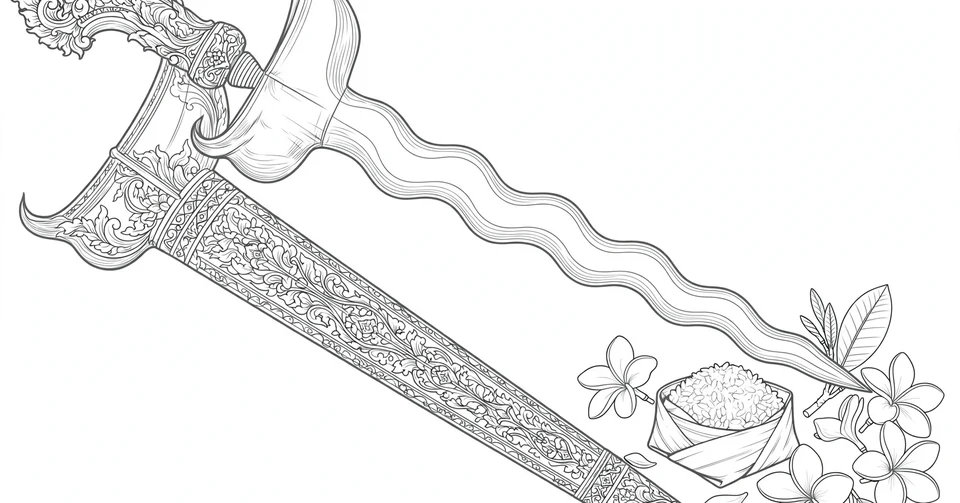
To understand how a dagger can sit at a man's waist for a lifetime without being used, you have to understand what a keris is in Java and Bali. It was never only a weapon. It is closer to a document, one written in folded metal, recording a maker, a family, and a whole set of beliefs about how the visible and invisible worlds fit together.
A keris is built to be recognised
The keris, also spelled kris in much English writing, is an asymmetrical dagger from Indonesia, associated above all with Java and Bali, though it is familiar across the archipelago and beyond. It comes in three parts, and each part is treated as a work of art in its own right: the blade, called wilah, the hilt, called hulu, and the sheath, called warangka. The blade is usually narrow, flaring into a wide and deliberately lopsided base, and the curved pistol grip hilt lets a palm press down behind a thrust.
The silhouette everyone knows is the wavy blade, but the waves are not compulsory. More than half of all keris made before the modern era had straight blades, and the older Majapahit era types were straight as well. Where the waves do appear, they are called luk, and their number is always odd, most commonly three to thirteen, with some blades carrying as many as twenty nine. In Bali the wavy blade is read as a naga, a dragon or serpent, caught mid movement, while a straight blade is the same creature at rest, its power dormant but ready.
The sheath and hilt complete the message. A warangka is a wooden frame that may be sheathed in brass, silver, or even gold and carved with floral scrollwork, and hilts range from plain wood to ivory and gold worked into gods, demons, and abstract human forms. Nothing about a good keris is meant to be hidden. It is made to be read at a glance, the way the pecalang himself is made to be read.
Folded metal and the empu who folds it
A keris blade is born in layers. The smith, honoured with the title empu, forge welds different iron ores together with iron rich in nickel, folding the metal dozens or even hundreds of times. When the finished blade is washed in acidic citrus juice and mineral preparations, a process called warangan, the nickel layers stay bright against the darkened iron and a pattern blooms across the surface. That pattern is the pamor, and it is the fingerprint of the blade.
Pamor patterns have names, and the names carry meanings and reputed powers. One celebrated pattern, beras wutah, scattered rice, was believed to grant its owner an easy life without famine, and blades carrying it were often assigned to officials who were paid partly in rice. The most prized pamor material of all was stranger still: iron from a meteorite that fell near the Prambanan temples at the end of the eighteenth century, dug up and carried to the court of Surakarta, where court smiths cut small pieces of it into their finest blades.
The empu was never just a metalworker. He was expected to hold knowledge of literature, history, and the occult alongside his technical skill, because the blade he produced was believed to carry a spiritual presence as well as an edge. In old Majapahit, bladesmiths were reputed to be able to work hot iron with their bare hands, and when the Majapahit world collapsed, many of its smiths fled to Bali, where the Pande clan keeps the craft alive to this day.
A keris can have a name and a temper
In Javanese culture the keris is revered as tosan aji, a sacred heirloom weapon, and as pusaka, a sanctified inheritance. Families do not merely own such blades. They keep them, the way you keep a person with a difficult character, with attention and a certain respect. Famous keris carry names of their own. Taming Sari, the flower shield, was said to make its bearer unbeatable. Setan Kober, the devil of the grave, forged with thirteen luk, was believed to have a temperamental and evil nature that infected its owners with ambition and impatience, because the empu was disturbed by a demon at the very moment he tried to fill it with power.
These are folktales, but they describe a real relationship. Traditional teaching holds that a keris contains all the elements of nature, water, wind, fire, and earth, together with a fifth presence, the self, a spirit or soul of its own. Some blades were rumoured to stand upright when their true names were called. Harmony between blade and owner was considered essential, and one old test was to sleep with the keris under your pillow: a good dream meant the pairing was sound, a bad one meant the blade should be passed on. A keris, in other words, could be wrong for you personally, and that was nobody's fault, not even the blade's.
Even the flat heroes of wayang, the shadow puppet theatre, are incomplete without one: kings and warriors in the carved leather carry a keris at the back, because that is simply what a person of consequence looks like in the Javanese imagination.
Washed every year and fed with offerings
An heirloom of this kind cannot be left in a drawer. Javanese tradition requires a yearly cleaning of the blade, the jamasan, and the ritual washing is part of the spirituality surrounding the object, so much so that ancient blades are often worn thin by centuries of devoted care. Owners made offerings to significant keris at shrines, because a sacred object with power was thought to deserve feeding, and neglecting the rites was said to invite bad fortune. Pointing a keris at someone was believed to mark them for death, which is why silat practitioners traditionally touch their blade tips to the ground before a demonstration, to neutralise the gesture.
The handing down was built into daily life. In battle a fighter might carry three keris: his own, one inherited from his father in law, and one that was the family heirloom, with the spares doubling as parrying blades. At a Javanese wedding the groom still wears a keris dressed with chains of jasmine, a custom said to descend from the Setan Kober story, the flowers standing in for patience, grace, and humility, and carrying a quiet instruction: a man should not be quick to anger, cruelty, or abuse. Women wore keris too, usually smaller than a man's. The blade ran through the whole society, not just its warriors.
The day the keris stopped being a weapon
For all its spiritual weight, the keris did see real violence. Warriors carried it as a secondary armament, the blade you reached for when the spear was lost, while commoners wore one daily, especially when travelling. The Portuguese writer Tome Pires, describing Java in the early sixteenth century, claimed that every man, rich or poor, had to keep a keris in his house, and that no man between twelve and eighty went outdoors without one in his belt. That is an outsider's sweeping claim and should be read as one, but it captures how ordinary the sight once was.
Firearms and colonial rule slowly stripped the keris of its battlefield role, and in Java the symbolic turning point came in 1830, when the defeated Prince Diponegoro had to hand his keris over to the Dutch at the end of the Java War. The disarmament of the keris as a fighting weapon was real, yet its other life continued untouched: as ceremonial dress, as sacred heirloom, as personal amulet. In March 2020 the Dutch king Willem-Alexander formally returned Diponegoro's own keris to Indonesia, where it now sits in the National Museum, treated not as a captured weapon but as a piece of the nation's honour coming home.
UNESCO placed the Indonesian kris on its Representative List of the Intangible Cultural Heritage of Humanity in 2008, after first proclaiming it in 2005, noting keris traditions that reach back to around the tenth century and probably spread outward from Java. UNESCO is honest, too, that the object has lost some of its social and spiritual prominence in recent decades, and that the number of honoured empu still working in the traditional way is shrinking. The recognition protects a meaning, not a military skill.
What the keris is doing at a pecalang's waist
All of this history is what hangs at the waist of the man directing traffic around a temple procession. I have written elsewhere about how you can read a pecalang from across the street, from the checked saput poleng cloth to the folded udeng, and the keris belongs to that same visible grammar. In Bali and Java alike, the keris is traditionally worn at the back, a placement often explained as violence kept as the last resort, behind you rather than in front. It announces that the wearer serves something older than himself: his village, his ancestors, and the customary order he has volunteered to guard without pay.
Its practical uselessness today is precisely the point. On modern traffic duty the keris usually stays at home and a handheld radio takes its place in the hand, because a radio actually helps. The keris comes out for ceremony, for processions, for the patrols of Nyepi, when the work being done is as much symbolic as physical. Nobody on that road is afraid of the blade, and nobody is meant to be. It is there the way a wedding ring is there, as evidence of a bond that exists whether or not anyone is looking at it.
I find something reassuring in the fact that the object survived its own obsolescence. The keris outlasted the wars it was forged for, outlasted the empire that tried to disarm it, and outlasted even the slow fading that UNESCO worries about, not because anyone needed a better dagger, but because families kept washing it once a year, kept offering it flowers, and kept deciding that the next generation should receive it. A weapon asks to be used. An heirloom only asks to be kept, and in Bali, at the waist of a village guard standing quietly in the road, you can see which of the two the keris chose to become.
More in Culture & Society
Latest posts
- Shimekasu Was Herring You Never Ate
- A Hana Donko Wears Its Cracks Like Flowers
- A Lembaga Perkreditan Desa Is a Bank the Village Owns
- Kaburiyu Is How You Talk Your Body Into the Bath
- Kuki Is the Spring the Sea Turned White
- Tatsuko Wished for Beauty and Became a Statue
- Warangan Is the Wash That Reveals the Pattern
- Ganbanyoku Is Bathing Without Water
- The Obuki Throws Out Nine Thousand Litres a Minute
- Every Village Writes Its Own Awig-Awig
- Sainokawara Is a Bath You Share With a Hundred Strangers
- Umaji Refused to Disappear
- Rwa Bhineda Keeps Opposites From Going to War
- Kasepekang Is Exile Without Leaving Home
- Jamasan Washes a Blade Thinner Every Year