Ngayah Is Work Nobody Pays For
· 9 min read
In Bali, ngayah is the tradition of unpaid work for the temple and the customary village, offered upward to God as devotion. For full members of a desa adat it is also a legal duty, and that double life is what makes it work.
Every Balinese temple festival is built twice. It exists first as a date on the ritual calendar, and then it has to be built again by hand, in the days before, out of bamboo, palm leaf, flowers, food and labour. Almost none of that labour is paid. In Bali, work like this has its own name: ngayah.
Ngayah is unpaid work offered to the temple, to the customary village and, as Balinese Hindu teaching frames it, to God. Everyone who describes it reaches for the word voluntary, and they mean it, because the work is understood as devotion. Yet the same work is also written into Bali's provincial law as a duty that full members of a customary village owe. Ngayah is both a gift and an obligation, and it works precisely because a Balinese village refuses to separate the two.
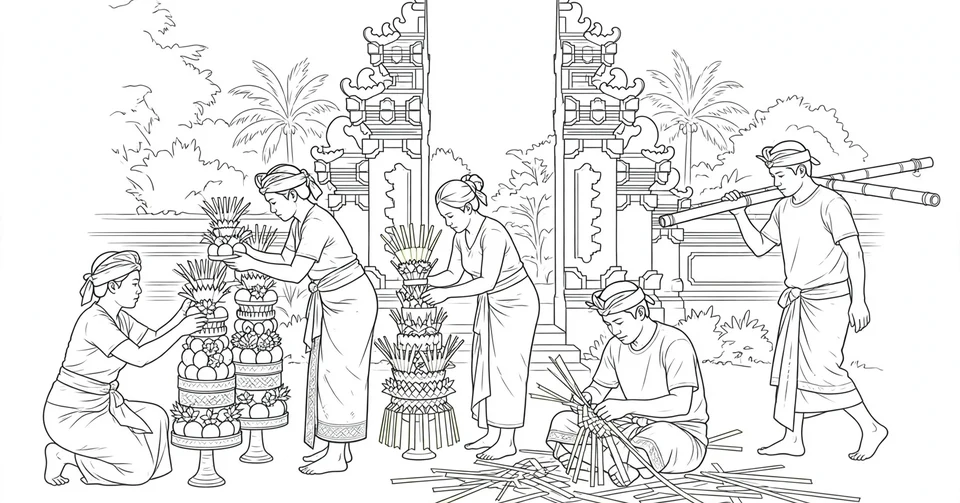
You can see ngayah most clearly in the days before a ceremony. The banjar hall fills early. Women sit in rows on the floor with young coconut leaves across their laps, cutting and sewing them into the small shapes that offerings are built from. Outside, men split and shape bamboo for decorations and temporary altars, while teenagers sweep the temple yard and carry water. A gamelan group runs through its pieces in the corner. Nobody sends an invoice afterwards. This is simply what the village does, and one word holds all of it.
What ngayah means, and where it comes from
The word comes from ayah, Balinese for service. A Balinese and Indonesian dictionary published in 1990 gives the literal meaning of ngayah as doing work without wages, and the family of words around it still maps the old arrangement: ayahan is the service owed, and a pengayah is the person who serves.
The shape of the idea comes from the age of Bali's kings. Households held village land known as tanah ayahan desa, and holding the land meant owing duties in return. Writers on the tradition usually divide those duties into three: pengayah pura, service to the village temples, above all the three temples of the kahyangan tiga; pengayah banjar, service to the customary neighbourhood and its social life; and pengayah puri, service to the ruling king, whose gift some of the land had been. The kings are gone, but the first two duties never left. Balinese still speak of ngayah ke pura, serving at the temple, and of serving at the banjar in the same breath.
The teaching underneath is karma marga, the path of selfless action. I Wayan Sudarma, a Hindu religious counsellor who has written for Indonesia's Ministry of Religious Affairs, sums the philosophy up as work as worship, and worship in work. He points to the Bhagavad Gita's famous instruction to act from duty, with no eye on the fruits of the act. In its narrow sense, most people picture ngayah as work at a temple festival: making offerings, dancing the sacred dances, sprinkling holy water. In its wider sense, any work done as devotion counts, including teaching religion or paying for an orphan's schooling. The missing wage is not an accident. Refusing the wage is close to the whole point.
The work itself, from bamboo to gamelan
At a temple festival, the work of ngayah is divided by long custom. The women make the offerings, the banten, and their central skill is mejejaitan, the sewing of young coconut leaves, busung, into trays, cones and small decorated forms, pinned together with tiny bamboo sticks called semat. Assembling the finished offerings from those pieces is metanding. The men prepare everything made of bamboo and put up the decorations. The young people decorate and clean, and young women join the offering work too. Temple centred work like this is common enough to carry its own label, ngayah pura.
Look further from the temple and the same service keeps going. Members of a subak in Selat cleaned their subak temple, repaired a road and cleared the channel that feeds their rice fields, all recorded by the local government as ngayah. In Buleleng, about fifty young people cleaned the grounds of the village temple and put the ceremonial equipment back in order. The gamelan group of the regency culture office plays at temple festivals as ngayah, which means the music at a Balinese ceremony is often as unpaid as the sweeping. Civil servants in Singaraja have offered their service at the yearly festival of the city temple, Pura Agung Jagatnatha.
Some ngayah wears a uniform. The pecalang, the customary security men who keep order at ceremonies and stand guard through the silence of Nyepi, serve without pay as a matter of principle, as I described in You Can Read a Pecalang From Across the Street. The same is true of the village youth who spend the weeks before Nyepi building the giant ogoh ogoh effigies, work that is closer to a construction project than to a hobby. Ngayah is the labour force behind almost everything visitors photograph in Bali, and it is a labour force of volunteers, at least on paper.
Voluntary, and also compulsory
Here is the honest complication. For a full member of a desa adat, a krama, ngayah is not only devotion. It is a legal duty. Bali's Regional Regulation Number 4 of 2019, the provincial law on customary villages, names two core obligations of full members: pawedalan, contributions in money or in kind, and ayah-ayahan, physical work. That work spans the three fields of tri hita karana, the harmony Balinese philosophy asks people to keep: with the divine, with each other, and with the natural world. The details are set by each village's own customary rulebook, the awig-awig, and its implementing rules. I have written elsewhere about how a desa adat governs itself, and ngayah is where that self government touches daily life most directly.
Miss the work and there is a price. Villages set a customary fine for absence, and a member who keeps missing the work can expect to pay it. But people who write about it from inside Bali tend to say the fine is not the sanction anyone fears. The feared sanction is social: being talked about. In a village where your neighbours are also your temple congregation, your security force and your burial society, a reputation as the person who never shows up is a real cost, and everyone can do the arithmetic.
I do not think this makes ngayah a fraud. It makes it a subscription, paid in hours instead of money, for the most complete social insurance most of us will ever see. The banjar you serve today is the banjar that will turn up, in force, when your family has a wedding or a cremation to carry. The only hope behind the work, as one Balinese writer put it, is that the banjar will come and help in turn. Reciprocity is not a hidden catch in ngayah. It is the design, stated out loud.
Not quite gotong royong
Outsiders often translate ngayah as gotong royong, and the two are cousins, not twins. Gotong royong is the ethos of communal work shared across Indonesia, often rendered as the joint bearing of burdens: a village road, an irrigation channel, a house of worship raised together. Ngayah is carried out in that spirit, and Balinese writers say so. But they also draw a line. Help between relatives preparing a family ceremony has its own name, nguopin, also called menyama braya, kinship. Ngayah is different because it is directed upward, to God, to the temple and to the village, rather than sideways between people. Gotong royong is horizontal. Ngayah is horizontal and vertical at once, which is why it carries a religious weight that a road repair, on its own, does not.
The pull home
The system was built for a farming island, and it now has to survive office hours. Ngayah for a cremation can run for a week. Official figures cited in the Bali Post show that nearly half of Bali's workforce now works for wages on fixed hours, and civil servants are reported to spend much of their twelve days of annual leave on banjar ngayah. Something has to give, and in many villages what gives is time itself: preparations that once took a week are being compressed into a few days.
Members who have moved away for work, the krama perantau, sit at the sharp end of this. Their membership does not lapse because they live in Jakarta or Denpasar, and neither do the dues. The tension has become a running public conversation in Bali, half affectionate and half sore. Satirical advice for rarely home members circulates online: pay every customary due promptly, keep your head down at meetings, show your face when you can. Underneath the jokes is a genuine dilemma that Balinese commentators state plainly, the choice between adat and keeping the kitchen stove lit. Many migrants answer it with money sent home and long drives back for the biggest ceremonies, because being absent from ngayah is one thing and being absent from the village is another.
The pull works on newcomers too. A woman who marries into a banjar arrives knowing almost nobody, and ngayah is where she meets her neighbours, working shoulder to shoulder over the same palm leaves. The work is the introduction. That, I suspect, is the deepest reason ngayah has survived every economic change thrown at it. It is not only how a Balinese village gets its festivals built. It is how the village keeps becoming a village, one working morning at a time.
There is a temptation, watching all this unpaid labour, to call it exploitation or to call it paradise, and ngayah is neither. It is a bargain a community makes with itself, written into law and into scripture at the same time: your hours for the temple, and the whole village's hours for you. The temples get cleaned, the offerings get sewn, the dead get carried, and nobody gets paid. What they get instead is each other, on call, for life. It is hard to look at that exchange and call the Balinese the poorer side of it.
More in Culture & Society
Latest posts
- Shimekasu Was Herring You Never Ate
- A Hana Donko Wears Its Cracks Like Flowers
- A Lembaga Perkreditan Desa Is a Bank the Village Owns
- Kaburiyu Is How You Talk Your Body Into the Bath
- Kuki Is the Spring the Sea Turned White
- Tatsuko Wished for Beauty and Became a Statue
- Warangan Is the Wash That Reveals the Pattern
- Ganbanyoku Is Bathing Without Water
- The Obuki Throws Out Nine Thousand Litres a Minute
- Every Village Writes Its Own Awig-Awig
- Sainokawara Is a Bath You Share With a Hundred Strangers
- Umaji Refused to Disappear
- Rwa Bhineda Keeps Opposites From Going to War
- Kasepekang Is Exile Without Leaving Home
- Jamasan Washes a Blade Thinner Every Year