Su Nuraxi Hid Under a Hill Until the 1950s
· 8 min read
Su Nuraxi in Barumini is the most complete Nuragic fortress in Sardinia, a tall central tower ringed by four smaller towers and a village of stone huts, and for centuries almost all of it lay buried until excavations in the 1950s brought it back into view.
There is a particular kind of invisibility that only time can achieve. For centuries, anyone crossing the fertile plain west of Barumini, in the south of Sardinia, walked straight past one of the greatest Bronze Age strongholds in Europe without knowing it was there. Su Nuraxi, the most complete surviving fortress of the Nuragic civilization, spent most of its afterlife underground, buried under accumulated earth until the site presented itself to the world as nothing more remarkable than a grassy hill.
The name alone should have been a clue. In Campidanese, the southern variant of the Sardinian language, Su Nuraxi simply means The Nuraghe, with the definite article, as if there were only one worth naming. Under the grass stood a central stone tower that originally rose to more than 18.5 metres, four further towers joined to it by a massive curtain wall, a second outer wall beyond that, and an entire village of round stone huts gathered around the whole complex. Almost none of it could be seen from the surface. It took a local archaeologist and seven years of digging, between 1950 and 1957, to give the hill back its real name.
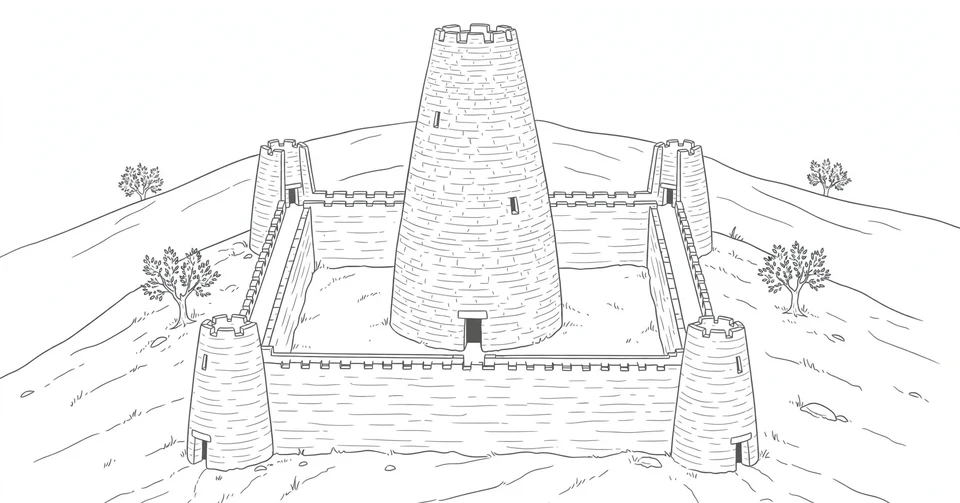
I have written on this blog before about the wider world of the Nuragic towers that outlived the people who built them, the thousands of truncated stone cones scattered across Sardinia by a civilization that left no written records of itself. Su Nuraxi is where that silent world becomes easiest to read. Scholars regard it as the most impressive expression of the Nuragic civilization, and when UNESCO added Su Nuraxi di Barumini to the World Heritage List in 1997, it described the site as the pre-eminent and most complete example of this whole form of architecture. The hill, it turned out, had been hiding the masterpiece of an entire civilization.
A tower first, then a fortress
Su Nuraxi did not begin as the layered stronghold visitors see today. The oldest part of the complex is the central tower, built in blocks of basalt somewhere between the seventeenth and thirteenth centuries BCE. Inside it, three chambers are stacked one above the other, connected by a spiral staircase running within the thickness of the wall, each chamber roofed by a corbelled vault of dressed stone. That single tower, already over 18.5 metres high, would have been a landmark on the plain for miles around.
Later, during the Late Bronze Age, its people wrapped their tower in a second skin of defences. Four subsidiary towers were built around the central one and linked by a massive stone curtain wall, creating an inner courtyard served by its own well. In time the courtyard was even sealed over with a roof, which restricted access to the central tower still further. During the Iron Age, a second outer curtain wall was added, built with seven lobes, so that it became a fortress inside a fortress inside a wall.
The well in the courtyard is a small detail that tells a large story. A stronghold with its own water supply inside its walls is a stronghold built to hold out, and that is one reason the fortress reading of Su Nuraxi has always been hard to dismiss. Whoever controlled it controlled a high place above a fertile plain, with water, storage and room for a community, and the building kept growing more defensive for centuries. Each generation there inherited the tower and answered the anxieties of its own age by adding another ring of stone.
The village that gathered around Su Nuraxi
A fortress alone explains only half of what the excavations found. Around the towers stood a village, inhabited from the thirteenth to the sixth century BCE, built on a circular plan with large boulders, dry stone walls and conical roofs of wood and branches. Because the village lived and changed for so long, archaeologists cannot fix the number of huts in any single phase. Estimates run from forty to two hundred huts, which means its population may have ranged from around one hundred people to around a thousand.
Among the huts, the most significant was a larger and more complex structure reserved for meetings of the local leaders, which contained symbols of the deities the inhabitants worshipped. Other rooms have been identified as workshops, kitchens and centres for processing agricultural produce. I find the finds from the village of Su Nuraxi more moving than the military architecture, honestly. Among the tools, weapons, pottery and ornaments recovered was a small stone model of a nuraghe, the builders making a miniature copy of their own great tower, perhaps as an offering, perhaps simply because the tower was the centre of their world and worth carving.
The village kept improving itself, too. During the ninth and eighth centuries BCE, the settlement gained a sewerage system, a paved square and paved streets. A place with drains and paved streets is not a temporary refuge. It is a town, one that happened to grow in the shadow of a very large tower, and the longer I sit with that fact the less Su Nuraxi looks like a castle with a village attached, and the more it looks like a community that gradually fortified the hill it lived on.
Fortress, shrine, or the seat of a chief
What Su Nuraxi was actually for is still debated, and the debate is worth reporting honestly. Giovanni Lilliu, the archaeologist who excavated the site, held to the traditional interpretation of the site as a fortress. Other archaeologists have argued that the oldest part of the complex may have served a religious purpose, or worked as a refuge, a civil centre, or the residence of a village chief, with the towers added later for military purposes and storage.
My own guess, and it is only a guess, is that the question has too few answers because the building had too many centuries. A complex in use for well over a thousand years rarely keeps a single job. It may have been a chief's stronghold in one age, a refuge in another, a sanctuary and meeting place in a third, and the stones would have absorbed each role without needing to choose. The silence of the builders does not help. The Nuragic people left no texts, so Su Nuraxi has to speak in basalt alone, and basalt is a language modern readers are still learning to parse.
What ended the long life of Su Nuraxi was the wider Mediterranean arriving in Sardinia. During the sixth century BCE the buildings were destroyed and subsequently restored by Carthage, and the site was later occupied by the Romans. Even then, Su Nuraxi did not empty at once. Excavations indicate that people continued to live there into the Roman period, in new houses of a different form, built from smaller stones in clusters of little rooms. Then, at some point, occupation stopped, and the long burial of Su Nuraxi began. UNESCO notes that the Nuragic structures appear to have been buried from that era onwards, undisturbed, until archaeology returned in the twentieth century.
Seven years with a spade
Giovanni Lilliu was a local expert, a Sardinian archaeologist excavating the most important site of his own island's prehistory, and between 1950 and 1957 he directed the full excavation of Su Nuraxi. The work let archaeologists retrace every stage of construction, from the first basalt tower to the last Roman era rooms, and it confirmed that the site had been a vibrant and vital centre for far longer than anyone had assumed. A systematic conservation campaign in the early 1990s stabilised a number of the structures, and today visits to Su Nuraxi are made only in small groups with a guide, a sensible arrangement for a place that waited this long to be seen again.
There is something about Su Nuraxi that fits the island it stands on. Sardinia has a habit of keeping its oldest things in circulation rather than behind glass. On the same island, the Mamuthones of Mamoiada still say nothing under their forty pounds of cowbells as they process through the winter streets, a ritual whose roots nobody can date with confidence either. Su Nuraxi belongs to that same Sardinian pattern of deep time surviving into the present, except that this fortress survived by disappearing, which is the strangest survival strategy of all.
I keep returning to the thought that the hill was not the enemy of Su Nuraxi but its longest serving guardian. Exposure is what destroys most ancient sites, through weather, theft and enthusiastic rebuilding, and for century after century the earth over Su Nuraxi did the quiet work of a locked museum door. When Lilliu's team finally removed it in the 1950s, they found not a skeleton but a whole Bronze Age town, towers, drains, meeting hut and all, preserved by the simple fact that the world had forgotten where it was. Su Nuraxi hid under a hill for most of two thousand years. It can be forgiven for taking its time, and it rewards anyone who takes the time to stand inside its courtyard and look up.
More in Culture & Society
Latest posts
- Shimekasu Was Herring You Never Ate
- A Hana Donko Wears Its Cracks Like Flowers
- A Lembaga Perkreditan Desa Is a Bank the Village Owns
- Kaburiyu Is How You Talk Your Body Into the Bath
- Kuki Is the Spring the Sea Turned White
- Tatsuko Wished for Beauty and Became a Statue
- Warangan Is the Wash That Reveals the Pattern
- Ganbanyoku Is Bathing Without Water
- The Obuki Throws Out Nine Thousand Litres a Minute
- Every Village Writes Its Own Awig-Awig
- Sainokawara Is a Bath You Share With a Hundred Strangers
- Umaji Refused to Disappear
- Rwa Bhineda Keeps Opposites From Going to War
- Kasepekang Is Exile Without Leaving Home
- Jamasan Washes a Blade Thinner Every Year