The Tengger Carry Their Dead Out of the Village in Entas-Entas
· 11 min read
Months or years after a burial, a Tengger family builds a small figure of leaves for the soul and carries it out in procession. Entas-Entas is the ceremony that finally lifts the dead away.
In the villages around Mount Bromo, a funeral is not finished when the grave is filled. The Tengger people bury their dead, hold the smaller rites of the first days, and then wait. Months later, sometimes years later, the family gathers the whole village once more for entas-entas, the ceremony that lifts the soul of the dead person up and away, out of the house, out of the village, and on toward the world of the ancestors.
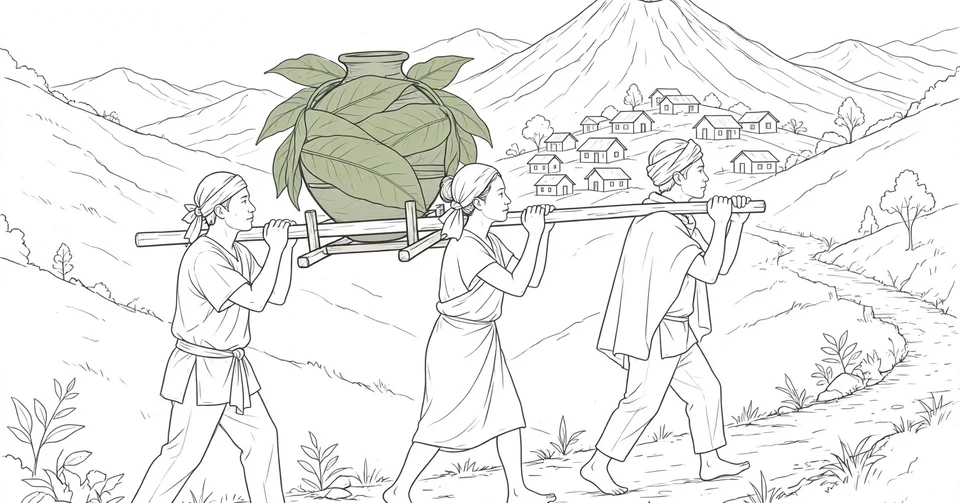
At the center of entas-entas stands a small figure called a petra, built from leaves and flowers to give the soul a body for one last journey. When the prayers are finished, the petra is dressed in clothes, carried out in procession, and burned. Only then is the long work of mourning considered complete.
It is a demanding ceremony, costly enough that families save toward it for a long time, and patient enough that a single rite can honour a grandmother who died decades earlier alongside a father buried last year. To understand entas-entas is to understand how the Tengger refuse to let death be a single day.
A people who keep their dead close
The Tengger are the highland people of the Bromo Tengger Semeru highlands in East Java, mostly Hindu, farming steep volcanic slopes in villages scattered across four regencies. Their religious year is dense with obligations to gods, volcano, and ancestors, and the Tengger people treat the dead as members of the community who have changed address rather than vanished.
Death, in this view, sets off a sequence rather than an ending. Accounts of Tengger practice describe smaller ceremonies in the days after a burial, including a prayer gathering on the eleventh day, and then a long interval in which the soul is understood to remain near the family, not yet settled, not yet fully an ancestor. The soul waits, and so does the family.
Entas-entas is the peak of that sequence, the rite that closes it. The name itself carries the idea. In Javanese, entas means to take something out, to lift it up and remove it, the way laundry is taken in from the line when it is dry. The ceremony takes the soul out of its waiting place and lifts it somewhere higher.
A farewell that waits until the family is ready
Most accounts equate entas-entas with nyewu, the thousandth day after a death, the final milestone in the Javanese calendar of mourning. But the number is a landmark, not a deadline. The dukun, the hereditary Tengger ritual priest who leads the ceremony, is quoted in a university community service report on the rite saying that entas-entas is not fixed to particular days at all. It is held when the family holding it is ready, and the dukun may be consulted to choose a good day.
Ready, in practice, means two things. The family must be spiritually prepared to let the person go, and it must be able to afford the feast, the offerings, and the sacrificial animals the rite can involve. A full entas-entas is one of the most expensive ceremonies a Tengger family will ever hold, and there is no shame in waiting years until it can be done properly.
The waiting built into entas-entas also allows the dead to be gathered. Because one entas-entas can serve many souls at once, families often lift several relatives together, pooling generations into a single farewell. A report by The Jakarta Post on an entas-entas in Jetak village, in the Sukapura district of Probolinggo, describes one family honouring eleven relatives in a single rite, people who had died between seven months and fifty years earlier. Half a century is a long time to remain unfinished business, but in Jetak it was simply a debt the family had finally become able to pay.
The rite can also be repeated. The same report notes that entas-entas may be performed more than once for the same soul, because different branches of a family may each want to express their own devotion. The ceremony belongs less to a calendar than to the family's conscience.
The petra, a small body built for a soul
Since the body of the dead person was buried long ago, entas-entas needs something for the soul to inhabit while it is prayed over, purified, and sent on its way. That something is the petra, a small human figure made entirely from plants, prepared by the wong sepuh, the elders who assist the dukun.
Research on the rite in the village of Ngadas lists what goes into a petra, and every part carries a meaning. Leaves of the pampung plant form the seat the soul rests on. Marigold flowers, called senikir, are there to drive away evil spirits. Tanalayu, a mountain edelweiss, is included so that the soul will be received by Sang Hyang Widi, the supreme God. Slivers of bamboo stand in for bones, bamboo fibre ties them like muscle, and a dress of alang alang grass and real clothing completes the small body. A little earthenware pot and a mortar accompany the figure in some village accounts, read as symbols of the crater and the sea of sand of Bromo itself, the landscape the soul is leaving.
Other descriptions, including the Jetak report, describe the petra set into a clay pot together with money and cigarettes, provisions for the journey ahead. The details vary from village to village, and the Tengger themselves are relaxed about that. What matters is that the figure exists, that it has been made carefully by the elders, and that the soul has somewhere to sit while the village performs its entas-entas around it.
Around the petra, the family arranges the offerings: rice, sugar, coconuts, bananas, vegetables, meat dishes, and snacks in the Jetak account, and in the Ngadas research a fixed cast of cakes and foods that includes eggs, jadah, jenang, wajik, and sate. The number of petra and the number of offerings match the number of souls being lifted, because in entas-entas nobody travels uncounted and nobody travels unfed.
What entas-entas is meant to finish
The theology underneath the ceremony is Hindu in structure and Tengger in accent. A person is an atman, a soul, and death does not free it automatically. Before it is lifted, the soul is believed to linger in an in between state, close to the family it left, still bound by what it did in life and still capable of unsettling the household it hovers around. Entas-entas purifies the atman and releases it from punarbhawa, the turning wheel of rebirth, so that it can return to its origin and rest among the ancestors in a realm of permanence.
That is why the dukun pandhita, as the Tengger priest is formally called, describes the ceremony in one account as the final feeding of the elders, the last selamatan, the last communal prayer meal, owed to the dead. It is a debt of care. Children owe it to parents, and some families in the accounts say plainly that they hold the rite out of love, out of respect, and out of a wish that nothing unfinished disturb the family's life.
In entas-entas, the purification is acted out, not just spoken. In the Jetak ceremony, the dukun chanted prayers asking that the souls' sins be forgiven and their road upward smoothed. Fire was used to draw off negative forces, the tips of the petra's hair and of the family members' hair were burned, and a duck and a chicken that had eaten rice from the family's heads were released over the site to carry evil away. The petra was lifted and turned clockwise three times while the name of each soul was spoken aloud, a small, deliberate act of recognition before departure.
Then comes the gesture that gives the ceremony its emotional shape. The family, who have sat through the rite with their heads covered in long white cloth, take the cloth off and flap it, waving the souls on their way. It is hard to read that detail without feeling its kindness. The living do not cling. They wave.
Carried out of the village and given to the fire
Once the souls have been waved off, the petra is dressed properly, in clothes, and carried out by the family to the place of burning. In several village accounts of entas-entas, this is the pedanyangan, the village shrine ground, where the wong sepuh set the figures alight. In the Jetak account the petra travelled in a bamboo basket to a cremation site, its clothes removed before the burning, and its ashes simply left where they fell, not scattered on any river or sea.
The comparison people reach for is Ngaben, the great Balinese cremation, and the Tengger chief priest Suja'i, quoted in the same report, accepts it up to a point: entas-entas carries a similar meaning, he said, done in the Tengger way. The resemblance is real but the scale is different. Bali burns the body itself, with great public theatre. The Tengger burn a figure of leaves for a body long since in the ground, in a rite that is solemn rather than spectacular, and whose drama is mostly the drama of timing, of a family finally ready.
This is also where the title of the ceremony earns its geography. The soul begins the day inside the house, seated in its small leaf body among the offerings. It ends the day outside, carried along the village path and given to the fire at the shrine ground, lifted out of the human settlement altogether. Entas-entas is, quite literally, a carrying out.
A feast the whole village cooks
No Tengger ceremony is a private production, and entas-entas can run through a sequence of stages over as many as three days. The Ngadas research lists them in order: a cleansing, prayer meals, the inviting of the souls, a stage built around animal sacrifice in which a goat or cattle beast serves as the vehicle the soul will ride, a great washing of the soul at the climax, and a closing rite led by the dukun. In another account the sacrifice could be as large as a bull, with hours of mantra before it, which goes some way to explaining why families save for years.
All of this has to be cooked, carried, arranged, and served, and the village does it together. The UMSida report dwells on the gotong royong, the mutual help, that powers an entas-entas: neighbours prepare the offerings, build what needs building, and staff the kitchen without being asked or paid. The village head quoted there gives the local vocabulary for it, biyodo for the women who help and jinoman for the men, arranging rice, dishes, and cakes on the tables. The feast that follows the prayers is eaten by the whole community, so the family's largest expense becomes the village's shared meal.
There is a social intelligence in that arrangement worth noticing. A ceremony as costly as entas-entas could ruin a family or quietly never happen. Instead, the cost is converted into food everyone eats and labour everyone gives, and the family's obligation to its dead becomes a day on which the whole village is fed. Grief, organised this way, does not isolate people. It caters for them.
One rite in a full calendar of duties
Entas-entas does not stand alone. It belongs to the same cycle of ancestor care as the Karo festival, the Tengger's great second month gathering of feasting, visiting, and remembrance, and it sits alongside the communal offerings of Yadnya Kasada, when the whole people carry produce up to the crater of Bromo. Kasada feeds the mountain that feeds everyone. Entas-entas looks after the family's own dead, one household at a time. Between the two, very little that matters to the Tengger is left unoffered.
Read together, these ceremonies describe a complete theory of obligation. The living owe the volcano gratitude, owe the gods worship, owe each other labour, and owe the dead a proper departure, completed not in the shock of the funeral week but years later, when it can be done well. A Tengger soul is not expected to find its own way out. It is carried.
That may be the most moving thing about entas-entas. Many cultures hurry their dead away, eager to close the grave and the subject. The Tengger do almost the opposite. They keep the soul close, feed it, wait until the family is ready and the village can gather, and only then walk it out of the village in procession, dressed, named, waved off under white cloth, toward the ancestors. It is a slower goodbye, and for the families who save years to afford it, clearly the right one.
More in Culture & Society
Latest posts
- Kombu Is the Quiet Half of Dashi
- Manza Onsen Bathes at 1,800 Metres
- Every Prefecture Argues About What Goes in Ozoni
- KRL Commuterline and the Trains That Move Jakarta
- Kecap Manis and the Sweet Soy Sauce of Indonesia
- In Mamoiada, Two Hundred Families Still Make Wine at Home
- Shochu and the Quiet Spirit of Japan
- A Dried Shiitake Is Louder Than a Fresh One
- Loma Linda's Long Lives Run on Saturdays
- Maruten Numazu and the Towering Kakiage Bowl of the Port
- The Three Sisters Grow Better Together
- Tatamiishi Terraces Filter a River Through Stone
- Wasabi-Zuke Puts the Whole Plant in Sake Lees
- Konyoku Is Still Out There, Past the Last Train Station
- Dry January Lasts a Month on Purpose