Japan's Winter Illuminations Turn Dark Nights Into Light
· 12 min read
Japan's winter illuminations turn parks, streets, and whole towns into fields of light from October to spring, and the biggest displays use millions of LEDs. Here are the ones worth travelling for, with dates and prices for the 2026 to 2027 season.
Japan goes dark early in winter, and that is exactly when the country starts to glow. From October until spring, parks, shopping streets, and whole towns switch on millions of small lights, and what looks like an ordinary garden by day becomes a field of light by night. The Japanese call these displays winter illuminations, and they have grown into one of the season's biggest reasons to go out after sunset.
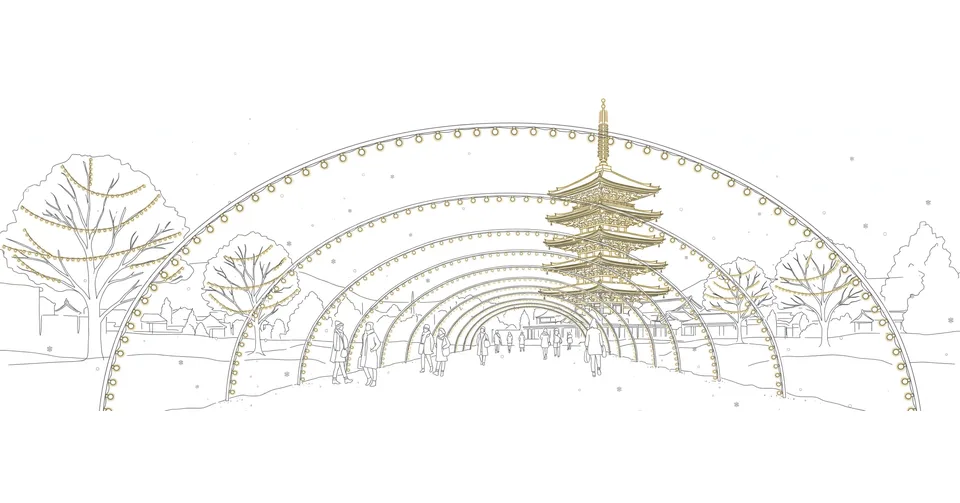
A winter illumination is not the same as a Christmas market. Japan does not celebrate Christmas as a public holiday, and most of these displays have nothing to do with it. They run for months, often long past New Year, and the best of them are built around flowers, rivers, and local history rather than Santa and reindeer. That is part of their charm. A winter illumination feels less like a seasonal decoration and more like a second season, one made of light. If you want to understand how Japan treats Christmas itself, it is a small, commercial affair built around fried chicken and strawberry cake, as I wrote in Christmas in Japan and the Fried Chicken Dinner That Started It All.
The scale of Japan's winter illuminations is hard to grasp until you stand inside one. The largest winter illuminations use five to eight million individual LED bulbs, spread over grounds the size of several football fields. You walk through tunnels of light, across fields that shimmer like water, and under trees wrapped so completely that you cannot see a single branch. It sounds like it should feel artificial, and in a photograph it sometimes does, but in person the effect is quieter than you expect. People walk slowly, they talk softly, and children point at things instead of shouting. I think that is the real appeal. Winter illuminations give a cold, dark evening a reason to be outside, and they give strangers a shared reason to slow down.
The light show that started as a memorial
Japan's winter illuminations are often traced back to one event, and it began in sadness. On 17 January 1995, the Great Hanshin Earthquake struck Kobe, killing more than 6,000 people and devastating the city. Less than a year later, in December 1995, artists Valerio Festi from Italy and Hirokazu Imaoka from Japan built a display of hundreds of thousands of lights donated by the Italian government in Higashi Yuenchi Park. It was meant as a memorial for the victims and as a message of hope for a city trying to rebuild.
The display was planned as a one time event. It drew more than 2.5 million people in its first year, and the city kept bringing it back. Today the Kobe Luminarie is one of the oldest winter illuminations in Japan, and it still carries its original purpose. Each year more than 200,000 individually hand painted lights are arranged into arches, towers, and cathedral like structures, and the event draws around three million visitors. The most recent edition ran from 30 January to 8 February 2026, a shift from its traditional early December slot, so check the official dates before you plan a trip. The Japan National Tourism Organization has a short guide to the Kobe Luminarie with the route from Motomachi Station through the former foreign settlement to Higashi Yuenchi Park. The name comes from the Italian word for light, which fits. This was never really about Christmas. It was about a city deciding that light was the right answer to darkness, and the rest of Japan seems to have agreed.
Nabana no Sato, the sea of lights
The biggest of the winter illuminations sits outside Nagoya, in Mie Prefecture. Nabana no Sato is a flower park for most of the year, and in winter it turns into what visitors often describe as a sea of lights. About eight million LED bulbs cover the grounds, and the centrepiece is a long tunnel of light, an arched walkway wrapped in small warm bulbs that you walk through for several minutes. Each season also brings a large themed display on the main field, a picture made of light that changes from year to year.
The 2026 to 2027 season runs from 17 October 2026 to 31 May 2027, which makes it one of the longest running winter illuminations in the country. Tickets cost 2,500 to 3,000 yen depending on the period, and each ticket includes a 1,000 yen voucher for food and shops inside the park, so the real cost is lower than it looks. The lights come on around sunset and stay on until closing. If you go, arrive before dark. The park is pleasant in daylight, the flower beds and the begonia garden are worth a slow walk, and then you watch the whole place change as the sun goes down. That transition, from garden to glowing field, is the part people remember. The Japan Winter Illuminations 2026 to 2027 guide lists the dates, hours, and prices for twelve of the best known displays, and it is worth checking before you travel.
Getting there takes a little planning. Nabana no Sato is in Kuwana, about half an hour by bus from Nagoya Station, and the return buses get crowded on winter weekends. A weekday evening is calmer, and the lights look no less impressive with fewer people in front of them.
Ashikaga Flower Park, where wisteria blooms in winter
Ashikaga Flower Park in Tochigi Prefecture is famous for its wisteria in spring, and its winter illumination copies the flowers in light. More than five million LED bulbs cover the park's 100,000 square metres, with trellises hung with strings of light shaped like hanging wisteria, tunnels, and projections. It is one of the three largest winter illuminations in Japan, and it has won awards for the display.
The 2026 to 2027 season runs from 17 October 2026 to 14 February 2027, closed only on 31 December. The park opens at 15:30 and the lights come on around 16:30 to 17:00, staying on until 20:30, or later on weekends and holidays. Admission is 1,500 yen for adults and 800 yen for children. The nearest station is JR Ashikaga Flower Park Station, a short walk away, which makes it one of the easiest of the big winter illuminations to reach from Tokyo without a car.
What I like about Ashikaga is that the display is a copy of something real. The park spends spring growing actual wisteria, and in winter it rebuilds the same shapes from light. It is a clever idea, and it works because the shapes are already beautiful. If you have seen the spring wisteria, the winter version feels like meeting an old friend in different clothes. If you have not, it is still a good reason to come back in spring, which is exactly what the park wants. Spring brings its own crowds for Japan's cherry blossoms and for the autumn leaves that come before winter, and the illumination season sits neatly between the two.
Tokyo's free lights, and the ones worth paying for
Not all winter illuminations need a ticket or a day trip. Tokyo's streets put on a free show every winter, and the best known is in Marunouchi, the business district in front of Tokyo Station. About 1.2 million champagne gold LED bulbs are strung across roughly 360 trees along Nakadori Street, and the display is free to walk through. The 2025 to 2026 season ran from 13 November 2025 to 15 February 2026, with the lights on from 16:00 to 23:00. The current season follows the same pattern, so an evening walk from Tokyo Station down Nakadori costs nothing and takes about half an hour at a slow pace.
Roppongi Hills and Tokyo Midtown run their own displays nearby, and the shopping streets of Omotesando and Shibuya add their own lights, so a winter evening in central Tokyo can easily turn into an unplanned tour of winter illuminations. That is the honest way to enjoy them in the city. You do not need a plan or a ticket. You walk out of dinner, you see the street glowing, and you keep walking a little longer than you meant to.
The paid winter illuminations near Tokyo are a different kind of evening. Sagamiko Illumillion, at Lake Sagami Resort Pleasure Forest in Kanagawa, spreads about six million LEDs across a hillside, with a chairlift ride that carries you over the lights. The last season ran from 15 November 2025 to 10 May 2026, with adult admission around 2,000 yen. Yomiuriland's Jewellumination, in the hills west of Tokyo, runs a similar scale of display into spring. Both are easy day trips, and both are at their best on a clear, cold night, when the air is sharp and the lights look brighter for it. A winter evening pairs well with a hot spring afterwards, and Japan's hot springs are at their best in exactly this season, steam rising into cold air while you soak.
Street lights with a story
Some winter illuminations are not parks at all. They are streets, and their charm is that they belong to the city rather than to a ticket gate. Sendai's Pageant of Starlight lines Jozenji-dori, the city's grand boulevard, with lights each December, and the whole street becomes a place to walk rather than a road to cross. Sapporo's White Illumination does the same in the centre of Hokkaido's capital, where the lights have to compete with real snow, and usually win.
These street winter illuminations are smaller than Nabana no Sato or Ashikaga, and that is the point. Winter illuminations do not need eight million bulbs to work. A single street, lit well, can change how a whole neighbourhood feels after dark. If you are travelling in December and you find yourself in a Japanese city at night, look up. There is a good chance the street you are standing on is part of the show, and it cost you nothing to see it.
When lights meet snow
Winter in Japan has another famous display, and it is made of snow rather than light. The Sapporo Snow Festival runs for eight days in early February across three venues, Odori Park, Susukino, and Tsudome, and the giant snow sculptures at Odori are lit up at night until 22:00. The 2027 edition, the 77th, runs from 4 to 11 February 2027. The 2026 edition drew 2,539,000 visitors. The festival began in 1950, when local students built six snow sculptures in Odori Park, and it has grown into one of the world's best known winter events. If your trip falls in early February, it is the natural companion to a winter illumination, the same love of winter darkness, expressed in snow instead of light. Japan's festival calendar has room for both, and so does a winter trip. The snow monkeys of Nagano, who bathe in hot springs while snow falls around them, are another winter sight worth pairing with the lights, as I wrote in Japan's Snow Monkeys and Their Hot Spring Baths.
How to enjoy winter illuminations well
A few practical notes make the difference between a good evening at the winter illuminations and a cold, crowded one. Go on a weekday if you can. The big parks are calmest on weekday evenings, and the popular tunnels of light are far easier to photograph without a queue of people in front of you. Dress warmer than you think you need to. You will be outside, standing still, for one to two hours, and the temperature drops fast after sunset. Gloves matter more than a heavy coat, because you will want to take photographs.
Arrive before the lights come on. Most winter illuminations switch on around sunset, between 16:30 and 17:30, and watching a park change from daylight to light is better than arriving when it is already dark. Check the official dates before you go. The seasons are long, but the exact dates, prices, and closing days change every year, and a few displays close on 31 December or for a couple of days in early January. The table below gathers the main facts for the 2026 to 2027 season.
| Winter illumination | Where | 2026 to 2027 season | Admission |
|---|---|---|---|
| Nabana no Sato | Kuwana, Mie | 17 Oct 2026 to 31 May 2027 | 2,500 to 3,000 yen, includes 1,000 yen voucher |
| Ashikaga Flower Park | Ashikaga, Tochigi | 17 Oct 2026 to 14 Feb 2027 | 1,500 yen |
| Marunouchi | Tokyo | Mid Nov to mid Feb, last season 13 Nov 2025 to 15 Feb 2026 | Free |
| Sagamiko Illumillion | Sagamihara, Kanagawa | Last season 15 Nov 2025 to 10 May 2026 | Around 2,000 yen |
| Kobe Luminarie | Kobe, Hyogo | Recent edition 30 Jan to 8 Feb 2026 | Free |
| Sapporo Snow Festival | Sapporo, Hokkaido | 4 to 11 Feb 2027 | Free |
Japan's winter illuminations work because they take the worst part of winter, the early darkness, and turn it into the reason to go out. They are not trying to be Christmas, and they are not trying to be summer. They are a season of their own, built from light, and they last for months, which means there is no bad week to see them, only colder ones. If you are in Japan between October and February, pick one, dress warmly, and go after sunset. The dark will do the rest.
More in Food & Travel
- Tumpeng Is the Rice Cone Java Serves When It Wants to Say Thanks
- Lake Toba and the Supervolcano That Made the World's Largest Volcanic Lake
- Raja Ampat and the Coral Kingdom at the Edge of Indonesia
- Tokyo Skytree and How Japan Built the World's Tallest Tower
- Tokyo Tower and the Orange Giant That Refused to Be Replaced
- Hakone and the Hot Spring Town Below Mount Fuji
Latest posts
- Barong Is the Lion Bali Calls Out When the Village Needs Protection
- Onsen Etiquette and the Unwritten Rules of Japan's Hot Springs
- Setsubun, the Bean Throwing Festival That Chases Winter Away
- Karate, the Empty Hand That Became Japan's Most Exported Martial Art
- Kemari Is the Ball Game Japan Played Without Trying to Win
- Chagama Is the Kettle That Never Leaves the Tea Room
- Judo, the Gentle Way Japan Gave the World
- Matsumoto Temari Turns Mountain Cocoons Into Wishes You Can Hold
- Nambu Tekki Is the Iron That Outlasted the Lords Who Ordered It
- Forest Bathing in Japan, the Quiet Science of Shinrin-Yoku
- Emoji, the Tiny Pictures Japan Gave the World
- Temari Is the Embroidered Ball Japan Gives for Good Luck
- A Tetsubin Turns Iron and Fire Into Japan's Slowest Kettle
- Ninja, the Shadow Warriors of Feudal Japan
- A Kamado Turned the Japanese Kitchen Into a Slow Oven