Setsubun, the Bean Throwing Festival That Chases Winter Away
· 11 min read
Setsubun falls on February 3, the day before spring begins in the old Japanese calendar, and families mark it by throwing roasted soybeans at demons and eating a lucky sushi roll in silence.
Every year on February 3, homes across Japan fill with shouting, laughter, and a small rain of roasted soybeans. It is Setsubun, the bean throwing festival that marks the end of winter and the start of spring in the old Japanese calendar. Families open their doors, throw beans outside while shouting "Oni wa soto, fuku wa uchi," which means "Demons out, good fortune in," and then eat one bean for each year of their age.
Setsubun is not a public holiday, and no one takes the day off work for it. Yet it survives in almost every Japanese household, in school classrooms, and at big temple festivals that draw thousands of people. The reason is simple. Setsubun asks for almost nothing, a bag of beans and a few minutes in the evening, and it gives back a small, satisfying ritual: chase out the bad luck of the past year, invite in the good luck of the year to come, and eat something tasty while doing it.
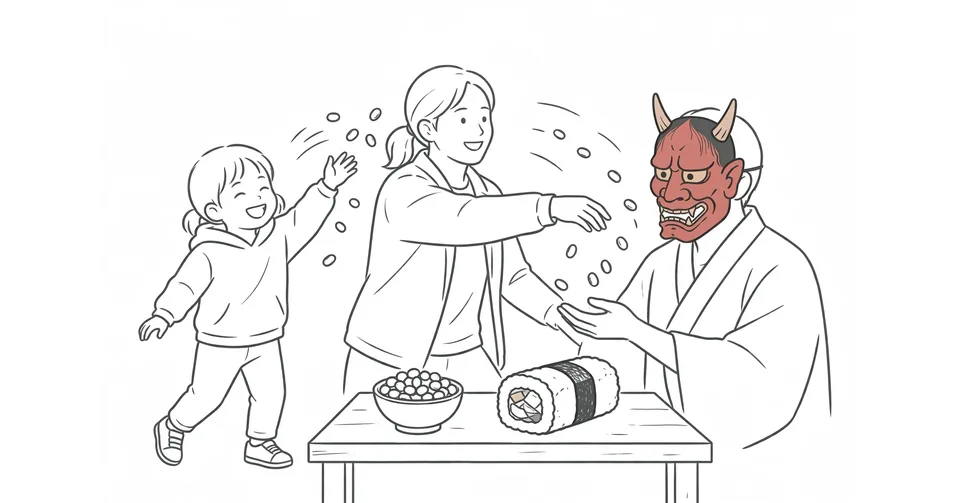
The charm of Setsubun is that it is both a festival and a housekeeping chore. The beans are real, the shouting is loud, and the mess on the floor has to be swept up afterward. In a culture that loves quiet, careful ritual, Setsubun is the one night a year when making a joyful mess is the whole point.
What Setsubun Means
The word Setsubun means "seasonal division." In the old lunar calendar, Japan divided the year into four seasons, and each season began with a setsubun, a day that marked the turn from one season to the next. Over time, only the most important of these four survived as a festival: the Setsubun before Risshun, the first day of spring. That is why Setsubun almost always falls on February 3, the day before spring begins in the traditional calendar, even though the weather in early February is still firmly winter.
The date is not fixed by law. It follows the position of the sun, so in some years Setsubun falls on February 2 instead. In 2025 it fell on February 2, the first time in four years, and in 2026 it returns to February 3. The next Setsubun after that, in 2027, falls on February 3 as well. The shift surprises people every time it happens, and every time the news explains it again, which is part of the festival's charm. Setsubun is old enough to run on astronomy, not on a printed calendar.
The festival's roots reach back more than a thousand years. Its bean throwing is thought to have grown from tsuina, an ancient Chinese rite for driving away evil spirits that arrived in Japan during the Nara period. By the Muromachi period, around 600 years ago, records already show people chanting "Oni wa soto, fuku wa uchi" while throwing beans. The oni, the horned demons of Japanese folklore, are not quite the devils of Western tradition. They stand for the invisible misfortunes of life: illness, bad harvests, accidents, and the general run of trouble that nobody can see coming. Throwing beans at them is a way of saying that the household will face the new season on its own terms.
The Bean Throwing Ritual
Mamemaki, the bean throwing itself, is the heart of Setsubun. The beans are always roasted soybeans, known as fukumame, or lucky beans. Roasting matters. Raw beans can sprout if they land in a damp corner, and a sprouting bean was traditionally seen as bad luck, a demon taking root in the house. Roasted beans are safe, crunchy, and ready to eat, which is convenient, because the ritual ends with eating them.
The ritual at home follows a simple pattern. In the evening, someone opens the front door or a window. The head of the household, or traditionally the oldest male family member, or sometimes the family member whose Chinese zodiac sign matches the coming year, throws a handful of beans outside while shouting "Oni wa soto." Then the door is closed, a few beans are thrown inside the room, and everyone shouts "Fuku wa uchi." In many families, one person puts on an oni mask, usually red, with horns and a wild grin, and plays the demon while the children pelt them with beans. It is the one night a year when children are encouraged to throw food at an adult, and they take full advantage of it.
Temples and shrines hold much bigger versions of the same ritual. At Senso-ji in Asakusa, Tokyo, the Setsubun-e festival draws large crowds who gather to catch beans thrown from the stage by celebrities and sumo wrestlers. At Naritasan Shinsho-ji in Chiba, sumo wrestlers and actors throw beans to thousands of visitors. At Yoshida Shrine in Kyoto, the festival runs for three days and ends with a bonfire. These public festivals turn a household ritual into a shared event, and they are the easiest way for a visitor to see Setsubun up close. Arrive early, stand where the beans are likely to land, and bring a bag to carry your catch home.
Why Roasted Beans, and Why Eat Your Age
After the throwing comes the eating. Tradition says each person should eat one roasted soybean for every year of their age, often plus one more for the year to come. A 30 year old eats 30 or 31 beans. A child of seven eats seven. It is a small, concrete way of taking in good luck, one bean at a time, and it turns the ritual into something you can taste.
The custom has a practical side too. Soybeans are rich in protein and fiber, and the handful of beans after dinner is a modest, healthy snack by festival standards. It is a long way from the feasting of other festivals, and that modesty is part of the point. Setsubun does not ask for a banquet. It asks for a handful of beans and a moment of attention.
| Setsubun at a glance | |
|---|---|
| Date | February 3 in most years, sometimes February 2 |
| Meaning | Seasonal division, the day before Risshun, the first day of spring |
| Main ritual | Mamemaki, throwing roasted soybeans |
| Chant | Oni wa soto, fuku wa uchi (Demons out, good fortune in) |
| Beans to eat | One for each year of your age, often plus one |
| Lucky food | Ehomaki, a thick uncut sushi roll eaten in silence |
| Lucky direction 2026 | South-southeast |
| Lucky direction 2027 | North-northwest |
One word of caution belongs here, and it comes from the Consumer Safety Commission in Japan itself. Whole soybeans are a choking hazard for small children, and the commission advises against giving them to children under five. Many families now give young children small bean shaped snacks or crushed beans instead. It is a sensible update to an old custom, and it keeps the ritual safe for the people it is meant to protect.
Ehomaki, the Lucky Roll Eaten in Silence
The second great Setsubun food is ehomaki, the lucky direction roll. It is a thick sushi roll, filled traditionally with seven ingredients, one for each of the Seven Lucky Gods, and it is eaten whole, uncut, while facing the year's lucky direction, the eho. The rule is to eat it in silence, making a wish, and to finish the whole roll without speaking or putting it down. If you talk, the luck escapes.
The custom is usually traced to the Osaka area, where it was a local practice for generations before convenience stores spread it across Japan from the late 1990s onward. Today, every konbini and supermarket sells ehomaki in the days before Setsubun, in sizes from a modest roll to a feast. The seven fillings usually include ingredients like eel, egg, cucumber, shiitake mushroom, and pickled gourd, though shops now sell everything from tuna to roast beef versions.
The lucky direction changes every year, following the traditional calendar. In 2026 it is south-southeast. In 2027 it will be north-northwest. The direction is set by the year's heavenly stem, one of the ten signs of the old Chinese calendar, and only four directions are ever used. Families check the direction in the newspaper or on the wrapper of the roll itself, then turn their chairs, face the right way, and eat in silence. The silence rarely lasts long in a house full of children, but that is part of the fun.
Where to See Setsubun
For a visitor, the best Setsubun experience is a temple festival. The biggest ones are free to watch, and the bean throwing from the stage is generous. Senso-ji in Asakusa holds its Setsubun-e on February 3, with beans thrown by invited guests. Naritasan Shinsho-ji in Chiba is famous for its sumo wrestlers. In Kyoto, Yasaka Shrine and Yoshida Shrine both hold festivals, and the Yoshida festival stretches over three days with food stalls and a closing bonfire.
If you are staying in a home or a guesthouse, the household version is just as memorable. Buy a bag of fukumame at any supermarket or konbini in late January. They are sold everywhere, often with a small paper oni mask included in the bag. Open the door in the evening, throw, shout, eat your beans, and then face the lucky direction with an ehomaki. The whole ritual takes twenty minutes, and it is one of the few Japanese festivals you can fully join without any preparation at all.
Setsubun shares the calendar with other seasonal festivals that mark the turning of the year. The tanabata festival fills summer nights with wishes tied to bamboo, and Shichi-Go-San dresses children in kimono each November to celebrate their growth. Setsubun is the winter entry in that same long list, and it is the only one where the celebration is a small act of housekeeping with a shout.
A Small Ritual With a Big Idea
What I like most about Setsubun is how honest it is about what it does. It does not promise that throwing beans will fix anything. It gives a household a shared moment to name what it wants to leave behind and what it wants to welcome in, and then it asks everyone to clean up the mess together. That is a better model for a new year than most resolutions. You do not need a grand plan. You need a door to open, a shout, and a handful of beans.
There is also something quietly generous in the way Setsubun treats bad luck. The oni are not destroyed or punished. They are simply shown the door. The ritual does not pretend that trouble will never come back. It just says, not tonight, not in this house, not in this season. For a festival that takes twenty minutes and costs almost nothing, that is a lot of wisdom to fit into a handful of soybeans.
The Japanese festival calendar is full of events that ask for travel, tickets, or elaborate preparation. Setsubun asks for none of that. It asks only that you show up in your own home, on a cold February evening, and throw something at the dark with the people you love. The idea behind it, that a season can be turned by a small deliberate act, is one I find myself returning to. Every culture has its own version of sweeping out the old year. Japan just happens to do it with roasted soybeans and a shout, and it has been doing it for six hundred years. That is a tradition worth keeping, one bean at a time.
For a deeper look at the festival, the guide at FUN! JAPAN covers its history and foods in detail, and Yunomi explains the two main rituals, mamemaki and ehomaki, with a clear eye for how families actually celebrate at home. The Japan Guide page on Setsubun lists the major temple festivals and their dates, which is the best place to start if you want to watch one in person. And if the idea of a small daily practice that gives life meaning appeals to you, the Japanese idea of ikigai sits close to the same spirit, a reason to get up in the morning, one bean at a time.
More in Culture & Society
- Karate, the Empty Hand That Became Japan's Most Exported Martial Art
- Kemari Is the Ball Game Japan Played Without Trying to Win
- Chagama Is the Kettle That Never Leaves the Tea Room
- Judo, the Gentle Way Japan Gave the World
- Matsumoto Temari Turns Mountain Cocoons Into Wishes You Can Hold
- Nambu Tekki Is the Iron That Outlasted the Lords Who Ordered It
Latest posts
- Lake Toba and the Supervolcano That Made the World's Largest Volcanic Lake
- Raja Ampat and the Coral Kingdom at the Edge of Indonesia
- Tokyo Skytree and How Japan Built the World's Tallest Tower
- Forest Bathing in Japan, the Quiet Science of Shinrin-Yoku
- Tokyo Tower and the Orange Giant That Refused to Be Replaced
- Emoji, the Tiny Pictures Japan Gave the World
- Temari Is the Embroidered Ball Japan Gives for Good Luck
- A Tetsubin Turns Iron and Fire Into Japan's Slowest Kettle
- Hakone and the Hot Spring Town Below Mount Fuji
- Ninja, the Shadow Warriors of Feudal Japan
- A Kamado Turned the Japanese Kitchen Into a Slow Oven
- Bizen Ware Lets the Fire Do the Painting
- The Japanese Alps and the Mountains at the Heart of Honshu
- Japanese Haiku and the Seventeen Syllables That Hold a Season
- Japanese Wagashi and the Sweets That Mark the Seasons