Karate, the Empty Hand That Became Japan's Most Exported Martial Art
· 11 min read
Karate means empty hand, and it began as a secret art on Okinawa, an island where weapons were banned. This is how a schoolteacher carried it to Tokyo and the world.
It looks like a fight, and it is one, but the name says the opposite. Karate means empty hand. No sword, no stick, no weapon of any kind, just the hands and feet you were born with, trained until they can do the work of a weapon. That contradiction is the whole story of the art: a fighting art invented on an island where carrying weapons was forbidden, refined in secret for centuries, and then carried to the world by a schoolteacher who believed it was mostly about character.
The short version is this. Karate grew in the Ryukyu Kingdom, the island chain we now call Okinawa, from a blend of the islanders' own fighting method, called te, and Chinese boxing brought by traders from Fujian. It stayed local and mostly secret until 1922, when Gichin Funakoshi demonstrated it in Tokyo. Within a generation it had dojos across Japan, and within two it was taught on every continent. The World Karate Federation claims 100 million practitioners worldwide, while Japan's Foreign Ministry puts the number at 50 million. Either way, it is the most widely practiced martial art Japan ever produced.
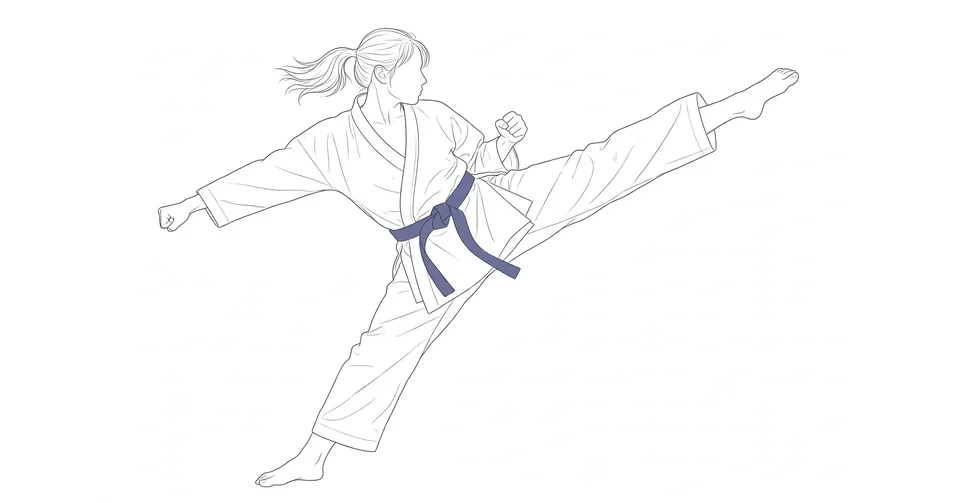
What surprises most people is that karate was not originally Japanese at all, at least not in the mainland sense. Okinawa was its own kingdom for centuries, trading with China and Southeast Asia, and it only became a Japanese prefecture in 1879. It carries that history in its name, its techniques, and its manners, and you can still see it today if you watch a class in Naha, where the old styles keep a flavour that the big Tokyo schools smoothed away.
From China hand to empty hand
Karate began as te, the Okinawan word for hand. From the 1300s onward, traders and envoys from Fujian province in China brought their boxing methods to the Ryukyu Kingdom, and island fighters folded those methods into their own. The result was called tode, meaning China hand, written with the characters for Tang, the Chinese dynasty, and hand. It was practical, close range, and passed from teacher to student in private, because it was never a public sport.
The story everyone in Okinawa tells about what happened next starts in 1609, when the Satsuma clan from mainland Japan invaded the Ryukyu Kingdom and imposed a ban on weapons. With swords confiscated, the story goes, ordinary people had to defend themselves with bare hands, and te flourished in secret. Historians now treat that tale with caution, since weapons bans were uneven and the art was already developing, but the ban is part of how the art understands itself, and the name it eventually chose reflects it.
The name changed in two steps. In 1905, a master named Chomo Hanashiro became the first to write the art as karate with the characters for empty and hand, a deliberate break from the old China hand. Then in 1936, the leading masters of Naha met and formally agreed on the new writing, empty hand, which also suited the art's philosophy, that the hand should be empty of weapons and the mind empty of malice. Okinawa still marks that meeting every year: 25 October is Karate Day on the island.
Three towns shaped the early art, and their names survive in the styles. Shuri, the old capital, produced Shuri-te, quick and upright. Naha, the port city, produced Naha-te, rooted in breathing and close grappling. Tomari, a small port between them, produced Tomari-te. The three were less separate schools than local flavours of one tradition, and the masters who later founded the big mainland styles each carried one of them to Tokyo.
The schoolteacher who carried it to Tokyo
The man who carried it to the mainland was Gichin Funakoshi, born in Shuri in 1868. He was a schoolteacher by profession, slight of build, and a student of two of the great masters of Shuri-te. He believed the art belonged in schools, not just in back rooms, and in 1922 he got his chance. Invited to demonstrate at a national physical education exhibition in Tokyo, he showed the mainland an art it had never seen, and he was asked to stay.
Funakoshi stayed for the rest of his life. He taught at universities, including Keio from 1924, published the first books on the art, and built a system a beginner could follow. In 1924 he borrowed the belt ranking system from judo, coloured belts for kyu grades and black belts for dan grades, an idea that came straight from his friend Jigoro Kano, the founder of judo. Kano had invited Funakoshi to demonstrate at the Kodokan, judo's headquarters, and that endorsement opened doors no outsider could have opened alone.
By the late 1930s Funakoshi had his own dojo in Tokyo. His students named it Shotokan, the hall of Shoto, from Funakoshi's pen name Shoto, meaning pine waves, a name he used when he wrote poetry. The style took the dojo's name, and Shotokan became the largest style in the world. Funakoshi died in 1957, at 88, having spent 35 years turning a secret Okinawan practice into a public discipline. His best known saying still hangs in dojos everywhere: karate ni sente nashi, there is no first attack in karate.
Four styles, one art
Mainland practice settled into four major styles, each founded by one of Funakoshi's generation. They share the same roots and the same basic techniques, but they feel different to train in, and the differences trace back to the three old towns.
| Style | Founder | Roots and character |
|---|---|---|
| Shotokan | Gichin Funakoshi | Shuri-te. Long, low stances and straight, powerful linear techniques. The most widely practiced style in the world. |
| Goju-ryu | Chojun Miyagi | Naha-te. Hard and soft in one name. Short stances, breathing exercises, and close range grappling. |
| Shito-ryu | Kenwa Mabuni | Shuri-te and Naha-te combined. Keeps more kata, the solo forms, than any other major style. |
| Wado-ryu | Hironori Otsuka | Shuri-te blended with jujutsu. Evasion and body shifting instead of meeting force head on. |
The styles are not rivals in the way sports teams are. A practitioner can spend a lifetime in one and still respect the others, and the big federations run competitions where all four meet under the same rules. What the table hides is the part that matters most to the people who train: each style is a different answer to the same question, how to generate power without a weapon, and none of them claims to have the only answer.
Kata, kumite, and the belt around your waist
Training in a dojo rests on three pillars. Kihon means basics, the same punch, block, and kick repeated hundreds of times until the body does it without thinking. Kata means form, a solo sequence of techniques performed against imaginary opponents, sometimes 20 moves long, sometimes more than 60. Kumite means sparring, two people facing each other, scoring points for controlled strikes to the head and body that stop just short of contact.
Kata is the part outsiders find hardest to understand, and the part practitioners defend most fiercely. It looks like shadowboxing, but every movement in a kata is a technique with a purpose, a block that is also a strike, a turn that is also a throw. Old masters recorded their whole system in kata, the way a cook records recipes, and learning a kata is learning to read. Modern competition turned kata into a performance judged on precision and spirit, which some traditionalists dislike, but the forms themselves are the oldest thing in the art, older than the belts, older than the dojos, older than the name.
The belts tell a simpler story. A beginner wears white, then climbs through the coloured kyu grades, and eventually earns a black belt, the first dan. There are ten dan grades, and the highest are awarded for a lifetime of teaching, not for winning fights. Children can earn junior black belts in some systems, which surprises visitors, but a black belt has never meant mastery. It means the student finally knows enough to start learning properly, and the best teachers say so on the first day. The full history of how these pieces came together is told well in this history of karate, which traces the art from Okinawan te to the modern dojo.
Karate's short Olympic summer
For decades, the art campaigned for the Olympics and was turned away. Then the Games came home. At Tokyo 2020, held in 2021, karate finally debuted as an Olympic sport, in the country where it began, with two disciplines, kata and kumite, and eight gold medals on offer. Japan's Ryo Kiyuna won the men's kata on home soil, a moment the Japanese press treated as a kind of homecoming, and for two weeks it was the most watched martial art on the planet.
Then it was gone. It was left out of the Paris 2024 programme, and it is not on the programme for Los Angeles 2028 either. The World Karate Federation keeps lobbying, and the sport still appears at the World Games and the Asian Games, but the Olympic door that opened in Tokyo has closed for now. It is a strange fate for an art with perhaps 100 million practitioners, more than judo and taekwondo combined by some counts, and it says something about how the Olympics chooses its sports, which has little to do with how many people practice them. The background to that Olympic campaign, and the decades of effort behind it, is summarised in this Karate 101 history.
The exclusion stings less in Okinawa than it does in Tokyo. On the island, it was never primarily a sport, and the people who kept it alive through the war and the postwar years did not do it for medals. They did it because it was theirs, a piece of Ryukyuan culture that survived annexation, war, and occupation, and that is the version of the art that still matters most there.
Where to see real karate today
The best place to see the art as its founders knew it is still Okinawa. The Okinawa Karate Kaikan, a dedicated centre opened in Naha in March 2017, runs demonstrations, seminars, and short courses for visitors, and its halls fill every October for Karate Day on the 25th, when masters of the old styles perform at Shuri Castle and at the Peace Park in Itoman. Shuri Castle itself is worth the trip on its own: the main hall, destroyed by fire in 2019, was rebuilt and completed in November 2026, and demonstrations were part of the reopening celebrations.
Okinawa rewards the visitor who stays a few days. The island is also one of the world's blue zones, the handful of places where people live unusually long lives, a fact explored in this look at the five places where people live the longest. The same unhurried life that keeps Okinawans healthy into their nineties shapes its training too: slow, precise, and unbothered by fashion. If you visit a dojo there, expect to bow, to sit quietly before training, and to be corrected on the same basic punch you thought you already knew.
Outside Okinawa, the easiest way in is a trial class. Almost every city in the world has a dojo, most affiliated with one of the four styles, and most welcome complete beginners for a first lesson. Watch a class before you join one, and look for the signs of a good school: students who bow to each other, a teacher who corrects form before speed, and nobody boasting about belts. The art's oldest rule still applies, and it is also the best advice for choosing where to learn it. There is no first attack in karate, and there should be no first boast either.
Karate is not the oldest martial art in Japan. That honour probably belongs to sumo, which predates it by more than a thousand years. But it is the one that travelled furthest, and the reason is simple enough to say in one sentence. It asked for nothing you did not already have, two hands, two feet, and the patience to train them, and it gave back something no weapon could: the knowledge that you could defend yourself, and the discipline to hope you never have to. That is a modest promise, and it is why, a century after a schoolteacher from Shuri showed it to Tokyo, people in two hundred countries still line up in white uniforms to practice it.
More in Culture & Society
- Setsubun, the Bean Throwing Festival That Chases Winter Away
- Kemari Is the Ball Game Japan Played Without Trying to Win
- Chagama Is the Kettle That Never Leaves the Tea Room
- Judo, the Gentle Way Japan Gave the World
- Matsumoto Temari Turns Mountain Cocoons Into Wishes You Can Hold
- Nambu Tekki Is the Iron That Outlasted the Lords Who Ordered It
Latest posts
- Lake Toba and the Supervolcano That Made the World's Largest Volcanic Lake
- Raja Ampat and the Coral Kingdom at the Edge of Indonesia
- Tokyo Skytree and How Japan Built the World's Tallest Tower
- Forest Bathing in Japan, the Quiet Science of Shinrin-Yoku
- Tokyo Tower and the Orange Giant That Refused to Be Replaced
- Emoji, the Tiny Pictures Japan Gave the World
- Temari Is the Embroidered Ball Japan Gives for Good Luck
- A Tetsubin Turns Iron and Fire Into Japan's Slowest Kettle
- Hakone and the Hot Spring Town Below Mount Fuji
- Ninja, the Shadow Warriors of Feudal Japan
- A Kamado Turned the Japanese Kitchen Into a Slow Oven
- Bizen Ware Lets the Fire Do the Painting
- The Japanese Alps and the Mountains at the Heart of Honshu
- Japanese Haiku and the Seventeen Syllables That Hold a Season
- Japanese Wagashi and the Sweets That Mark the Seasons