Tumpeng Is the Rice Cone Java Serves When It Wants to Say Thanks
· 15 min read
Tumpeng is a cone of yellow rice ringed with seven side dishes, served at Javanese thanksgivings to turn gratitude into a meal the whole community shares.
A tumpeng arrives before anyone eats. It comes out on a round woven tray, a tall cone of golden rice rising from a ring of small dishes, and the room goes quiet for a moment. Everyone knows what it means. Something good has happened, and the proper response is not a speech or a gift, but a meal made to be shared.
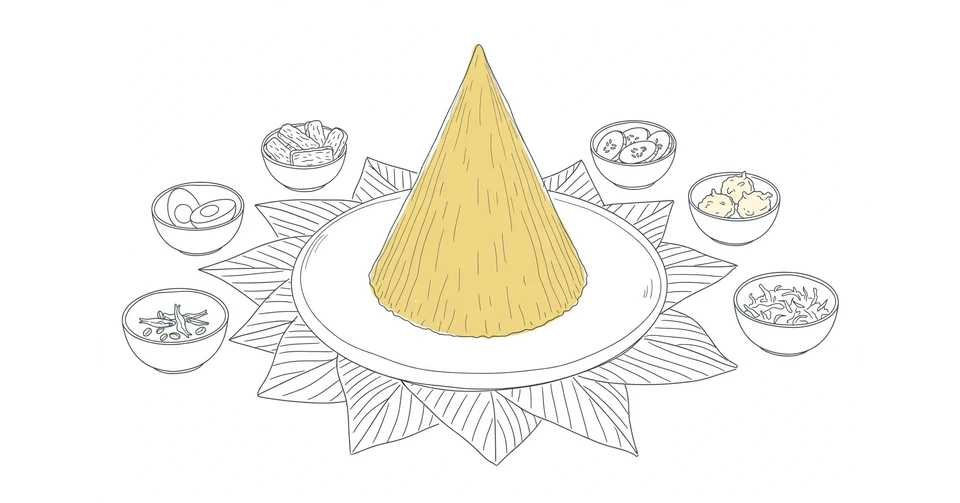
Tumpeng is the Javanese answer to the question of how gratitude should look. It is rice shaped into a mountain, coloured yellow with turmeric, surrounded by seven side dishes, and placed at the centre of the table so that nobody can eat without first seeing the whole. It is food, but it is also a small ceremony in itself, one that has survived centuries of change in Java without losing its meaning.
You do not need a special occasion in the grand sense to meet a tumpeng. It appears at birthdays and housewarmings, at the opening of a new shop, at a graduation, at a harvest, and at the quiet family gathering that follows a piece of good news. The cone is always the same shape, but the reason for it changes with the family that ordered it, and that flexibility is part of why it has lasted so long.
What a tumpeng actually is
A tumpeng is a cone of rice, usually yellow rice cooked with turmeric and coconut milk, set on a tampah, a round tray woven from bamboo, lined with banana leaf. Around the base sit the side dishes, and the whole arrangement is carried to the table as one piece. The rice may also be plain white rice or uduk rice, rice cooked in coconut milk without turmeric, depending on the occasion. Yellow is the festive version, the one most people picture, because its colour suggests gold, prosperity, and a life lived well.
The shape is the point. Java is an island of volcanoes, and for a very long time its people have regarded mountains as sacred places where ancestral spirits dwell. The cone of a tumpeng echoes that mountain, a small peak built from the most ordinary food there is. Eating from it is, in a quiet way, an act of taking the mountain down to the level of the family table. A 2025 review of the dish published in the Canrea Journal of Food Technology, Nutritions, and Culinary traces this history back to ancient Hindu practice in Indonesia, and notes how the dish adapted as Javanese society changed around it, keeping its form while its meanings layered up over time.
The rice cone is never served alone. Tradition calls for seven side dishes, and the number is not an accident. Seven in Javanese is pitu, a word that sounds like pitulungan, which means help. The seven dishes are a reminder, set out in food, that people get through life by helping one another. The usual spread includes fried chicken or a whole roast chicken, urap, which is vegetables mixed with spiced grated coconut, a boiled egg, fried tempeh, anchovies with peanuts, and shredded omelette, though the exact list varies by region and by family budget. What matters is that the dishes come from the land and from the water, from the garden and the sea, so that the tray holds a small picture of the world that fed the family.
Why seven dishes, and why a mountain
Every part of a tumpeng carries a meaning, and Javanese cooks have never been shy about explaining it. The yellow rice stands for wealth and good morals, or so the tradition says, while white rice stands for holiness and purity. The chicken, often a rooster, is said to stand for the bad qualities people should leave behind, such as arrogance and greed. The egg, round and whole, stands for a life that should be planned and lived with care. The fish stands for patience and persistence. The vegetables stand for harmony with nature. None of this is written down in a single official book, and different villages will give you slightly different readings, but the readings agree on the direction. A tumpeng is a meal that teaches while it feeds.
The cone itself carries the biggest idea. In Javanese thought, the tall shape points upward, toward the divine, and the food spread around its base points outward, toward the community. One dish holds both directions at once, and that is the whole philosophy in a single object. The Canrea review puts it plainly, describing tumpeng as an expression of gratitude to the divine and a way of building communal unity through a shared meal. That is a grand claim for a plate of rice, but anyone who has watched a room fall silent as the cone is carried in will recognise it as true.
There is also a piece of wordplay that Javanese elders love to repeat. Tumpeng is often explained as coming from the phrase "yen metu kudu mempeng", which means roughly that when you set out to do something, you should do it with full seriousness. Scholars would call this a folk etymology rather than a proven linguistic origin, and it is best treated as the kind of explanation a culture tells about itself, a story that reveals values even if it is not a dictionary fact. Either way, the message fits the dish. A tumpeng is not a casual snack. It is a deliberate act.
Selamatan, syukuran, and the occasions that call for a cone
A tumpeng belongs to a family of Javanese gatherings known as selamatan, also spelled slametan, communal meals held to ask for safety, give thanks, or mark a passage in life. The word syukuran is used for the thanksgiving side of the same tradition, a meal given because something has gone well. A birth, a seventh month of pregnancy, a wedding, a new house, a recovery from illness, a business opening, a safe return from a journey, all of these can be a reason. The meal usually opens with prayer, and only then is the food shared.
The most famous moment in the meal is the cutting of the tip of the cone. The top of the tumpeng is sliced off and given to the most honoured person present, often the oldest guest, or the person whose achievement is being celebrated. It is a small gesture with a large meaning. The best part of the dish goes to the person the community most wants to honour, and everyone else eats from what remains, which is plenty. In a culture that values deference to elders, this single cut says more than a long speech could.
There is a lovely detail in how the food leaves the gathering. In the Tengger highlands of East Java, the great gathering of Karo ends with a tumpeng crowned with roast chicken, blessed by the ritual priest and then carried home by families to eat together. The same tradition describes families carrying tumpeng, the cone shaped mounds of rice, along with cakes and other dishes, some for the shrine and some simply to be eaten together, and after the sodoran ceremony the village head hosts the tumpeng gede, the great rice cone to which every family contributes. You can read the full story of that highland season in our account of Karo, the Tengger's other great gathering. The pattern is the same everywhere in Java. The blessed food is not left behind. It goes home, and the celebration continues at the family table.
That habit of carrying food home matters more than it looks. A tumpeng is not a restaurant dish, and it is not really a dish for strangers. It is a dish for a circle of people who know each other, and its proper ending is not applause but a quieter thing, neighbours walking home with a plate wrapped in banana leaf, feeding children who were too small to sit through the prayers. The cone makes gratitude visible, and the leftovers make it last into the next day.
The many kinds of tumpeng
Not every tumpeng looks the same, because not every occasion is the same. The differences are worth knowing, since they show how one idea can bend to fit a whole calendar of human life. The best known is tumpeng nasi kuning, the yellow rice version, used for cheerful celebrations such as births, engagements, weddings, and holidays. Its colour is the colour of celebration itself.
Tumpeng putih, made with plain white rice, belongs to sacred ceremonies, because white stands for holiness. It is the version served when the mood is solemn rather than festive, and its simplicity is the point. Tumpeng robyong appears at the siraman, the traditional bridal shower ceremony, set on a bamboo rice container with egg, shrimp paste, shallots, and red chilli placed on top. Tumpeng nujuh bulan is served in the seventh month of pregnancy, a main white rice cone surrounded by six smaller cones, all set on a banana leaf lined tray. Tumpeng pungkur is the sombre one, served at the ceremony for the death of an unmarried person, made from white rice with only vegetable dishes, and later cut vertically into two halves and placed facing each other.
There is also tumpeng nasi uduk, also called tumpeng tasyakuran, made with coconut milk rice and served for the celebration of the Prophet Muhammad's birthday. And then there are the modern versions, which the tradition has absorbed without much fuss. The mini tumpeng is a single serving cone, made for one person, often packed in a small box with a clear lid so the food can be seen. Character tumpeng, shaped and decorated for children's birthdays and fan conventions, turns the cone into a playful centrepiece. Purists may grumble, but the fact that the shape survives even as a cartoon character suggests the idea is stronger than any single recipe.
One detail from recent history shows how far the shape has travelled. In 2009, Garuda Indonesia began serving a mini nasi tumpeng as part of its effort to present Indonesian hospitality on its flights. A ceremonial dish had become, in miniature, an ambassador. Tumpeng is now also served in Indonesian restaurants abroad, in Singapore, the Netherlands, and elsewhere, wherever Javanese families have settled and wanted a taste of home for a celebration.
How a tumpeng is made and served
Making a tumpeng is a team effort, and the work starts long before the guests arrive. The rice is washed, soaked, and cooked with turmeric, coconut milk, lemongrass, and bay leaves until it is fragrant and golden. It is then packed firmly into a cone shaped mould, traditionally a woven bamboo cone, and turned out onto the tray. The firmness matters. A cone that slumps is a small embarrassment, and experienced cooks know exactly how much to press.
The side dishes are cooked separately, each in its own way, and arranged around the base in a pattern. There is no single official layout, but the arrangement is deliberate, with the dishes placed so that the colours balance and every guest can reach something. The tray is lined with banana leaf, which keeps the rice from sticking and adds its own faint fragrance. Sometimes the cone is decorated with carved vegetables, a chilli flower, or a small flag on top, though older tradition keeps the decoration modest.
Serving follows a rhythm. The tumpeng is placed where everyone can see it, the prayer is said, the tip is cut and presented, and only then do people serve themselves. The elders take their portions first, and the young ones follow. That order is not a formality. It is the same deference that runs through Javanese life, expressed here in the order people hold out their plates. A good host watches the tray and makes sure the shy guests, the ones who hang back, get a proper share.
It is worth saying plainly that a tumpeng is a generous amount of food. The cone is large, the dishes are many, and the meal is designed so that no one leaves hungry. That generosity is part of the meaning. A thanksgiving that leaves guests hungry would be a contradiction, and Java has never been a culture that skimps on a feast.
Tumpeng in modern Indonesia
The modern life of tumpeng is a good example of how a tradition survives, by changing just enough. Office birthdays now feature a tumpeng ordered from a catering service, delivered in a box with the cone already formed. Independence Day celebrations in schools and neighbourhoods often centre on a tumpeng competition, with each group presenting its own cone. Wedding receptions that otherwise follow a modern buffet format will still bring out a tumpeng for the cutting ceremony, because the moment of cutting the tip belongs to the tradition in a way no buffet line can replace.
In 2013, the Indonesian Ministry of Tourism and Creative Economy promoted tumpeng as one of thirty Indonesian culinary icons, and in 2014 it was declared Indonesia's official national dish, described as the dish that binds the diversity of Indonesian culinary traditions. That official recognition is worth noting carefully. Tumpeng was declared the national dish, not inscribed by UNESCO, and the distinction matters, since the UNESCO claims that sometimes circulate about Indonesian dishes are often wrong. The national dish status is a government declaration, and it is the correct way to describe it. You can read the fuller account of its history and status in the Wikipedia entry on tumpeng.
There is also a nutritional side to the dish that modern writers have begun to notice. A cone of rice surrounded by vegetables, egg, chicken, tempeh, and fish is, taken as a whole, a balanced plate, with staple food, protein, and vegetables in one arrangement. The 2025 Canrea review notes this balance, and argues that tumpeng offers a rich source of essential nutrients when eaten as part of a balanced diet. It is a generous reading, and it should not be pushed too far, since a festive tumpeng is also rich in coconut milk and fried food, but the underlying point stands. The traditional arrangement already understood something about a balanced meal, long before nutritionists gave it a name.
Perhaps the most telling modern detail is the simplest one. A tumpeng is now easy to order, easy to photograph, and easy to share online, and yet the heart of it has not changed. People still gather around the cone, still pray first, still give the tip to the honoured guest, and still carry food home. The cameras are new. The gesture is old.
What tumpeng says about Javanese communal life
If you want to understand a culture, watch what it does with food when it is happy. Java answers with a mountain of rice and a circle of dishes, and with the insistence that gratitude is not complete until it has been eaten together. That insistence is the real subject of the tumpeng, more than any recipe. The dish is a way of saying that good fortune is not a private possession. It is something to be divided, while it is still warm, among the people who helped make it possible.
There is a quiet humility in the design too. The most important food in the room is rice, the most ordinary food in Java, and the most honoured guest receives a slice from the top of a cone that anyone could have made. Nothing about it is exclusive. The ingredients are humble, the cooking is familiar, and the ceremony is one that a village can perform without hiring anyone. That accessibility is part of its power. A tumpeng does not require wealth. It requires people.
I find that genuinely moving, and I think it is why the dish has outlasted so many fashions. Modern life in Java is fast, urban, and often lived far from the village where a person grew up, yet the cone still appears at the moments that matter, and it still does the same work. It slows a room down. It puts a shared object in the middle of the table. It reminds everyone present that they are, for an evening, part of one household.
It is also a useful contrast with the way the rest of the world celebrates. A birthday cake is cut and shared too, and the comparison is often made, but a cake is usually sweet, individual in its portions, and gone in minutes. A tumpeng is a meal in itself, savoury and substantial, and its sharing takes time. It asks more of its guests, and it gives more back. The cone is not a decoration on a feast. It is the feast.
That is why I would argue that tumpeng deserves its place beside the better known icons of Indonesian food. Nasi goreng, Indonesia's fried rice the world loves may be the dish the world knows best, but tumpeng is the dish that explains Java to itself. One feeds the traveller. The other feeds the community, and tells it why it gathers.
The next time you see a tumpeng, look past the colour and the height of the cone. Look at the people around it, at who cuts the tip, at who serves first, and at who carries a plate home. The rice will be eaten and forgotten by the next day. The pattern of who was honoured, who was fed, and who was included, that is the part that lasts, and that is what the cone was built to hold.
More in Food & Travel
- Japan's Winter Illuminations Turn Dark Nights Into Light
- Lake Toba and the Supervolcano That Made the World's Largest Volcanic Lake
- Raja Ampat and the Coral Kingdom at the Edge of Indonesia
- Tokyo Skytree and How Japan Built the World's Tallest Tower
- Tokyo Tower and the Orange Giant That Refused to Be Replaced
- Hakone and the Hot Spring Town Below Mount Fuji
Latest posts
- Barong Is the Lion Bali Calls Out When the Village Needs Protection
- Onsen Etiquette and the Unwritten Rules of Japan's Hot Springs
- Setsubun, the Bean Throwing Festival That Chases Winter Away
- Karate, the Empty Hand That Became Japan's Most Exported Martial Art
- Kemari Is the Ball Game Japan Played Without Trying to Win
- Chagama Is the Kettle That Never Leaves the Tea Room
- Judo, the Gentle Way Japan Gave the World
- Matsumoto Temari Turns Mountain Cocoons Into Wishes You Can Hold
- Nambu Tekki Is the Iron That Outlasted the Lords Who Ordered It
- Forest Bathing in Japan, the Quiet Science of Shinrin-Yoku
- Emoji, the Tiny Pictures Japan Gave the World
- Temari Is the Embroidered Ball Japan Gives for Good Luck
- A Tetsubin Turns Iron and Fire Into Japan's Slowest Kettle
- Ninja, the Shadow Warriors of Feudal Japan
- A Kamado Turned the Japanese Kitchen Into a Slow Oven