Ayu, the Sweetfish That Rules Japan's Clear Rivers
· 9 min read
Ayu, the sweetfish that rules Japan's clear rivers each summer, lives for a single year and smells faintly of melon. This is its journey from the sea to the stones, the decoy fishing it inspired, and the salt grill that does it justice.
Stand beside the Kano River in Numazu on a June morning and you will see them: anglers in waders, standing motionless in the current, rods held high, every one of them waiting on the same fish. That fish is the ayu, a slender silver fish that lives for about a year, smells faintly of melon, and is treated in Japan with a seriousness usually reserved for far grander animals.
The ayu is a fish with no close relations. It is the only species in its genus and its family, a distant cousin of the smelts, and it spends its one year commuting between the river and the sea. For Numazu the sea at the end of that journey is Suruga Bay, the deepest bay in Japan, and this fish is the thread that ties the bay to the river running through the middle of town.
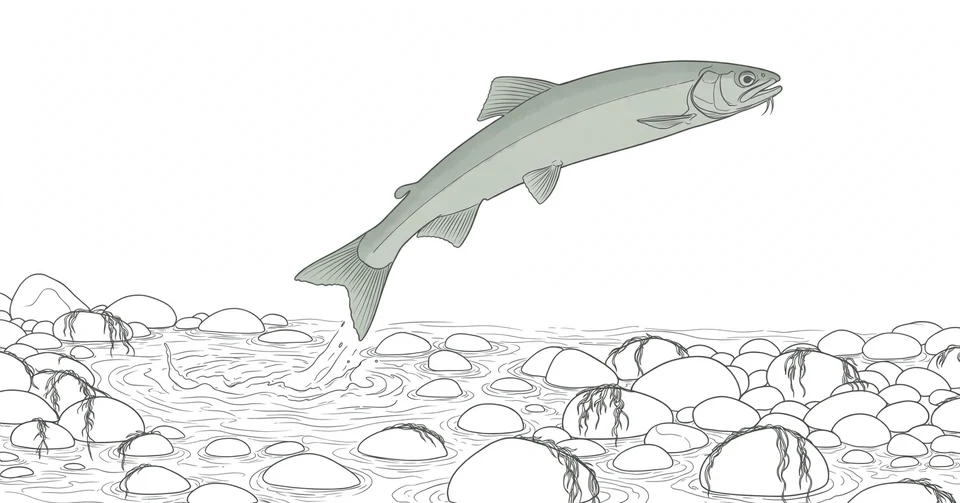
That brevity is not a flaw in the story. It is the story. Almost everything about it, the fishing invented for it, the festivals built around it, the price it commands in early summer, comes from the fact that it gets exactly one year and spends most of it within a short swim of where it was born.
A life that lasts one year
The year begins in autumn, in the lower reaches of a river, where adults dig small pits in the gravel and lay their eggs. The eggs hatch quickly and the tiny larvae are carried downstream to the sea, where they spend the winter in coastal water, feeding and waiting. In spring the young fish, by then about six centimetres long, turn back into the rivers and push upstream.
Summer is when an ayu becomes an ayu. In the warm months it grows fast, reaching somewhere between 15 and 30 centimetres, grazing its way up the river. By autumn it is mature, and it turns downstream again to spawn in the same gravel shallows where the cycle started. Most ayu die after spawning. A minority survive, return to the sea, and come back to spawn again, some as many as three times, but they are the exception that proves the rule written into the fish's other name. In Japanese, ayu can be written with characters that mean year fish. The biology of the species is well documented, and the one year arc is the first thing every account of it mentions, because everything else about the fish hangs on it.
Not every ayu in a Japanese river was born there. Juveniles are raised in aquaculture and released into rivers in large numbers ahead of the season, so the summer run is a mixture of wild fish and stocked ones. Anglers argue about whether the two taste different, and the honest answer is that the river has more say in the matter than the hatchery does. It is, to an unusual degree, a product of the water it grew up in.
Why ayu taste of melon
The flavour that made the ayu famous starts with a very plain diet. Once it is back in the river, an ayu lives mostly on algae, which it scrapes off submerged stones with a mouthful of fine, saw-like teeth. You can find the pale scrape marks it leaves behind on river rocks, a signature any angler can read. Because algae is thin food spread over hard ground, each adult defends a feeding territory, a patch of stones it grazes like a tiny farmer and protects from rivals. Hold that thought, because Japan's strangest fishing method is built entirely on it.
An algae diet gives the flesh its perfume. Ayu are famously sweet, and people who know the fish describe melon and cucumber aromas in it, a freshness that seems impossible for a fish until you remember what it has been eating all summer. The scent is strongest in fish from clean, fast water, and it fades into something merely pleasant in fish from lesser rivers. This is why the Japanese word for a truly clear stream and the word for good ayu country are practically the same idea. The fish is a report card on the river, published every summer, edible.
I think that is the real reason the ayu sits above other river fish in Japanese cooking. Trout and char are fine fish, but they do not testify about their home water the way an ayu does. Eat one from the Kano in June and you are tasting the Izu mountains, the spring water, the clean stones. Eat one from a muddy river and the fish tells you that too.
Tomozuri, fishing with a living decoy
Most fishing hides the fisherman's intentions. Tomozuri weaponises the ayu's own temper. The method, called ayu no tomozuri in Japanese, works like this. The angler buys or catches a live ayu and fixes it, gently, to a hook arrangement so that it swims naturally in the current, inside another ayu's territory. The resident fish sees an intruder grazing its stones and does what territorial ayu do: it charges and tries to drive the stranger off. In the attack it meets the hooks trailing behind the decoy, and the decoy goes home alive while the attacker goes into the creel.
It is an elegant, slightly ruthless idea, and it is old. The Kano River can claim a special place in its history: Japan's transport ministry, in its official portrait of the river, says the Kano is said to be the birthplace of tomozuri. Whether or not that claim would survive a courtroom, it fits. The upper and middle Kano, all clean gravel and fast runs through the onsen valley of Yugashima, is textbook tomozuri water, and when the season opens the wading anglers appear along it within days.
The season itself is part of the ritual. Ayu are protected while they grow, and on many rivers the closed season lifts at the start of June, which makes the first weekend of June a small national festival of waders and long rods. Fish caught early, the young waka ayu, are tender enough to eat whole, bones and all. Fish caught in high summer are bigger, fattier and more fragrant. Fish caught in autumn, heavy with roe and heading downstream to spawn, have their own melancholy following. One fish, three different dishes, depending on which chapter of its year you meet it in.
Cormorants, bamboo traps and an ending
Tomozuri is not the only theatre built around this fish. On the Nagara River in Gifu, cormorant fishing, ukai, has been performed for some 1,300 years. Trained cormorants, a domesticated sea cormorant called umi-u in Japanese, dive from boats under torchlight, catch ayu, hold them in their throat pouches and deliver them to the fishing master. Fish from the Nagara's official ukai have been offered to the imperial family and to Ise Jingu shrine, and the whole system of river, fish and fishermen was recognised as a Globally Important Agricultural Heritage Site in 2015. Gifu takes the fish seriously enough to name it a prefectural fish, an honour it also holds in Gunma.
The humbler method is the yana, a temporary trap of wooden stakes and bamboo built across the current to intercept fish moving downstream. Yana are at their busiest from late summer into autumn, and many now double as riverside restaurants where you can catch an ayu by hand in the trap pond and have it grilled on the spot, which the Japan National Tourism Organization's guide to Gifu lists among the prefecture's signature summer pleasures.
The Kano River, for its part, keeps a quieter memory of all this. Cormorant fishing was staged on the Kano centuries ago, and a crown prince, the future Emperor Taisho, came to watch it in the early nineteen hundreds. It is not performed there any more. The tomozuri anglers remain, and on a Numazu river that is probably pageant enough.
Salt, charcoal and nothing else
For all the ingenuity spent catching it, the classic way to cook one could hardly be simpler. Ayu no shioyaki means ayu grilled with salt, and it means only that. The fish is skewered whole, bent into a gentle wave shape so that it looks as if it is still swimming, dusted with salt, with a little extra worked into the fins so they do not burn, and grilled over charcoal. No sauce, no marinade, no garnish worth the name. The skin crisps, the flesh stays soft, and the melon scent that was in the living fish is still there, fainter, under the smoke.
You eat it whole, head, bones, guts and all, at least if it is a good fish from good water. The guts are bitter, deliberately so, and the pleasure of shioyaki is precisely that contrast: sweet flesh, bitter belly, salt on the skin. Riverside inns in the Yugashima valley on the upper Kano serve it this way through the season, a short walk from the water the fish came out of, and I have never seen the point of eating it any further from a river than that.
And then, by October, it is over. The last ayu go down to the gravel to spawn, the yana come down, the anglers hang up their rods, and the rivers belong to winter. What I like about the ayu is that it refuses to be hurried or stored or improved. It gives a river one bright season to show what it is made of, and then it is gone, and the only thing to do is keep the water clean and wait for next June.
More in Food & Travel
Latest posts
- Loma Linda's Long Lives Run on Saturdays
- Half the Old Springs in Japan Thank Kobo Daishi
- Tatamiishi Terraces Filter a River Through Stone
- Wasabi-Zuke Puts the Whole Plant in Sake Lees
- Konyoku Is Still Out There, Past the Last Train Station
- Karo Is the Tengger's Other Great Gathering
- Dry January Lasts a Month on Purpose
- Urashima's Dragon Palace Had a Name, Ryugu
- Petruk's Nose Arrives Before He Does
- Ikaria Runs on Island Time
- Why Nicoya Cooks Its Corn in Lime
- A Ngaben Can Take a Village Years to Prepare
- Juryo Is Where Sumo Starts Paying
- Nobody Eats the Daidai, and That Is the Point
- There Are Only 105 Toshiyori Shares in All of Sumo