Suruga Bay, Japan's Deepest Bay and the Water That Feeds Numazu
· 9 min read
Suruga Bay drops to about 2,500 metres beside Mount Fuji, and that single stretch of deep water explains Numazu Port, the deep sea aquarium, and the famous fisheries of Shizuoka.
Stand on the shore at Numazu on a clear morning and you are looking at the two extremes of Japan at once. Behind the town, Mount Fuji rises to 3,776 metres, the highest point in the country. In front of it, the water of Suruga Bay falls away to about 2,500 metres deep, which makes it the deepest bay in Japan. From the summit to the seabed, the land drops more than 6,000 metres, and almost all of that drop happens in front of a single coastline.
That depth is not a piece of trivia. It is the reason this corner of Shizuoka lives the way it does. The morning auction at the port, an aquarium that keeps frozen coelacanths instead of dolphin shows, shrimp that fishermen are licensed to catch in this one bay and nowhere else in Japan, all of it traces back to the water of Suruga Bay and how quickly it gets deep.
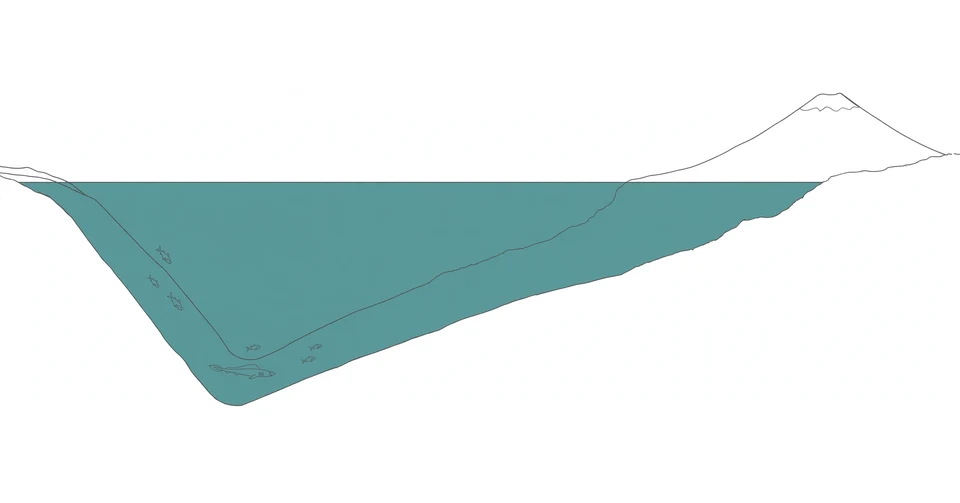
So before the port, the aquarium and the seafood bowls, it is worth starting with the water itself. This is the story of how Suruga Bay became so deep, what lives inside it, and why so much of life in eastern Shizuoka is organised around a bay that behaves more like the open ocean.
A plate boundary runs under the water
The shape of the bay was decided long before there were ports or fishermen. Running up the middle of Suruga Bay is the Suruga Trough, a deep gash in the seabed and the deepest trough in Japan. The trough marks the line where the Philippine Sea Plate slides beneath the Eurasian Plate, in the slow collision geologists call subduction. The bay was formed by that subduction, and the same process gives the bay its extreme depth. The trough under the bay is also the northern end of the longer Nankai Trough system that runs along the Pacific side of Japan.
That geology comes with a price. A plate boundary is a source of considerable seismic activity, and this stretch of coast is watched closely for that reason. The long discussed Tokai earthquake scenario, the one disaster planners in Shizuoka have prepared around for decades, is tied to this same boundary under the bay. Further south, the trough continues into the Nankai Trough, the boundary behind several of the largest earthquakes in Japanese history, which is why instruments on the seabed here are read so carefully. The water that feeds the region is also the water that worries it, and people here live with both facts at once.
On land, the mountains answer the trough. Rivers such as the Fuji, the Oi and the Abe run down from the high ground of Shizuoka and empty into the western side of the bay, carving canyons into the seabed as they go. At the eastern end, the Kano River reaches the sea at Numazu. Mountain water is constantly being delivered into the deepest bay in the country, which is part of why the bay stays so rich.
Why Suruga Bay drops so steeply
Most bays shelve gently, and you can walk out a long way before the water reaches your waist. Suruga Bay does the opposite. The seabed falls away fast, and true deep sea water sits close to shore, within reach of small fishing boats rather than research ships. From the summit of Fuji at 3,776 metres to the floor of the trough at about 2,500 metres below the surface is a vertical span of roughly 6,276 metres. Few coastlines on earth stack that much height and that much depth into one view.
The Izu Peninsula wraps around the eastern side of Suruga Bay and shelters it from the open Pacific, so the water inside is often calmer than its depth suggests. I find that combination hard to hold in my head: a sheltered, swimmable bay on the surface, and an abyss underneath it. The two are the same water, separated only by a short swim downward.
Around 1,000 species in a single bay
All that depth stacks habitats on top of each other. The sunny surface layer holds the familiar fish of Japanese tables. Below it come the cold, dark layers where pressure rises and light disappears. Shizuoka Prefecture counts about 1,000 species of fish in Suruga Bay, and the variety makes sense once you picture the bay as several seas piled into one place.
The deep layers hold animals that elsewhere need an ocean expedition to see. Frilled sharks and megamouth sharks turn up in fishermen's nets. Giant spider crabs walk the floor, and giant isopods, the deep sea cousins of garden woodlice, come up with the catch. A small red octopus called mendako drifts in whenever a boat brings one in alive.
For most of history, the people exploring this deep water were not scientists but fishermen, hauling up animals nobody could name and carrying them to market anyway. That has not entirely changed. Much of the ecosystem of Suruga Bay remains unmapped, and new species are still being recognised. In 2016, a research team led by the Japan Agency for Marine Earth Science and Technology caught four large slickheads at depths of about 2,100 to 2,600 metres. The biggest measured well over a metre, and the fish turned out to be a species unknown to science, an apex predator of the deep bay whose name carries the word yokozuna, the highest rank in sumo. A bay that can still hide a top predator a short boat ride from a city port is not a finished subject. It is a frontier that happens to have fishing towns on it. The Numazu Deep Sea Aquarium exists because of this steady supply from the bay outside its doors, and its most famous residents are its frozen coelacanths, fish once thought extinct, kept from these very waters. The aquarium is less a collection brought to Numazu than a sample of Suruga Bay moved indoors.
The water that feeds Numazu and Shimizu
The depth of Suruga Bay would only be a curiosity if nothing ate from it. An undersea plateau at the southwestern end of the bay, known as Senoumi, is famous as a rich fishing ground, and the working ports around the rim land the rest. A walking guide to Numazu published by the Urban Renaissance Agency describes a port town welcomed by Japan's deepest bay and Mount Fuji, where the bounty of the sea is landed every day. At Numazu Port, that bounty starts moving at the morning auction, long before the restaurants around the harbour open their doors.
The most famous catch of Suruga Bay is also its smallest. The tiny pink sakura ebi spends its days 200 to 350 metres down, then rises toward the surface at night, and the whole fishery is built around that nightly climb. Suruga Bay is the only place in Japan where fishermen hold licences to catch it commercially, and every catch lands at just two ports, Yui Port and Oigawa Port, with Yui sitting in Shimizu Ward of Shizuoka City. Alongside the shrimp comes shirasu, the silver whitebait of Shizuoka, often served in the same bowl so the pink and the silver sit side by side.
The working rhythm of Suruga Bay runs through the whole day. The shrimp boats go out at dusk and race home before morning, the auction sets the price while the town is still waking up, and by lunch the catch is on rice in a dozen small restaurants. Numazu also built a quieter fame on dried horse mackerel, landed from the same water and split and salted in the sun, with one of the highest production volumes in the country. From Numazu at the northeastern corner to the Shimizu shore in the west, the towns around Suruga Bay have arranged themselves around what the water gives. Dried fish, sushi counters, market streets and one very unusual aquarium are all, in the end, answers to the same deep water.
The bay also remembers being dirty
The depth has not always protected the bay. After the war, the paper mills of Fuji city poured so much waste water into the harbour at Tagonoura that by 1970 the daily discharge was compared to the sewage of Tokyo. Sulphur laden sludge threatened to block the harbour, dredging damaged marine life, and protests by local people and fishermen pushed the government to act. The pollution of Suruga Bay became so notorious that it fed into the 1971 film Godzilla vs. Hedorah, whose monster takes its name from hedoro, the Japanese word for mud. Regulations cleaned the water a great deal, although surveys in the mid 2010s still found heavy contamination from banned chemicals in the deep ecosystem. The bay forgives slowly, which is worth remembering when people call it pristine.
On a clear evening, the whole arrangement explains itself visually. From the pine grove at Senbon Matsubara in Numazu, the sun goes down over Suruga Bay with Mount Fuji standing behind the town, the highest point in Japan reflected at the edge of its deepest water. People sit on the beach and watch it the way people elsewhere watch a river or a mountain lake, as the fixed point their town happens to face.
None of that cancels what the bay is. The port at Numazu, the aquarium beside it, the shrimp boats going out at dusk and the whitebait bowls at lunch are all chapters of one story, and the story is the water. Suruga Bay is the deepest bay in Japan, but around here it is something simpler as well: the reason the table is full. Start with the bay, and the rest of Numazu explains itself.
More in Culture & Society
- The Tengger Carry Their Dead Out of the Village in Entas-Entas
- Urashima Opened the Tamatebako and Time Came to Collect
- How Supersemar Borrowed the Authority of a God
- Bali Has Its Own Semar, and His Name Is Twalen
- White Silk Means You Made It as a Sekitori
- The Dohyo-Iri Gives a Yokozuna Three Minutes to Own the Ring
Latest posts
- Sober Curious Is Not Quitting, It Is Choosing
- Real Wasabi Refuses to Grow Almost Anywhere
- There Is Miso in Far More Than the Soup
- A Glass of Cannonau a Day in the Sardinian Hills
- A Rotenburo Is a Bath With Weather
- Katsuobushi Is a Fish You Shave Like a Block of Wood
- Nobody Commutes to a Heya
- Why Kagami Mochi Is Never Cut With a Knife
- Narazuke Pickles Spend Years Asleep in Sake Lees
- Tokyo Keeps a Hundred Tiny Fujis Called Fujizuka
- Tomozuri Sends a Living Fish to Do the Fishing
- One Thousand Three Hundred Years of Ukai Nights on the Nagara River
- Fuji Ko, the Pilgrim Societies That Climbed Mount Fuji Together
- Dashi, the Quiet Stock Under Almost Everything Japan Cooks
- Ayu, the Sweetfish That Rules Japan's Clear Rivers