The Kesho-Mawashi Comes Out Only for the Ceremony
· 11 min read
A kesho-mawashi is the heavily embroidered silk apron a top division sumo wrestler wears for a few minutes of ceremony and never in a bout, usually a gift from the supporters who believe in him.
The most expensive thing a sumo wrestler owns may be something he wears for only a few minutes at a time. A kesho-mawashi is a wide apron of silk, heavy with embroidery, that a wrestler from the top two divisions puts on for the ring entering ceremony and takes off again before any fighting begins. Nothing about it helps him win a bout. That is exactly what it is for.
Sumo strips clothing down to almost nothing, a single belt and a topknot, so the one garment of pure display stands out all the more. For the rest of the day the same man is dressed for work in a plain length of silk. The kesho-mawashi belongs to the parade, not the contest, and everyone in the arena understands the difference the moment it appears.
It is also a certificate. Only wrestlers ranked in the top two divisions, makuuchi and juryo, are allowed to wear a kesho-mawashi, so a man's first one marks the moment a trainee who cooked and cleaned for his seniors becomes a salaried professional. Before that day, a young wrestler being introduced to the crowd borrows an apron that belongs to his stablemaster or to a senior in his stable.
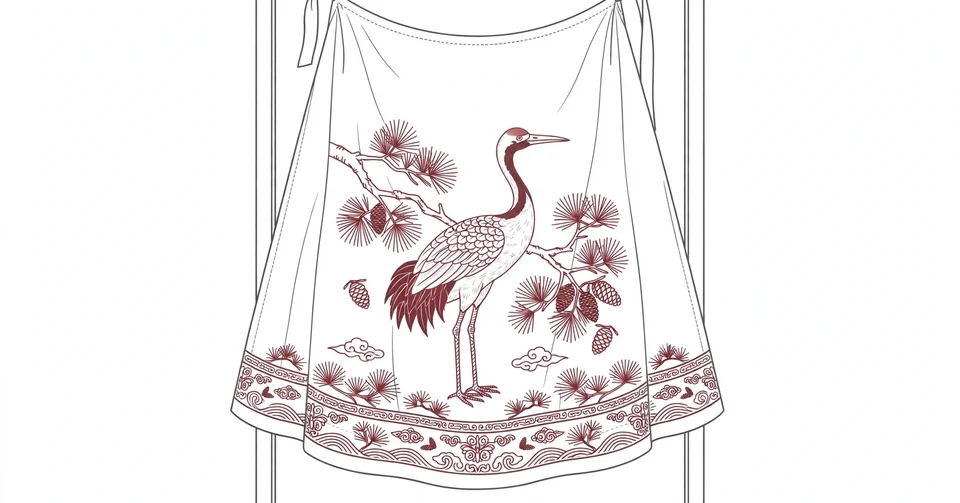
Look closely at the front of one and you are reading a small biography. The picture on a kesho-mawashi can tell you where the man comes from, who paid for the silk, and what he or his supporters wanted the world to know about him. The back is plain belt. All of the meaning hangs in front, where the crowd can see it.
What a kesho-mawashi is made of
A kesho-mawashi begins as a belt of silk, like the fighting belt it sits over, but at the front it opens out into a broad apron panel that hangs from the waist nearly to the ankles. The panel is usually heavily embroidered, and along its bottom edge runs a fringe of thick tassels. The fringe on a kesho-mawashi is most often gold, and it may be almost any colour except purple, which is reserved for wrestlers of ozeki and yokozuna rank.
These aprons are not bought off a rack. Each kesho-mawashi is ordered for one man, and the weaving and embroidery are specialist work, often in silk brocade in the tradition of the Nishijin weavers of Kyoto. The finished garment is large and heavy, awkward to fold and impossible to ignore. Woven into or hung from the fringe you will usually find the name of whoever gave it, so the gift quietly advertises its giver every time the wrestler appears.
The word itself gives the game away. Kesho carries the sense of adornment, of dressing something up, and a kesho-mawashi makes no apology for being decoration. In a sport that is severe about almost everything, hair, dress, speech, the order in which men eat and sleep, this is the single licensed piece of splendour, and it is licensed only for men who have reached the top of the pyramid.
Worn for the dohyo-iri, never for a bout
The one job of a kesho-mawashi is the dohyo-iri, the ring entering ceremony that comes before the bouts of each top division. The wrestlers file down the aisle to the ring in their aprons, each man announced by name, and climb up to walk a slow circuit of the ring. They turn to face the crowd, clap their hands together, raise both hands to the sides, and lift the hem of the apron slightly before filing out again. The whole thing takes a few minutes, and then the kesho-mawashi comes off.
I have written elsewhere about the dohyo-iri a yokozuna performs alone, and the same logic runs through the group version. The ceremony says: these are the men, this is their rank, look at them properly before the violence starts. The aprons do the saying. A makuuchi wrestler in a plain belt is an athlete. The same man in a kesho-mawashi ablaze with a golden dragon is a personage.
Once the ceremony ends, attendants help each wrestler out of his kesho-mawashi and it is carried away and put carefully back into storage. The men return later in the plain silk belts they actually fight in. Even then, a ghost of the apron stays in the ring: the stiffened cords called sagari that hang from a sekitori belt during a bout are said to represent the kesho-mawashi, a small starched reminder of the finery hanging in a box somewhere backstage.
So the kesho-mawashi spends almost its whole life in the dark, folded away, and is brought out for minutes at a time on fifteen afternoons of a tournament. It is less a uniform than a piece of regalia, closer to a mayoral chain or a ceremonial sword than to anything else in a sportsman's kit bag.
A kesho-mawashi is a gift before it is a garment
Getting a kesho-mawashi is one of the first orders of business when a wrestler is promoted to juryo, and the striking thing is that he almost never buys it himself. The apron is ordered and paid for by other people: a supporters club, a sponsor, a group from his hometown. As The Japan Times explains in its Sumo 101 column on the kesho-mawashi, the average price is about one million yen, some cost many times that, and the person or institution paying chooses the design, normally after consulting the wrestler.
That arrangement is not charity. It is the visible half of a bargain at the heart of sumo. Reaching the top two divisions gives a wrestler the right to have a supporters club, a koenkai, of his own, as I set out in my piece on what changes when a man becomes a sekitori. The club pools money from fans, local businesses and hometown well-wishers, and the kesho-mawashi is often the first grand thing the pool buys. In return the supporters get access, invitations, and the pleasure of seeing their name on the fringe of an apron circling the ring at the Kokugikan.
This is why the apron so often speaks about belonging rather than about the wrestler alone. His hometown is on it because his hometown paid for it. A company crest is on it because the company wants its loyalty seen. The kesho-mawashi is, among other things, a receipt, proof that a young man from a particular place, backed by particular people, made it to the seventy salaried places at the top of sumo.
The longer a man holds his rank, the more aprons he tends to accumulate, because promotion, a championship or a milestone gives supporters a fresh excuse to commission another. A popular veteran may own a wardrobe of kesho-mawashi and rotate them across a tournament, choosing which gift to honour on which day. A wrestler barely clinging to juryo may have exactly one, and guard it accordingly.
Reading the front of the apron
There are remarkably few rules about what may go on the front of a kesho-mawashi, and the result is a gallery that wanders from classical painting to advertising. Traditional choices include dragons, cranes, waves, tigers and blossom, worked in coloured silk and gold thread. A hometown might commission its famous mountain, its castle, its festival or its best known product. Graduates of famous universities and high schools sometimes carry the crest of their school.
Sponsors are blunter. The Bulgarian ozeki Kotooshu famously wore a kesho-mawashi carrying the name of a Japanese yogurt brand, Bulgaria, that sponsored him, turning the most traditional garment in the sport into a billboard and delighting everyone involved. Foreign born wrestlers have worn their national flag. Popular culture gets in too: designs have ranged as far as Hello Kitty, and the Russian wrestler Roho once appeared in a kesho-mawashi fitted with stars that lit up and flashed.
I confess I like the shameless ones as much as the solemn embroidered landscapes. A kesho-mawashi is supposed to be read across an arena in a few minutes, by people who may know nothing about the man inside it. A crane in gold thread and a glowing yogurt logo are doing the same honest work. Both say where this wrestler's support comes from, and both will be remembered long after the day's results are forgotten.
Three matching aprons at the very top
At the summit of the sport the kesho-mawashi multiplies. A yokozuna does not receive a single apron but a matching set of three: one for himself and one each for the two attendants who flank him in his personal ring entering ceremony, the sword bearer and the dew sweeper, who must themselves be top division wrestlers, ideally from his own stable. For those minutes the three men form a single picture, dressed from the same bolt of cloth.
The set of three is where the money and the craftsmanship climb highest, because a yokozuna set is a gift meant to mark a once in a generation event for a town, a stable or a sponsor. This is also where the purple fringe appears, the colour no one below ozeki may use, a small dyed line between the very good and the immortal. A kesho-mawashi worn by a yokozuna in his prime is about as close as modern sport gets to a coronation robe, and it is treated that way: photographed, discussed by fans, and remembered by name long after the man retires.
In the Edo period they fought in them
It was not always a purely ceremonial object. As the history of the mawashi records, in the Edo period the kesho-mawashi also served as the wrestler's fighting belt. Wrestlers then were kept by feudal lords, and the lord's crest went on the apron, so a bout could be read as a contest between houses as much as between men. Over time the aprons grew more ornate and more precious, and sending a fortune in embroidered silk into a grappling match stopped making sense. The two jobs split apart: a plain, strong belt for fighting, and the kesho-mawashi kept back for show.
Something of the old world survives in that split. Modern wrestlers are no longer retainers of a lord, but the kesho-mawashi still declares a patron, a hometown, a company, a club. The names changed. The structure, a strong man carrying the marks of the people who raised and funded him, did not.
What happens to an apron afterwards
For something so expensive, a kesho-mawashi has a quiet life. It travels with the stable from tournament to tournament, comes out for its few minutes, and goes back into storage, washed of nothing worse than dust because it never touches the clay of a bout. Wrestlers look after them the way musicians look after a good instrument, and a damaged or faded apron is a small sorrow.
When a career ends, the aprons are often what remains on public view. Retired wrestlers give old kesho-mawashi back to the towns and schools that presented them, and they turn up in hometown museums and local exhibitions, standing in glass cases with the wrestler's name beside them, the embroidery still bright. A boy from the same town can stand in front of one and see, in silk, exactly how far a local can go.
There is something fitting in that ending. A kesho-mawashi begins as an act of faith by other people, money raised before the wrestler has proved he can stay at the top, and it ends as a piece of evidence in a museum case. In between it works only minutes at a time, yet those minutes, repeated over years of tournaments, are when the crowd actually sees who a wrestler is: not the record, not the techniques, just the man, his town, his backers and his dragon, walking slowly around the ring.
More in Culture & Society
- Sodoran Treats an Heirloom Like an Honoured Guest
- You Can Read a Pecalang From Across the Street
- When the Gara-Gara Starts, the Puppets Drop the Plot
- Forty Pounds of Cowbells, and the Mamuthones Say Nothing
- The Oarfish Still Answers to a Name From the Dragon Palace
- Irezumi Was an Art Before It Was a Warning
Latest posts
- Toji Meant Moving to a Hot Spring Until You Got Better
- Nyuto Onsen Hides Seven Inns at the End of a Snow Road
- A Donko Never Got the Chance to Open
- The Milpa Is a Garden That Thinks Like a Forest
- The Kitamaebune Came Home Loaded With Kelp
- Nobody Just Watches a Panigyria, Everybody Dances
- Ponzu Began With a Fruit Too Bitter to Eat
- Kombu Is the Quiet Half of Dashi
- Manza Onsen Bathes at 1,800 Metres
- The Oshi Kept Fuji's Pilgrims Fed, Housed, and Devout
- Every Prefecture Argues About What Goes in Ozoni
- Japan's Population Decline and the Villages It Leaves Behind
- KRL Commuterline and the Trains That Move Jakarta
- Kecap Manis and the Sweet Soy Sauce of Indonesia
- In Mamoiada, Two Hundred Families Still Make Wine at Home