Every Heya Runs on an Okamisan
· 11 min read
The okamisan, the wife of a sumo stablemaster, holds no rank and draws no salary from the Japan Sumo Association, yet the food money, the recruits' savings, and the emotional survival of a heya all pass through her hands.
Every sumo stable has a father. The oyakata, a retired wrestler who has become an elder of the Japan Sumo Association, coaches the wrestlers, sets the rules, and answers for the house. Less visibly, every stable also has a mother. She is the okamisan, the stablemaster's wife, and if you ask people inside the sport who keeps the building running from one day to the next, her name tends to come up before his does.
The strange part is that, officially, she does not exist. The okamisan holds no position in the association, receives no salary, and works under a title that appears in no rulebook. Her authority rests on a marriage and on the fact that the whole arrangement wobbles without her. Our own look at the heya, the communal house where wrestlers live and train, put it this way: "Beside him works his wife, the okamisan, and many people inside sumo will tell you the house would collapse without her."
So what does she actually do all day? Almost everything that is not coaching.
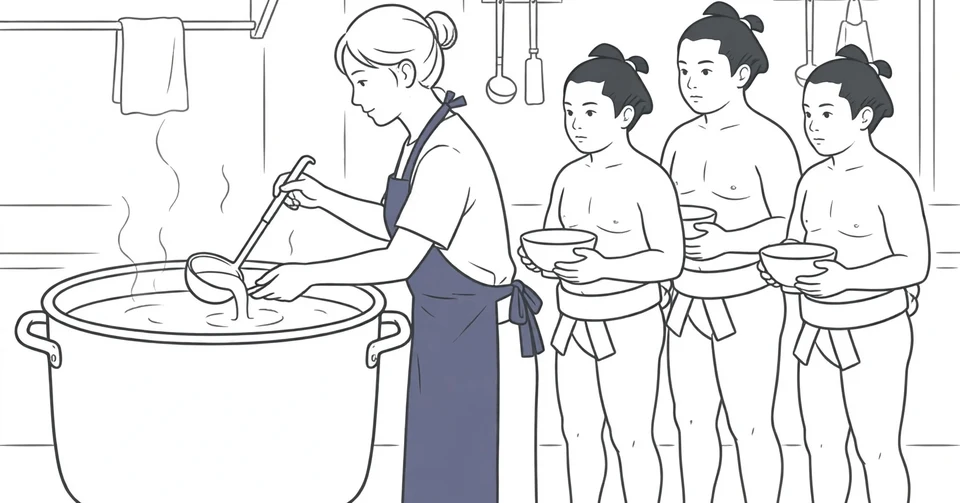
To understand the job, it helps to understand the word. Okamisan is not a sumo invention. In everyday Japanese it is the title of the woman who runs a traditional inn or a small restaurant, the proprietress who greets the guests, directs the kitchen, and settles the bill at the end of the night. Sumo borrowed the word for the master's wife, and the borrowing is honest. A heya is part sports team and part boarding house, and she is its landlady in the fullest sense of the word.
A word borrowed from the inn
The fit was often literal. Wikipedia's overview of the heya system notes that in earlier generations, many stablemasters' wives came from families that ran ryokan inns, or from the world of traditional dance, trades built on feeding people, housing people, and managing a household in public view. Hospitality was their family business long before it became their marriage.
Others arrived from further afield. The wife of the former sekiwake Wakashimazu was the singer Mizue Takada. The okamisan of Asakayama stable wrestled professionally herself before marriage, and the okamisan of Nishikido stable is a soprano. There is no recruitment process and no standard background, because there is no job posting to apply for. There is only a wedding, after which a woman discovers the size of the household she has actually married into.
The job description nobody wrote down
Start with the money, because a stable burns through it. The association pays each stablemaster a monthly upkeep sum, with extra amounts for wrestlers below the salaried ranks, and patron groups called koenkai add donations on top. Even so, feeding a house of growing wrestlers costs thousands of dollars a month. Somebody has to stretch that budget across rice, meat, vegetables, utilities, and a building full of young men who eat like a small army, and that somebody is usually the okamisan. She is in charge of the stable's management and accounting, paying the suppliers and keeping the books that keep the kitchen alive.
Her financial role goes further than the house accounts. The okamisan often holds the young wrestlers' savings herself. A boy who joins at fifteen earns no salary, sometimes for years, and the allowances and gift money that come his way are not sums a teenager far from home is well placed to manage. So the money sits with her, in the stable's informal bank of one, to be handed back in portions or kept safe until he is older. It is a remarkable arrangement by modern standards, built entirely on trust, and it only works because the woman at the centre of it is trusted completely.
Then there is the teaching. Formal coaching belongs to the oyakata and his assistant coaches, but the okamisan teaches too, in the domestic register: how a recruit behaves, how he speaks to seniors and guests, how a household of dozens of men stays civil at close quarters. She helps with kitchen work and supervises the world around the great chanko pot, even though the cooking itself is traditionally done by junior wrestlers on rotating duty. A visit to the Takadagawa stable in Tokyo described the division of labour in one clean line: the stablemaster acts as father to his charges, his wife the okamisan is the mother, and in addition to looking after the wrestlers as she would her own sons, she handles the day to day operations of the stable. Day to day operations is a modest phrase for the entire non-wrestling life of the building.
Mother to other people's sons
The emotional half of the job is the half the wrestlers remember. Most recruits arrive at about fifteen, straight out of junior high school, and move into a dormitory of giants where rank decides when they wake, when they bathe, and when they eat. The separation from their own families can be genuinely painful, and comforting and advising those boys is formally recognised as the okamisan's role. She is the surrogate mother of the house, deliberately mirroring the oyakata's role as its father.
The boys she comforts have usually been up since before dawn for asageiko, the dawn training session held on an empty stomach, and the tears, when they come, rarely come in front of the master. They come in the kitchen, or on the stairs, or wherever she happens to be. A homesick recruit cannot go home, and he cannot easily unburden himself to the man who grades him. He can go to her.
Even the master's own children are folded into the fiction. When the brothers Takanohana and Wakanohana joined their father's stable as teenagers, they were instructed to stop calling their parents father and mother, and to address them as oyakata and okamisan instead. Inside the house, the titles outrank the blood.
The bond runs warmly in the other direction too. The Ukrainian wrestler Shishi, of Ikazuchi stable, refers to his okamisan as his mama, and means it. Unusually, she is a former amateur sumo world champion, and she helps with his training as well as everything else, a reminder that the boundary of the role is set by custom rather than by ability.
The parents on the other end of the phone
Before a boy can be comforted, he has to be recruited, and recruitment runs through families. Joining a heya means parents hand a fifteen year old to a closed institution for years of unpaid apprenticeship, on the far side of the country, under rules they barely understand. Somebody has to answer a mother's questions and keep answering them for years afterwards, and that somebody is the okamisan. She manages the stable's relations with the wrestlers' families, which in practice makes her the voice of the heya in a hundred kitchens and living rooms she will never see.
The same social labour faces outward in the other direction, toward the koenkai. Patron groups fund a large share of stable life, and patronage is a relationship, not a transfer. There are banquets to host, gifts to acknowledge, supporters to greet at tournaments and thank in person. The oyakata is the public name of the stable, but much of the warmth that keeps supporters loyal is generated by his wife, working rooms he is too busy, or too gruff, to work himself.
The okamisan has no salary, no title, and no safety net
Every other traditional professional in sumo is a man with a defined place in the association. Referees, ring announcers, and the tokoyama hairdressers all belong, all hold rank, and all are paid. The okamisan is the lone exception. She receives no salary at all, despite the importance of her position, because her position is based exclusively on a marital bond. She is essential staff and, on paper, a spouse who happens to live at her husband's workplace.
That dependence has a hard edge, and it shows at the worst moment. When a stablemaster dies, his widow can be required to hand the stable, which is also her home and the whole of her working life, to a successor, and to move out of the apartment at the top of the building. Wikipedia records the case of the wife of Asashio the third, who faced exactly that loss after her husband's sudden death: the house she had run for years stopped being hers because the marriage that entitled her to run it had ended.
Her daily life carries smaller reminders of the same bargain. Bound by the rules that keep women away from the sacred ground of the sport, she cannot enter the training area itself. The woman who may have planned the menus, paid the rice merchant, settled the accounts, and talked a crying recruit down the night before watches the morning's practice from the observation platform at its edge. There is no tidy way to defend that arrangement, and sumo mostly does not try. It simply relies on her, and she, mostly, stays.
Raised in the world she now runs
It helps that many okamisan are not newcomers to this world at all. It is not unusual for a stablemaster's wife to have grown up around stables, and some are the daughters of wrestlers who became stablemasters themselves. For a woman raised as a stable's daughter, the etiquette of the house, the rhythms of tournament season, and the management of large hungry households are not a culture shock. They are childhood.
Marriage keeps weaving these families together. Former ozeki Takakeisho married the daughter of the former top division wrestler Hokutenyu in 2020, and in earlier generations a wrestler marrying his own master's daughter was a recognised road to inheriting the stable itself. The result is a quiet paradox. The most unofficial job in professional sumo is very often held by one of its most native insiders, a woman who understood what a heya demands long before she was asked to run one.
A quiet network of their own
Each okamisan is, inside her own building, the only person doing her job, and for a long time each of them did it alone. That has changed at least a little. The okamisan of the various stables have organised a group of their own, to advise and support one another, a peer network for a profession that officially does not exist. It is easy to see the need. There is no manual for being the mother, bookkeeper, and public face of a wrestling stable, so the women who have done it longest have become the manual for each other.
The edges of the role are also slowly shifting. Since the nineteen nineties, stablemasters and okamisan have increasingly taken part in the cooking and housekeeping that used to belong entirely to the lowest ranked wrestlers. Some modern stables have gone further and hired professional cooks or food advisors, lightening the kitchen side of her load so the house can run more like a contemporary sports team. The okamisan is not disappearing from these reforms. She is, at last, getting a little help.
Sumo prides itself on being a world where everything has its place: every rank has a name, every role a costume, every duty a line in a very old chart. The great exception stands in the kitchen doorway with the accounts in one hand and a ladle in the other. The okamisan is proof that an institution can run for centuries on labour it refuses to write into its own structure. Whether that is tradition's blind spot or its quiet design is a matter of how generous you are feeling. The wrestlers who grew up calling her mother, in a house that was never quite their home, have mostly decided the question for themselves.
More in Culture & Society
Latest posts
- Kombu Is the Quiet Half of Dashi
- Manza Onsen Bathes at 1,800 Metres
- Every Prefecture Argues About What Goes in Ozoni
- KRL Commuterline and the Trains That Move Jakarta
- Kecap Manis and the Sweet Soy Sauce of Indonesia
- In Mamoiada, Two Hundred Families Still Make Wine at Home
- Shochu and the Quiet Spirit of Japan
- A Dried Shiitake Is Louder Than a Fresh One
- Loma Linda's Long Lives Run on Saturdays
- Maruten Numazu and the Towering Kakiage Bowl of the Port
- The Three Sisters Grow Better Together
- Tatamiishi Terraces Filter a River Through Stone
- Wasabi-Zuke Puts the Whole Plant in Sake Lees
- Konyoku Is Still Out There, Past the Last Train Station
- Dry January Lasts a Month on Purpose