Golden Week, Japan's Busiest Holiday Season
· 10 min read
Golden Week is the string of four national holidays in late April and early May that turns Japan into its busiest travel week of the year, with trains, flights and hotels booked out weeks ahead.
If you have ever tried to book a train in Japan in late April and found every seat taken, you have probably run into Golden Week. It is the one week of the year when the whole country seems to be on the move at the same time, and it catches first time visitors by surprise more than any other date on the calendar.
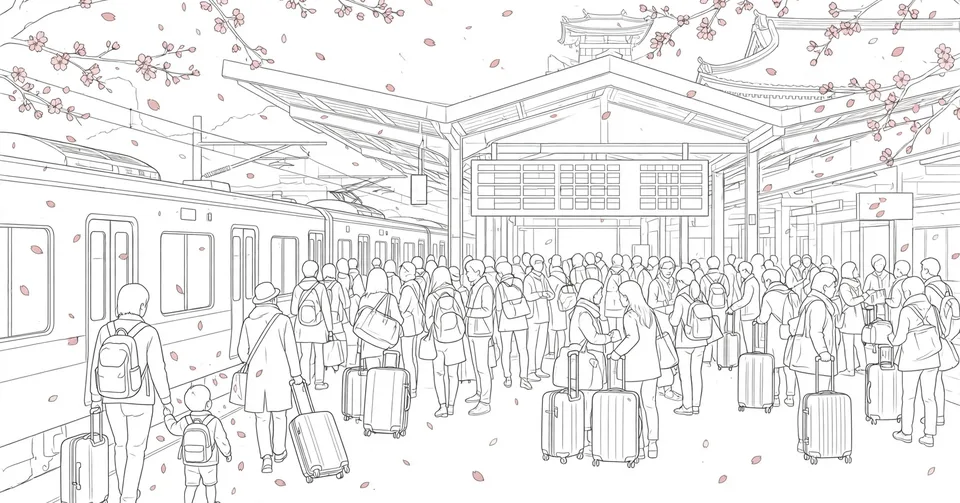
Golden Week is a string of four national holidays that fall close together in late April and early May. Because the gaps between them are so short, many people take the days in between off as well, and the result is the longest break most Japanese workers get all year. Trains fill up, hotels double in price, and the famous sights are at their most crowded. Anyone planning a spring trip to Japan needs to know the dates before booking anything, because a trip that runs into Golden Week is a very different trip from one that ends just before it.
What Golden Week actually is
Golden Week is not a single holiday. It is the name for the cluster of four national holidays that fall between 29 April and 5 May: Showa Day, Constitution Memorial Day, Greenery Day, and Children's Day. The name is said to come from the film industry, which noticed in the 1950s that this week earned more at the box office than any other, the way a golden time slot earns more than an ordinary one. The name stuck, and today it is the standard term for the whole period.
What makes Golden Week special is not any one of the four holidays. Each of them on its own is an ordinary public holiday, the kind Japan has sixteen of in a year. What makes the week special is the pile up. With four holidays in the space of seven days, plus the weekends on either side, most people can take a week off by using only one or two days of annual leave. That is rare in a country where long holidays are hard to come by, and it is why the whole nation travels at once.
The four holidays behind Golden Week
Each of the four holidays has its own meaning, and knowing them helps you understand what the week feels like on the ground.
| Holiday | Date | What it marks |
|---|---|---|
| Showa Day | 29 April | The birthday of Emperor Showa, who reigned from 1926 to 1989 |
| Constitution Memorial Day | 3 May | The day the post war constitution came into force in 1947 |
| Greenery Day | 4 May | A day to appreciate nature and the greenery of spring |
| Children's Day | 5 May | A day to celebrate the health and happiness of children |
Showa Day opens the week. It was once simply the birthday of the reigning emperor, and after his death it was kept as a day to reflect on the Showa era, the long period of Japanese history that ran from 1926 to 1989. Constitution Memorial Day marks the constitution that has governed Japan since 1947. Greenery Day is the quietest of the four, a day for parks and gardens at the moment spring is at its greenest. Children's Day closes the week, and it is the most visible of the four: families hang carp streamers called koinobori outside their homes, and you will see them everywhere, from apartment balconies in Tokyo to riverbanks in the countryside.
None of the four holidays is a festival in the usual sense. Shops stay open, trains run, and there are no nationwide closures. The effect of Golden Week comes from the travel it causes, not from anything shutting down.
Why the dates shift every year
The four holidays fall on fixed dates, but Golden Week never looks quite the same two years in a row. The reason is the calendar. When a holiday falls on a Sunday, the law moves the day off to the following Monday, which is called a substitute holiday. And when the holidays fall on a Thursday and a Friday, or a Monday and a Tuesday, the working days between them become natural days to take off.
Some years the holidays line up neatly into one long break. Other years they split into two shorter breaks, and workers call the neat years a good Golden Week and the split ones a bad one. In a good year the crowds concentrate into one intense week, while in a split year they spread out a little.
This is why you should check the exact calendar for the year you are travelling, rather than relying on a general description. The dates of the holidays never change, but which days of the week they fall on changes everything about how the week plays out.
Why Golden Week is Japan's busiest travel week
Golden Week is the busiest domestic travel week of the year in Japan. The Shinkansen, domestic flights, and express buses are booked out early, and the most popular trains can sell out weeks in advance. Hotels in Kyoto, Tokyo, and the other big destinations raise their prices sharply, and the cheaper rooms disappear first. It is the one week when even Japanese travellers complain about the crowds in their own country.
The numbers tell the story. Railway companies add extra services and still run full trains. Airports see their biggest domestic passenger counts of the year. Highway traffic jams stretch for tens of kilometres on the routes out of Tokyo, and the return traffic on the final day of the week is famously slow. If you are travelling during Golden Week, you are travelling with the whole country.
There is a reason the crowds concentrate so much. Japan has few long holidays, and the school year starts in April, so families cannot easily travel at other times. Golden Week is the first long break of the new school year, the weather is warm, and the spring flowers are still out. For many families it is the only week they can all travel together, and they take it.
Golden Week and the end of cherry blossom season
Golden Week comes just after the cherry blossom season, and the two are easy to confuse when you are planning a spring trip. The blossoms reach full bloom in Tokyo around the end of March, and in Kyoto and Osaka around the start of April. By the time Golden Week arrives at the end of April, the blossoms are gone in most of the country. Only in the far north, in places like Hokkaido, does the blossom season overlap with the holiday week.
That timing matters. A traveller who books a late April trip hoping to see the blossoms will find the petals gone and the Golden Week crowds in their place. The cherry blossom season is best enjoyed in late March and early April, before the holiday week begins, while the autumn leaves offer a second beautiful season later in the year, in November and early December, with no equivalent holiday crush. Spring in Japan is really two trips: a blossom trip in late March, and a Golden Week trip at the end of April. They need different plans, different budgets, and different expectations.
The one exception is worth knowing about. In Hokkaido, the blossoms open late, often in late April or early May, so the holiday week and the blossoms can overlap there. It is one of the few places where the two spring highlights meet, and it is correspondingly popular.
How to plan around Golden Week
If your trip falls during Golden Week, the single most important rule is to book early. Shinkansen reserved seats can be booked a month in advance, and for the busiest trains they sell out within days of opening. Hotels should be booked weeks or even months ahead, and you should expect to pay more than you would in an ordinary week. Flights between Tokyo and the big cities follow the same pattern.
A few practical steps make the week much easier:
- Book Shinkansen seats the moment reservations open, a month before travel, and take an early morning train if you can.
- Stay in a smaller city or a quieter neighbourhood, and make day trips to the famous sights instead of sleeping next to them.
- Visit popular places early in the morning or late in the afternoon, when the day trip crowds have thinned out.
- Keep one day in your plan with nothing booked, so a delay or a full train does not break the whole trip.
If you can choose your dates, the simplest advice is to travel just before or just after the week. The week before Golden Week has warm weather, green parks, and ordinary prices, and the week after it is quiet in a way that surprises first time visitors. Shifting a trip by a single week can cut the cost and the crowds in half.
One more thing is worth remembering. The days immediately before and after the week are also busy, because people stretch their break by a day on either side. The last working day before the holidays and the first working day after them are two of the most crowded travel days of the year. If you must travel on those days, allow extra time for everything.
Is Golden Week worth it
Golden Week has a bad reputation among travellers, and some of it is deserved. The crowds are real, the prices are high, and the most famous places lose some of their charm when you are standing in a queue to see them. A first time visitor who lands in Kyoto on 3 May without a plan will have a worse trip than the same visitor a week earlier.
But the week is not only crowds. It is also the moment Japan is most itself: families travelling together, carp streamers flying from balconies, parks full of people enjoying the first warm days of the year. If you plan for it and choose your sights with care, you will see a side of Japan that the quiet weeks do not show.
The honest answer is that Golden Week is worth it if you go in with your eyes open, and a poor choice if you stumble into it by accident. The week rewards planning and punishes improvisation more than any other week of the year. Know the dates, book early, or step around the week entirely. Any of those three choices will serve you better than discovering the crowds when you are already standing in them.
Golden Week is Japan at its busiest, four holidays and one long break at the end of spring. Plan for it, and it becomes part of the trip. Ignore it, and it becomes the trip.
More in Food & Travel
- Dashi, the Quiet Stock Under Almost Everything Japan Cooks
- Ayu, the Sweetfish That Rules Japan's Clear Rivers
- Sake Kasu, the Sake Lees Japan Cooks With Instead of Throwing Away
- Kopi Tubruk and the Indonesian Way to Drink Coffee
- Subak and the Rice Terraces of Bali
- Nara Deer and the Sacred Animals of the Old Capital
Latest posts
- Fuji Ko, the Pilgrim Societies That Climbed Mount Fuji Together
- Gensen Kakenagashi, the Onsen Water That Never Circles Back
- Shiko, the Leg Stamp That Starts Every Sumo Day
- Semar, the God Who Chose to Work as a Servant
- Kyushoku and the Japanese School Lunch
- Sumadori, Japan's Smart Drinking for People Who Do Not Drink
- Bureiko, the Drinking Party Where Rank Is Left at the Door
- Kagami Biraki, Japan's Ceremony of Breaking Things Open
- Capsule Hotels and Sleeping in a Pod in Japan
- Hiroshima and the City That Chose Peace
- Shinnenkai, Japan's New Year Parties That Start the Year Over
- Punakawan, the Clown Servants Who Steal Every Wayang Show
- Kashikiri, the Private Onsen Bath You Book by the Hour
- Nomi-Hara, When After-Work Drinks in Japan Turn Into Harassment
- Shio Koji, Japan's Salted Ferment That Seasons Everything