Umami, the Fifth Taste Japan Gave the World
· 8 min read
Umami is the fifth basic taste, the savoury depth in dashi, ripe tomatoes, parmesan and cured ham, identified in a Tokyo laboratory in 1908 when Kikunae Ikeda isolated glutamate from a bundle of kombu.
There is a taste in a bowl of clear dashi that is not sweet, sour, salty or bitter. It is round, savoury and quietly satisfying, and it has a name: umami, the fifth basic taste. A Japanese chemist identified it in 1908, and the word he built for it is now spoken in kitchens all over the world.
Umami is, in chemical terms, the taste of glutamate, an amino acid that appears wherever protein is broken down by cooking, aging or fermentation. Your tongue reads umami as a signal that protein is on the way, and it answers by making saliva flow. Japan gave the taste its name and its science, but no cuisine owns it. Every food culture on earth had been cooking with umami for centuries before anyone thought to call it a taste at all.
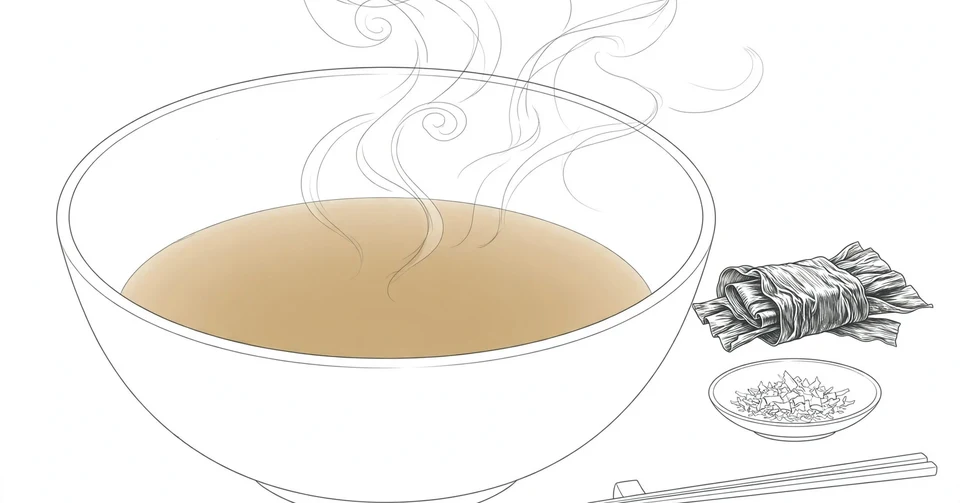
That gap, between eating a thing for centuries and naming it, is the interesting part. Cooks knew the effect intimately and built their stocks, sauces and cheeses around it. What they lacked was the idea that umami was a basic taste in its own right, as fundamental as sweetness, rather than a shadow cast by the other four. Closing that gap took one professor, one bowl of soup, and then, oddly, almost another hundred years.
Chefs who work with it describe umami less as a flavour than as a behaviour. It spreads across the whole tongue instead of striking one spot, it lingers for minutes after the food is gone, and it makes the mouth water in a slow, sustained way. It does not shout. It fills in.
A professor tastes something the textbooks missed
Kikunae Ikeda was a professor of chemistry at Tokyo Imperial University, and around 1900 he spent two years studying in Germany. There he ate tomatoes, asparagus, meat and cheese for the first time, and he kept noticing a savoury taste in them that none of the four recognised tastes could explain. Back in Japan, the same taste met him at home. In the spring of 1907 his wife, Tei, brought home a bundle of kombu, the thick kelp that Japanese cooks simmer into dashi, the stock that sits under almost everything. The taste was in the kelp broth too, unmistakable.
Ikeda took the question into his laboratory and worked through large quantities of kelp until he had isolated the substance responsible: glutamic acid, an amino acid. The Umami Information Center records the scale of the effort in one memorable figure, 12 kilograms of kombu yielding 30 grams of glutamate. In 1908 Ikeda published his finding and gave the taste a name built from umai, the everyday Japanese word for delicious. He called it umami, and he was clear about the claim: this was not a blend of the four known tastes, but a fifth thing, basic and separate.
Ikeda also thought like an inventor. He worked out how to turn glutamic acid into a stable, soluble seasoning, monosodium glutamate, and patented the production method in 1908. A year later he and Saburosuke Suzuki founded the company Ajinomoto to sell it, and the small bottle of white crystals began its slow journey around the world's kitchens. Profit was not really the point. Ikeda believed a cheap, reliable savoury seasoning could help ordinary Japanese families eat better, and he treated the discovery as a duty as much as a business.
The partner that makes umami multiply
The discovery had a sequel inside Ikeda's own laboratory. In 1913 his leading disciple, Shintaro Kodama, analysed katsuobushi, the dried bonito flakes that Japanese cooks pair with kombu in dashi, and found a second umami substance, the nucleotide inosinate. Decades later, in 1957, Akira Kuninaka identified a third, guanylate, the umami carrier concentrated in dried shiitake mushrooms.
The deeper discovery was what happens when these substances meet. Glutamate on its own is pleasant. Glutamate combined with inosinate or guanylate is dramatically stronger, an effect scientists call umami synergy. At an equal mix of glutamate and inosinate, the perceived umami runs seven to eight times stronger than either substance gives alone. When researchers analysed the classic ichiban dashi served at one long established Japanese restaurant, the ratio came out at almost exactly that balance, which suggests the chefs had found the optimum by tongue long before the instruments confirmed it.
Once you see the pattern, you see it everywhere. French bouillon marries vegetables to meat. Chinese tang builds on chicken or pork bones with green onions. Italian cooking leans tomato against aged cheese. None of those cooks needed the word umami, and most never heard it. They had the practice, refined over generations, and it amounts to the same chemistry.
Where umami hides around the world
Glutamate appears wherever protein breaks down, so the map of umami is really a map of cooking, ripening and fermenting. Ripe tomatoes are rich in it, which is why a tomato sauce cooked down to sweetness still tastes deeply savoury underneath. Aged cheeses carry more of it the longer they mature, and parmesan sits near the top of the list. In cured ham, the long salting and drying multiplies the glutamate by a factor of around fifty. Dried mushrooms concentrate guanylate, and the fish sauces of Southeast Asia, nam pla in Thailand and nuoc mam in Vietnam, are close to pure savouriness in a bottle.
Fermentation is the most reliable producer of all, and in Japan fermentation usually means koji. The mold at the centre of koji mold, the quiet engine behind Japanese food, spends its life breaking protein into amino acids, glutamate included, which is why miso, soy sauce and mirin all taste the way they do. The same mold feeds the mash of Japanese sake, where its first job is making sugar for the yeast, but the amino acids it leaves behind are part of sake's soft, savoury finish.
The most persuasive evidence that umami is basic, though, is that we meet it before we can choose anything at all. Human breast milk is rich in glutamate, and so is the fluid that surrounds a baby before birth. The fifth taste is not an acquired sophistication, learned at expensive restaurants. It is closer to a first language.
Why the West waited a century
If the evidence was sitting in every soup pot, why did textbooks in Europe and America go on listing four basic tastes for so long? Partly because the West met umami as a product before it met umami as an idea. MSG was filed away as a flavour enhancer, a seasoning, something added, rather than the marker of a taste the tongue was built to detect. Ikeda's claim also had to compete with a tidy four taste model that had been taught for generations, and tidy models die slowly.
The turning point came from biology. In 2000, researchers at the University of Miami reported receptors on the tongue that respond to umami substances, and within two years other teams had pinned down the receptor itself, a pairing of taste proteins that locks onto glutamate. A taste with its own dedicated receptor is hard to argue with. Around the same years, chefs in London and New York began building dishes and even whole menus around the word, and umami finally entered English as something more than a footnote about Japanese food. The scientific history of the taste makes slightly humbling reading: the evidence was published in 1908, and the permission to take it seriously took about ninety years to arrive.
A fair word on MSG
Because MSG is pure umami in a bottle, it attracts arguments that the taste itself never does. The chemistry is worth keeping straight: the glutamate in MSG is the same glutamate your body meets in tomatoes, cheese and kombu, and it is handled the same way. Regulators who have reviewed the question land in a similar place. The United States Food and Drug Administration designates MSG as a safe ingredient, and a study it commissioned found only transient, mild symptoms in a few subjects, and only when the MSG was consumed in unrealistically large quantities. Europe's food safety authority reviewed glutamate additives in 2017 and answered with a safe daily intake level rather than a ban. None of that makes the seasoning compulsory, and nobody has to like it. It does mean the fear around it is considerably larger than the evidence.
The taste also has a practical dividend that has nothing to do with controversy. Because umami deepens flavour on its own, it lets cooks use less salt without the food tasting punished. In one experiment reported by the Umami Information Center, an egg drop soup boosted with umami kept its appeal with about 30 percent less salt. For an aging country watching its blood pressure, that is not a small thing.
Umami spent centuries hiding in plain sight, inside stocks and cheeses and sauces that nobody thought to interrogate. Japan's contribution was not the taste but the attention: one chemist who trusted his tongue over his textbooks, and a word short enough to travel the world. Once you have the word, dinner is never quite as undescribed again, and you start noticing umami in places it was never announced, which is most of them.
More in Food & Travel
- Katsuobushi Is a Fish You Shave Like a Block of Wood
- Why Kagami Mochi Is Never Cut With a Knife
- Narazuke Pickles Spend Years Asleep in Sake Lees
- Tomozuri Sends a Living Fish to Do the Fishing
- Dashi, the Quiet Stock Under Almost Everything Japan Cooks
- Ayu, the Sweetfish That Rules Japan's Clear Rivers
Latest posts
- Bali Has Its Own Semar, and His Name Is Twalen
- White Silk Means You Made It as a Sekitori
- The Dohyo-Iri Gives a Yokozuna Three Minutes to Own the Ring
- Nobody Commutes to a Heya
- Tokyo Keeps a Hundred Tiny Fujis Called Fujizuka
- One Thousand Three Hundred Years of Ukai Nights on the Nagara River
- Fuji Ko, the Pilgrim Societies That Climbed Mount Fuji Together
- Gensen Kakenagashi, the Onsen Water That Never Circles Back
- Shiko, the Leg Stamp That Starts Every Sumo Day
- Semar, the God Who Chose to Work as a Servant
- Kyushoku and the Japanese School Lunch
- Sumadori, Japan's Smart Drinking for People Who Do Not Drink
- Sake Kasu, the Sake Lees Japan Cooks With Instead of Throwing Away
- Bureiko, the Drinking Party Where Rank Is Left at the Door
- Kagami Biraki, Japan's Ceremony of Breaking Things Open