Chankonabe, the Hot Pot That Feeds a Sumo Stable
· 9 min read
Chankonabe is the protein rich hot pot that sumo wrestlers eat in large quantities to build and keep their weight. Here is what goes into the pot, who cooks it, and where to taste it in Ryogoku, Tokyo.
Chankonabe is the hot pot at the centre of sumo stable life. After a morning of training, the wrestlers of a stable gather around one enormous pot of chankonabe, eat far more than seems reasonable, and then go to sleep. The meal is not a treat or a tradition kept for show. It is the fuel system of the sport.
To understand the pot, it helps to understand the life around it. As our guide to sumo, Japan's oldest sport explains, wrestlers live together in stables under a master, train hard from early morning, and follow a strict order of rank in almost everything they do. Chankonabe fits that world perfectly: one pot, cooked by the juniors, eaten by everyone, in an order decided by seniority.
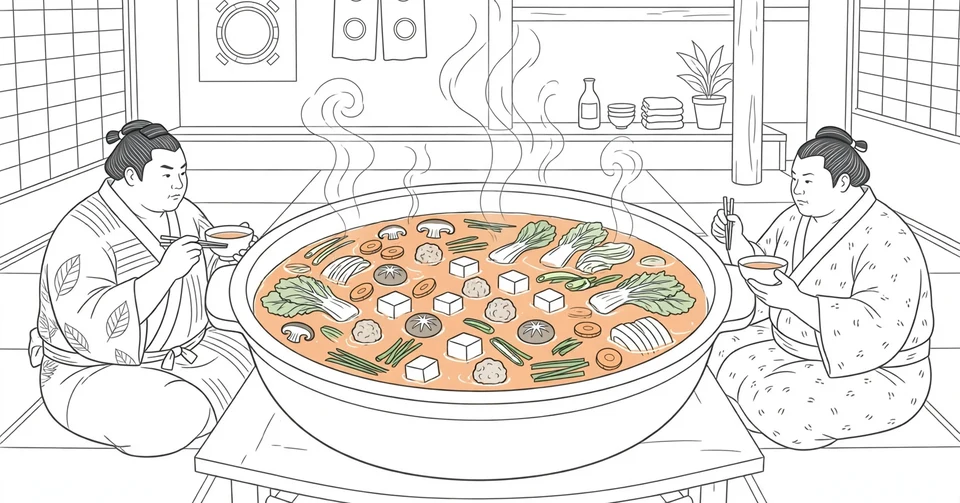
What surprises most people is that chankonabe is not really a fixed recipe. There is no official list of ingredients and no single correct broth. The pot changes with the stable, the season, and whatever the cook found at the market that morning. What never changes is the purpose: a lot of protein, a lot of vegetables, and enough volume to feed very large men.
Chanko means more than the pot
The first thing to clear up is the word itself. In a sumo stable, chanko is the general name for the food the wrestlers eat, all of it. The wrestlers who cook are ranked below makushita, the third highest division, and they take turns in the kitchen on a rotation. A junior who turns out to be genuinely good at it earns the job of chanko ban, the stable cook, and every meal that cook produces counts as chanko. If he makes ramen, it is chanko ramen. If he tries something French, it is chanko French.
Chankonabe is simply the most famous member of that family: chanko served as a nabe, a hot pot. Nabe dishes are cooked in a shared pot of simmering broth, with ingredients added and fished out as everyone eats. Japan has many of them, from oden to shabu shabu, but chankonabe is the one built for appetite. It is designed to be cooked in quantity, eaten in quantity, and cooked again the next day.
There is a quiet logic to it. One big pot is cheaper and faster than dozens of individual meals, it uses whatever is fresh and affordable, and it gets the whole stable eating together at one table. In a sport built on hierarchy, the shared pot is also the place where the stable feels most like a family.
Where the word chanko comes from
Nobody knows for certain where the word chanko came from, and the stable world tells it two ways. The most common explanation splits it into chan and ko. The stable master, the oyakata, is the father figure of the stable, and chan is said to come from a word for father. The ko are his children, the young apprentices he feeds and raises until they master the sport. Put together, chanko is the food of the father and his children, which describes the stable dinner table rather well.
The second story looks further away. On a regional tour in Nagasaki, so the story goes, wrestlers cooked seafood in a thin Chinese metal pot called a chan guo, and the name of the pot travelled home with them and stuck to the food. Nagasaki had deep trading ties with China, so a borrowed pot is not unlikely.
Both stories may be wrong, and neither can be proven. I find the father and children version hard to resist, mostly because it matches what the meal actually does. But it is worth holding both lightly, the way the stable world itself seems to.
What goes into a pot of chankonabe
A pot of chankonabe starts with broth, and the broth is where each stable signs its name. The flavour base is usually one of three seasonings: miso, soy sauce, or salt, built on dashi or chicken stock, often with sake or mirin added for depth. Beyond that, the rule is that there is no rule. The cook works with what is available.
Into the broth goes protein, a great deal of it. Chicken is the classic choice, often quartered with the skin left on, or minced and rolled into meatballs with ginger. Fish goes in too, sometimes fried and shaped into balls. There is tofu, and there are vegetables in bulk: daikon radish, bok choy, cabbage, carrots, mushrooms, leeks, whatever fills the pot well. The result is rich in protein and, for all its size, built from ordinary, healthy ingredients.
One old custom shaped the menu for years. Wrestlers traditionally avoided meat from four legged animals, such as beef and pork, because in sumo a wrestler who touches the ground with his hands and ends up on all fours has lost. Eating four legged meat felt like bad luck. Chicken, standing upright on two legs like a winning wrestler, was the safe and favoured meat. The chankonabe served during tournaments is still made exclusively with chicken for exactly this reason. Modern stables are more relaxed, and beef and pork do appear, but the old reasoning tells you a lot about how deeply superstition and food are mixed in this sport.
The contrast with the other end of Japanese dining is part of the charm. Where kaiseki, Japan's multi course art of dining is all restraint, small portions, and careful sequence, chankonabe is abundance in a single pot, eaten communally and without ceremony. Both are serious food cultures. They just answer different questions.
Eating by rank, then sleeping it off
Chankonabe is served according to seniority. When the pot is ready, the senior wrestlers eat first, along with any guests of the stable, and they take the first and best choice of what is in it. The junior wrestlers, including the ones who cooked, eat after them and take whatever is left. It sounds harsh, and in a way it is, but it is the same order that governs training, chores, and almost everything else in the stable. The juniors are not forgotten, either. There is always more broth, more rice, and often a second pot.
The pot is only half the system. Alongside the chankonabe, wrestlers eat huge bowls of rice, bowl after bowl, and when almost nothing is left in the pot, the remaining broth, now full of flavour from everything cooked in it, is used to finish noodles or more rice. Nothing is wasted.
Then comes the part outsiders find strangest: the nap. After the midday meal, the wrestlers sleep. This is deliberate. Training on an empty stomach in the morning, a huge protein rich meal at midday, and then sleep is the stable's method for building and keeping mass. Most top division wrestlers weigh well over 130 kilograms, and that weight does not appear by accident. It is trained, eaten, and slept into place, and chankonabe is the middle step of the three.
A Meiji era answer to a growing stable
The communal pot itself is a relatively young idea. Before the early 1900s, each wrestler in a stable was served his meal individually. The change is credited to the Dewanoumi stable, home of Hitachiyama, the 19th yokozuna and one of the great champions of the Meiji era. His stable grew so popular that recruits flooded in, and feeding them one by one became slow and expensive.
The hot pot solved several problems at once. It cut food costs, it cut the time needed to serve a room full of hungry apprentices, and it put the master at the same table as his wrestlers, where he could watch over their condition. The wrestlers got a meal packed with protein from chicken, fish, and tofu, and vitamins from the vegetables. Other stables copied the idea, and chankonabe spread across the sumo world.
Each stable then did what families do with a shared dish: it made the recipe its own. Japan has dozens of stables, and each guards its own chankonabe flavour, its own balance of broth and ingredients, passed down from one generation of cooks to the next. Ask a retired wrestler about his stable's pot and you are asking about his upbringing.
Tasting chankonabe in Ryogoku
For anyone who is not a wrestler, the place to taste chankonabe is Ryogoku, the Tokyo district that has been the centre of the sumo world for more than a century. The Kokugikan, the national sumo stadium, stands there, many stables are based in the surrounding streets, and the area is full of restaurants serving the dish. A guide to the district on japan-guide.com notes that many of these restaurants are managed by retired wrestlers, men who cooked the pot as juniors and ate it for twenty years.
That last detail matters. A retired wrestler running a chanko restaurant is not trading on a theme. He is cooking the food of his own youth, often his own stable's version of it. One well known example is Chanko Kirishima in Ryogoku, opened by a former wrestler, and the trade is old: the first retired wrestler's chanko restaurant, Kawasaki Chanko, opened in Ryogoku in 1937. A detailed account of the dish and its stable traditions on Musubi Kiln's journal describes how the same rules still apply in these kitchens, where the food is expected to be made the stable way.
Restaurant portions are generous but human. You order the pot by flavour, miso, soy sauce, or salt, choose your ingredients, and eat it at the table as it simmers, usually finishing with noodles or rice in the broth, exactly as the stable does. It is one of the easiest Japanese meals to share and one of the hardest to leave hungry.
For me, the appeal of chankonabe is that it refuses to be just a recipe. It is a feeding system, a family ritual, a piece of Meiji era practicality, and a retirement plan, all in one pot. The wrestlers change, the rankings change, and the stable's young cook changes every few years. The pot stays.
More in Food & Travel
- Dashi, the Quiet Stock Under Almost Everything Japan Cooks
- Ayu, the Sweetfish That Rules Japan's Clear Rivers
- Sake Kasu, the Sake Lees Japan Cooks With Instead of Throwing Away
- Kopi Tubruk and the Indonesian Way to Drink Coffee
- Subak and the Rice Terraces of Bali
- Nara Deer and the Sacred Animals of the Old Capital
Latest posts
- Fuji Ko, the Pilgrim Societies That Climbed Mount Fuji Together
- Gensen Kakenagashi, the Onsen Water That Never Circles Back
- Shiko, the Leg Stamp That Starts Every Sumo Day
- Semar, the God Who Chose to Work as a Servant
- Kyushoku and the Japanese School Lunch
- Sumadori, Japan's Smart Drinking for People Who Do Not Drink
- Bureiko, the Drinking Party Where Rank Is Left at the Door
- Kagami Biraki, Japan's Ceremony of Breaking Things Open
- Capsule Hotels and Sleeping in a Pod in Japan
- Hiroshima and the City That Chose Peace
- Shinnenkai, Japan's New Year Parties That Start the Year Over
- Punakawan, the Clown Servants Who Steal Every Wayang Show
- Kashikiri, the Private Onsen Bath You Book by the Hour
- Nomi-Hara, When After-Work Drinks in Japan Turn Into Harassment
- Shio Koji, Japan's Salted Ferment That Seasons Everything