Borobudur, the World's Largest Buddhist Temple
· 10 min read
Borobudur temple is the largest Buddhist temple on Earth, a 9th-century stone mountain in Central Java covered in 1,460 relief panels. This is what it is, how it was lost and found, and how to visit it.
Borobudur temple is the largest Buddhist temple in the world, and it does not look like a temple at all. From a distance it looks like a stepped stone hill rising out of the rice fields of Central Java, ringed by volcanoes. Up close it is a mountain built by hand: nine terraces of dark volcanic stone, 1,460 carved relief panels, and 72 bell-shaped stupas.
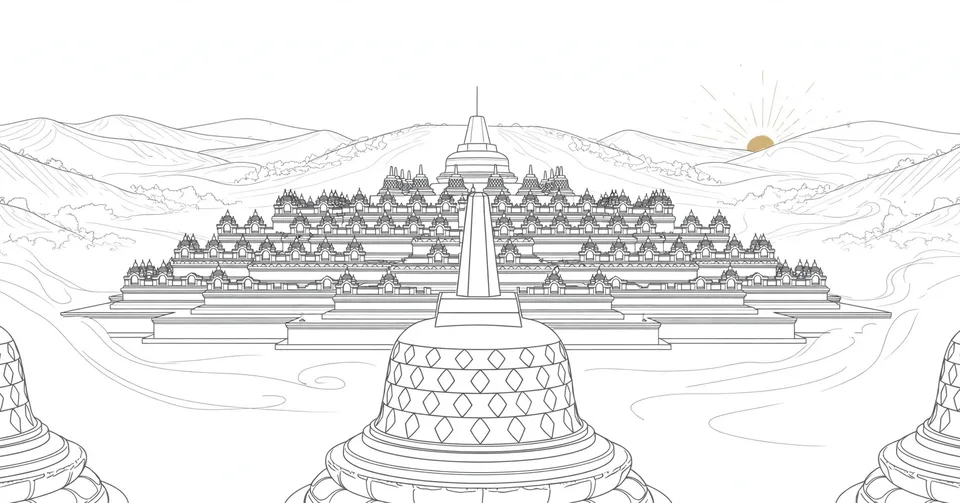
Borobudur temple was built in the 9th century, abandoned for hundreds of years, buried under volcanic ash and jungle, and then found again. Today it is a UNESCO World Heritage Site and the most visited monument in Indonesia. If you go to Central Java, this is the one place you do not skip.
It rewards a slow visit. Borobudur temple is not a building you walk into and admire from the inside. It is a path you climb, and the climb is the point. Every terrace teaches something, and the top teaches the most by showing the least.
What Borobudur temple is
Borobudur temple stands near the town of Magelang in Central Java, about 40 kilometres northwest of Yogyakarta. It was built around 825 AD under the Sailendra dynasty, the same dynasty that built the great temples of the region. Nobody knows exactly who ordered it built, or how long it took. Estimates run from a few decades to most of a century. The story of its construction and rediscovery reads like an adventure in its own right.
The base is about 123 metres on each side, and the structure rises in three tiers: a hidden foot at the bottom, five square terraces above it, three circular terraces, and a single large stupa at the very top, empty, open to the sky.
The 1,460 narrative relief panels on the walls tell stories. The lowest levels show the world of desire and the law of cause and effect, with scenes of everyday life. Higher up, the panels tell the life of the Buddha and the journey of the pilgrim Sudhana, who visits 53 teachers in search of enlightenment. The carvings are not decoration. They are the textbook, written in stone for people who could not read.
The 72 stupas on the circular terraces are the most famous part of Borobudur temple. Each is shaped like a bell, pierced with diamond-shaped holes, and each contains a seated Buddha statue. One stupa has a statue with its hand reaching out, and visitors have long believed touching it brings good luck. The statues have survived more than a thousand years of rain, ash, and earthquakes, which is luck of a different kind.
How the temple tells a story in stone
Borobudur temple was designed as a mandala, a three-dimensional map of the Buddhist universe, and as a staircase through it. Pilgrims in the 9th century walked clockwise around each terrace, reading the reliefs as they went, and climbed to the next level only when they had finished the one below.
The three tiers match the three worlds of Buddhist cosmology. The hidden foot is Kamadhatu, the world of desire. The five square terraces are Rupadhatu, the world of forms, where the reliefs tell their stories. The three circular terraces and the great stupa are Arupadhatu, the formless world. As you climb, the carvings thin out and stop. The architecture itself is the lesson: the higher you go, the less there is to hold on to.
That is why the temple still works as a place of pilgrimage, even for visitors who are not Buddhist. You do not need to know the doctrine to feel the design. The walk is slow, the stone is warm, and each level opens a wider view of the valleys and volcanoes around it.
Lost, buried, and found again
One of the strangest facts about Borobudur temple is that it was forgotten. By the 14th century, as Islam spread across Java and the centre of power moved east, the temple fell out of use. Volcanic ash from Merapi covered it, jungle grew over it, and for centuries local people knew only that there was a hill with stones in it.
The rediscovery came in the 19th century. In 1814, during the brief British rule of Java, lieutenant-governor Thomas Stamford Raffles heard reports of a great stone monument buried in the jungle near Magelang and sent the Dutch engineer Hermann Cornelius to investigate. His men cut through the jungle and cleared the top. It took months before anyone understood the scale of what was under the trees. Volcanic ash is an old enemy of Javanese monuments: the eruption of Mount Tambora in 1815, on the neighbouring island of Sumbawa, darkened skies around the world and buried whole landscapes in ash.
Full clearing took the rest of the century, and the first serious restoration came in the early 1900s under the Dutch archaeologist Theodoor van Erp. But the great restoration came much later. Between 1973 and 1983, UNESCO led a project that dismantled Borobudur temple stone by stone, cleaned and numbered each block, rebuilt the foundations with modern drainage, and put it all back together. It was the largest restoration UNESCO had ever attempted.
In 1991, Borobudur temple was inscribed on the UNESCO World Heritage List, together with Mendut and Pawon, as the Borobudur Temple Compounds. The inscription recognised what the restorers already knew: this is one of the greatest monuments ever built. The restoration also uncovered 160 relief panels on the hidden foot, buried since the temple was new.
The sunrise question
Ask anyone about visiting Borobudur temple and the first word you hear is sunrise. The classic experience is to climb to the upper terraces before dawn and watch the sun rise over the mist, the stupas silhouetted against a pink sky and the volcanoes appearing one by one. The photographs are famous, and the experience lives up to them on a clear morning.
But a few honest things first. The sunrise is not guaranteed. Central Java has a rainy season from roughly November to March, and on a cloudy morning the sun rises behind a grey wall and the mist never lifts. The dry season, from about April to October, gives you the best odds, and even then a clear dawn is luck as much as planning.
Second, sunrise access is limited and organised: the temple opens early, tickets are limited, and you climb with a group. If you want quiet, the late afternoon, after the day visitors have left, can be just as beautiful, with the stone glowing gold and the crowds gone.
Third, the temple now limits how visitors move on the upper terraces. Climbing onto the stupas is not allowed, and visitor numbers on the top levels are controlled to protect the stone. These rules are easy to resent in the moment and easy to defend once you think about them. Two million visitors a year walk on stone that is twelve centuries old. The rules are what keep Borobudur temple standing for the next twelve.
Go for the sunrise if you can, but do not make the whole trip depend on it. Borobudur temple is worth the visit on a cloudy day, in the rain, at noon, whenever you can get there. It only needs you to slow down and look at it properly.
How to visit Borobudur temple
Yogyakarta is the usual base, about an hour and a half by car, and most visitors come as a day trip. Magelang, the nearer town, is quieter and closer, and it makes a good base if you want to see Borobudur temple at dawn without a very early start. Public buses run from Yogyakarta, but a hired car with a driver is the common choice, and it lets you combine Borobudur with Mendut and Pawon in one morning.
Tickets are sold online and at the gate, with separate prices for Indonesian and foreign visitors, and the sunrise visit is a separate ticket with limited numbers. Book it in advance if that is your plan, and check the current rules before you go, because the visitor system has changed several times in recent years. The temple park also hosts the Borobudur Marathon every November, when thousands of runners start at dawn in the shadow of the temple.
Wear shoes you can walk in and clothes that cover your shoulders and knees, out of respect for a sacred site. Bring water, sunscreen, and a hat. The climb is not difficult, but there are many steps, and the sun is strong by mid-morning. Allow at least two to three hours inside the grounds. One hour is enough to climb to the top and come down, but it is not enough to look at anything. The reliefs reward attention: a market scene, a ship with outriggers, a musician, a mother holding a child. They are pictures of a world that existed twelve hundred years ago.
Three temples, one journey
Borobudur temple does not stand alone. It is part of a straight line of three temples, all built in the same century, all facing the same direction. Mendut, about three kilometres east, is the smallest and oldest, and holds a great seated Buddha flanked by two bodhisattvas. Pawon, between the two, is barely larger than a house.
The three temples stand on a single axis, and scholars believe the pilgrimage once began at Mendut, passed through Pawon, and ended at Borobudur. Walking that line today takes you through villages, rice fields, and workshops where stone carvers still work the same volcanic rock the builders used.
Why Borobudur temple still matters
There are bigger temples in the world, and older ones, and more famous ones. Borobudur temple matters for a different reason. It is the most complete picture we have of a civilisation that built in stone what it believed: that life is a climb, that the climb is guided by stories, and that the top is not a throne but an open sky. Indonesia keeps other ancient wonders too, from the dragons that still walk the island of Komodo to the temples of Bali, but Borobudur is the one that explains the rest.
Borobudur temple survived abandonment, burial, earthquakes, and two million visitors a year, because the stone was good, the design was honest, and people from many countries decided it was worth saving. That is a hopeful story for a monument, and for the people who visit it.
Go slowly. Read the walls. Climb to the top, look at the volcanoes, and look back down at the terraces you climbed. The temple is a map of a journey, and for a few hours, it is your journey too.
More in Food & Travel
- Numazu Deep Sea Aquarium and the Creatures of Suruga Bay
- Numazu Himono and the Art of Dried Fish
- Numazu Port and the Freshest Seafood in Shizuoka
- Bullet Climbing Mount Fuji, the Overnight Ascent Japan Is Trying to Stop
- Climbing Mount Semeru, Java's Highest Volcano
- Tamago Sando and Japan's Konbini Egg Sandwich
Latest posts
- Love Live Sunshine and How Anime Changed Numazu
- Numazu Imperial Villa and Japan's Seaside Imperial Retreat
- Disaster Vending Machines in Japan That Give Their Drinks Away
- The E33G Remote Worker Visa and How to Legally Work from Bali
- Wabi-Sabi and the Japanese Beauty of Imperfect Things
- Women Only Train Cars in Japan and the Problem They Answer
- Maneki Neko and Japan's Beckoning Lucky Cat
- The Baduy People and Life Without Modern Technology
- The Salaryman and Japan's Loyal Office Culture
- Onsen Tattoo Rules in Japan and How They Are Slowly Changing
- Key Money in Japan and Why Renting Costs Four Months Up Front
- Sento, Japan's Everyday Public Bathhouse
- The Fuji Five Lakes and the Best Views of Mount Fuji
- The Obon Festival, Japan's Week for Honouring Ancestors
- Visiting the Ghibli Museum and Ghibli Park in Japan