One Thousand Three Hundred Years of Ukai Nights on the Nagara River
· 11 min read
Ukai, Japan's cormorant fishing, has lit up the Nagara River in Gifu for some 1,300 years. This is how the masters, their birds and a basket of fire still catch sweetfish on summer nights.
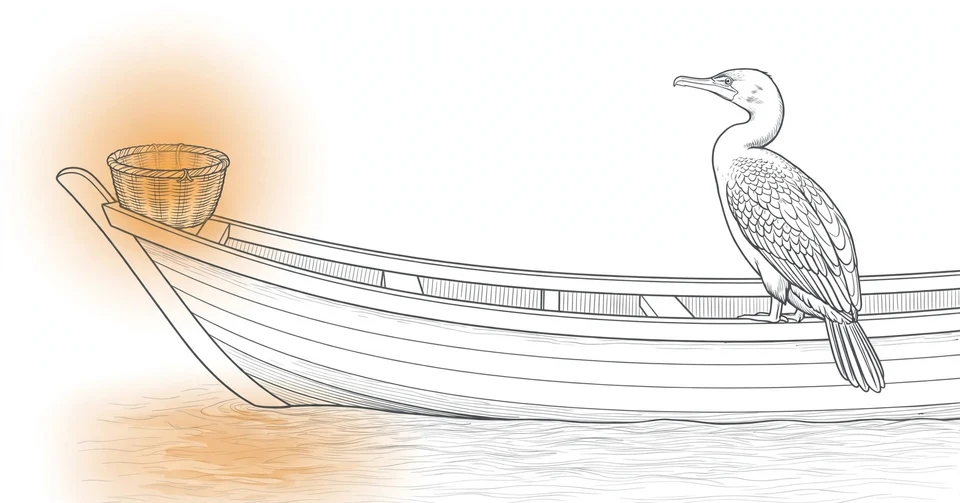
Just after dark on the Nagara River in Gifu, an iron basket of fire swings out over black water from the bow of a long wooden boat, and the night's work begins. Below the flames, a team of cormorants fans out through the lit water, each bird on a cord held by one standing man. This is ukai, cormorant fishing, and by the usual reckoning it has been performed on this river, in roughly this way, for some 1,300 years.
The method sounds like a fable and works like a trade. The fisherman, called an usho, handles ten or more cormorants at once, reading their cords the way a puppeteer reads strings. The birds dive, chase and swallow, but a ring at the base of each throat stops the best fish from going down, so the catch collects in the bird's gullet until the master draws it in and empties it by hand. The prize is the ayu, the sweetfish that rules Japan's clear rivers each summer, drawn out of the dark by firelight.
It would be easy to file ukai away as a performance staged for visitors, and visitors certainly come. But the birds are really fishing, the fish are really eaten, and the men steering them hold a hereditary post under the Imperial Household Agency, which is not the kind of employer a folk dance usually has. Ukai is a working method that outlived its economic necessity and became, almost by accident, one of the oldest continuously running shows in Japan, except that nobody involved calls it a show.
How ukai works, bird by bird
The birds are umi-u, Japanese cormorants, a sea cormorant larger and stronger than the river species, built for working in current. They are not pets and they are not machines. A good bird has moods, favourites among its teammates and days when it would rather sit on the bow and watch, and the master's skill lies as much in managing those temperaments as in handling the cords.
Each evening of the season, the master selects ten to twelve healthy birds for the night. Around the base of each bird's throat sits a loose snare, tied with a judgement built over years. The fit is the whole secret of ukai. Small fish slip past it and are swallowed, and those small fish are effectively the bird's wages, the reason it keeps diving. A larger ayu cannot pass. It lodges in the gullet, where a bird can hold as many as six fish at once, until the master pulls the cord in, takes the bird in hand and gently presses the catch out. Done badly, this would injure the bird and end a career. Done by a master, it takes seconds and the bird is back in the water, hunting again.
The cords, called tenawa, are strong, but there is a deliberate weakness in the system. If a cord snags under a rock mid-dive, a trapped bird would drown, so the master can break the line instantly with a practised snap. It is a small detail that says a lot about ukai. The bird's life is worth more than the gear, and the technique has been refined over centuries by people who understood that a drowned cormorant catches nothing, tonight or ever.
The third partner in the method is fire. At the bow of the boat hangs an iron basket, the kagari, carried on a pole and filled with split pinewood that burns fast and bright. The flame, the kagaribi, lights the master's way and pulls the ayu toward the surface, where the birds are waiting. The crew beat the side of the boat with a steady rhythm, which keeps the cormorants alert and moving. Fire, noise, feathers and cordage: ukai is low technology arranged with extreme competence, and it has stayed low technology on purpose, because the arrangement is the heritage.
The usho, masters with an imperial title
Six usho currently work the Gifu stretch of the Nagara, and their job title is unlike any other in fishing. They are Cormorant Fishermen of the Imperial Household Agency, appointed under the agency's Board of Ceremonies, and the post passes from father to son. Even reaching the starting line is slow. It takes at least ten years to become a cormorant fishing master, years spent as an apprentice in the boat, learning the river, the birds and the cords in that order.
The imperial connection is not ceremonial decoration. The first sweetfish of each season are still sent to the capital, as they have been for centuries, and formal Imperial viewings, the goryo ukai, are held eight times a year, though the public can watch on those nights too. The masters at Seki, downstream on the same river, share the imperial appointment, which makes the Nagara the only river in Japan where the emperor effectively keeps fishermen on staff. The history of cormorant fishing on the Nagara River is well documented, and the imperial thread runs through all of it.
That thread did the river a favour nobody planned. Because the fishing belonged to the Imperial Household, the Nagara was treated as a protected river, guarded against the pollution and overfishing that degraded so many Japanese waterways. The ayu stayed, the water stayed clear enough to be famous for it, and so the ukai stayed commercially plausible long after rival methods appeared. Patronage preserved the technique, and the technique, in return, preserved the river.
On the boat, the master does not work alone. A cormorant boat, the ubune, runs about 13 metres long and carries a crew of three. The usho stands at the bow with the cords and the fire. In the middle sits the nakanori, a rower and assistant who is very often the master's own son, absorbing the trade from the inside before he inherits it. At the stern, the tomonori steers. Three people, a dozen birds, one flame: when the boat is working well it has the quiet coordination of a much rehearsed piece of music.
A night on the water
The ukai season runs from May 11 to October 15, almost every night for five months. There are two standing exceptions. Fishing stops when the river runs too high, because ukai in floodwater would be dangerous theatre rather than fishing, and it rests on the night of the harvest moon, traditionally so the moon can have the river to itself. Everything else is weather permitting and mostly it permits, which means the masters and their birds work a schedule that would exhaust most professional athletes.
The night opens with three fireworks over the river, the signal that fishing has begun. One by one the six boats come down the current, fires lit, birds working the lit water in front of each bow. Spectators watch from yakatabune, the roofed viewing boats, where dinner is served while the boat drifts alongside the fishing, close enough to hear the cords hiss and the birds splash. Before the fishing starts, a dancing boat with five dancers makes its rounds to entertain the waiting audience, and a refreshment boat calls at each vessel selling snacks and drinks. The stretch of river runs below the wooded hill crowned by Gifu Castle, so the whole scene plays out under a floodlit silhouette that has watched it for centuries.
The finale has a name: sougarami. Near the end of the night, the six boats stop taking turns and line up side by side, six fires abreast, and sweep down the river together in one bright front, driving the last fish ahead of them. It is the moment every camera on the viewing boats has been waiting for, and it is also genuinely good fishing, a net made of light and birds instead of rope. Then the fires come down, the catch is shown, and the river goes dark again until tomorrow.
Warlords, poets and one sad haiku
Ukai is old enough that its first records are foreign ones. The Book of Sui, a Chinese dynastic history completed in 636, already describes the Japanese fishing with cormorants, which means the method was established enough to be reported abroad well over a millennium ago. By the Heian period, watching ukai had become an amusement of aristocrats, who came to the river at night to be entertained by other people's skill, much as the passengers on the yakatabune do now.
Power liked it too. In 1568 the warlord Oda Nobunaga, receiving a messenger from his rival Takeda Shingen, had a new boat built and staged ukai as hospitality, then chose ayu with his own eyes and sent them to the guest as a gift. Tokugawa Ieyasu came to Gifu after the Siege of Osaka in 1615 and enjoyed the fishing and the sweetfish so much that the masters were granted privileges, including freedom of movement on the river, and began presenting ayu sushi to the shogun. Diplomacy by fish is an old Japanese art, and ukai was one of its finest instruments.
The most honest review ever written of ukai is seventeen syllables long. The poet Matsuo Basho watched the fishing and wrote: "Exciting to see, but soon after, comes sadness, the cormorant boats." Anyone who has watched a bird come up with a fish it is not allowed to swallow understands the second half of that haiku. The English language borrowed a smaller souvenir. Japanese speakers say unomi, to swallow like a cormorant, when someone accepts a claim whole, without chewing on it first. Charlie Chaplin, who came to watch twice, had no such reservations. He called the skill of the fishing masters wonderful, and on that point the silent film star and the haiku poet were watching the same river and simply reporting different halves of it.
Ukai beyond the Nagara
The Nagara is the famous home of ukai, but it is not the only one. Today cormorant fishing is performed in thirteen cities across Japan. Inuyama runs ukai on the Kiso River, under its own castle. Kyoto has it twice over, on the Uji River at Uji and on the Oi River at Arashiyama, where the viewing boats drift through one of the most painted landscapes in the country. Seki, on the Nagara itself, keeps the Oze ukai, smaller and quieter than Gifu's. Further afield there are birds working rivers in Yamanashi, Hiroshima, Yamaguchi, Ehime, Oita and Fukuoka, each with its own local style and its own small audience.
Not every river kept its birds. Ukai once belonged to the everyday history of many more waterways than thirteen, including the Kano River in Numazu, where the fishing is no longer performed and the river's ayu are pursued these days by anglers standing in the current. Rivers lost their ukai for ordinary reasons. The fish thinned, the young men left, cheaper methods won, and a skill that takes a decade to learn and a lifetime of evenings to practise does not survive on nostalgia alone. Gifu's version endured because the imperial appointment gave it a floor of support, the protected river kept its fish, and the viewing boats turned the whole thing into an economy that could pay its masters.
That is, in the end, what the 1,300 years really measure. Not the age of a trick with birds, but the length of an unbroken chain of evenings: a master choosing his birds at dusk, a son in the middle of the boat learning by watching, a fire lit over dark water, and a river kept clean enough, by luck and by patronage, for the fish to keep rising toward the light. Techniques this old usually survive in museums. On the Nagara, ukai survives by going to work again tomorrow night, and there is something quietly moving about a heritage that still has to catch its dinner.
More in Culture & Society
Latest posts
- Every Prefecture Argues About What Goes in Ozoni
- KRL Commuterline and the Trains That Move Jakarta
- Kecap Manis and the Sweet Soy Sauce of Indonesia
- In Mamoiada, Two Hundred Families Still Make Wine at Home
- Shochu and the Quiet Spirit of Japan
- A Dried Shiitake Is Louder Than a Fresh One
- Loma Linda's Long Lives Run on Saturdays
- Maruten Numazu and the Towering Kakiage Bowl of the Port
- The Three Sisters Grow Better Together
- Tatamiishi Terraces Filter a River Through Stone
- Wasabi-Zuke Puts the Whole Plant in Sake Lees
- Konyoku Is Still Out There, Past the Last Train Station
- Dry January Lasts a Month on Purpose
- Ikaria Runs on Island Time
- Why Nicoya Cooks Its Corn in Lime