Mountain Huts on Mount Fuji, the Only Beds Above the Clouds
· 8 min read
Mountain huts are the only legal place to sleep on Mount Fuji, where camping is banned. Here is what a night in one feels like, what it costs in 2026, and how the new gate rules made booking one essential.
There is no campsite on Mount Fuji. Pitching a tent anywhere on the mountain is prohibited, so if you want to sleep above the clouds on Japan's highest peak, there is exactly one option: the mountain huts that line its four climbing trails. They are not hotels, and nobody up there pretends otherwise. But for one short summer season each year, these simple lodges are the only legal beds on the mountain.
That makes the mountain huts far more than a convenience. A hut booking shapes how your body handles the altitude, whether you reach the summit in time for sunrise, and, since the rule changes of 2024 and 2025, whether the trailhead gate will even let you through at night. On the modern Fuji, the climb is planned around the hut, not the other way round.
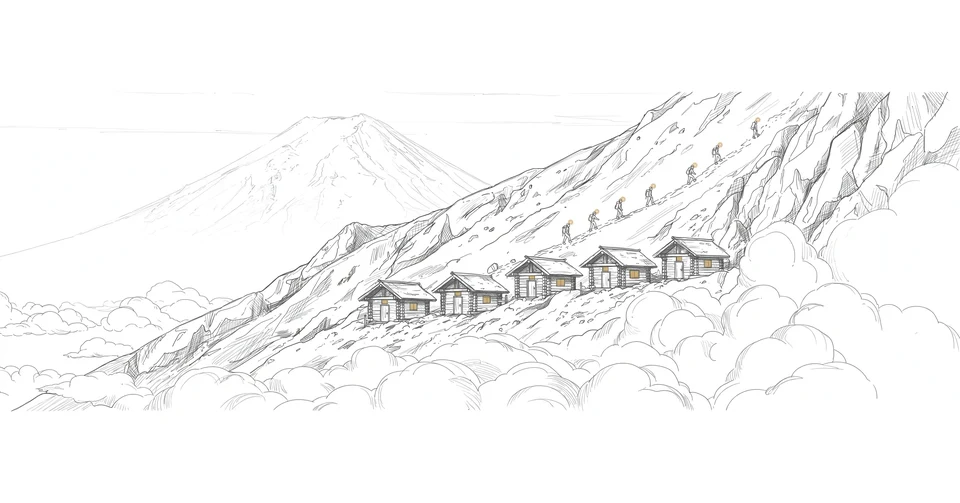
Most climbers meet the mountain huts on the Yoshida Trail, the route used by roughly half of all Fuji climbers, where the huts cluster thickest between the seventh and eighth stations. The Fujinomiya, Subashiri and Gotemba trails each have their own thinner line of huts. Wherever you climb, though, the pattern of the night is much the same, and it has barely changed in generations.
Why the mountain huts are the only way to sleep on Fuji
The ban on tents is not a suggestion. The official Mount Fuji climbing website states plainly that tent pitching is not permitted on the mountain and tells climbers to stay in a mountain hut instead. The upper mountain is a special protection area of a national park, and the rules are enforced by real people at real gates, not just signs.
There is a practical side to it as well. Above the fifth stations there is no flat, sheltered ground worth the name, only volcanic gravel and slope. Even in midsummer, the temperature at the 3,776 metre summit can drop close to zero before sunrise, and the official site warns that climbers caught by thunderstorms or violent wind should take shelter in the nearest hut. The mountain huts double as the mountain's emergency shelter network, which is another reason the authorities would rather have every sleeping climber inside one, counted and accounted for.
So the choice is simple. You climb Fuji in a single day push, you turn back, or you book one of the mountain huts and sleep the way pilgrims have slept on this mountain for centuries.
What a night in the mountain huts actually feels like
A typical hut night starts earlier than most people expect. Climbers leave the fifth station around midday, walk three to four hours, and reach the mountain huts of the seventh or eighth station by mid to late afternoon. Dinner comes early, often around five or six in the evening, and it is mountain food in the best sense: a hot plate of curry rice is the classic, eaten at long tables with strangers who are all doing exactly what you are doing.
Then the lights go out, sometimes as early as eight. You sleep in a shared room, in a futon or bunk space laid out side by side with everyone else's, close enough to hear your neighbours breathe. The official climbing site recommends bringing earplugs and an eye mask, which tells you most of what you need to know about privacy. Nobody books the mountain huts for the sleep itself. You book them for warmth, calories, a few horizontal hours at altitude, and a head start on the summit.
The wake up call comes in the small hours, often around two in the morning, earlier at the lower huts. Headlamps on, boots laced in the dark, and the line of lights begins moving up the final slope so the room can stand on the summit for the goraiko, the sunrise. Breakfast is part of most meal plans, served before departure or packed to carry, depending on the hut.
I find something honest in all this. A hut sells you nothing you do not need: a roof, a hot meal, a flat place to lie down. Everything else on Fuji is weather and effort, and the mountain huts have never pretended to change that.
Where the mountain huts sit on the trails
The sleeping huts are concentrated high on the mountain, mostly between the seventh and eighth stations at roughly 2,700 to 3,400 metres, because that is where a night's rest does the most good. From an eighth station hut, the summit push takes about two hours. From the seventh, longer. There are even a few mountain huts on the summit ring itself, at about 3,710 metres, where the night is shortest and the air thinnest.
The Yoshida Trail has the most mountain huts by a wide margin, one reason it suits first timers. It climbs the northern flank of the mountain, the side that faces the Fuji Five Lakes, so its huts catch the sunrise side of Fuji. Fujinomiya, the shortest and steepest trail, packs its huts into a shorter climb. Subashiri starts in forest and merges with the Yoshida near the top, sharing its upper huts. Gotemba, the longest trail of the four, has the fewest places to sleep, and its climbers plan their night more carefully because of it.
One detail surprises many first timers: there are effectively no mountain huts for sleeping low on the mountain. Below the upper stations you will find rest stops and shops at the fifth stations, but the sleeping line starts high. Your bed on Fuji is always most of the way up the mountain.
What the mountain huts cost in 2026
Prices have moved a lot in recent seasons, so treat any older guidebook figure with care. Guides such as MATCHA's climbing guide still quote the traditional range, from about 5,000 yen for a bed without meals and 7,000 to 10,000 yen with two meals. Rates actually charged in the 2026 season at popular Yoshida huts ran higher, roughly 12,000 to 20,000 yen per person with dinner and breakfast, and the summit huts charged more than 25,000 yen. Always confirm the price on the hut's own booking page before you commit.
Two money habits matter more than the exact figure. First, most mountain huts do not accept credit cards, so payment and everything else on the mountain runs on cash. Second, the bed is not the only cost of the night: the toilets at the huts charge around 100 to 300 yen in coins, and bottled water and snacks carry mountain prices. A pocket of 100 yen coins is standard Fuji equipment.
The new rules turned mountain huts into a key
Until recently, a hut was a comfort. The rule changes of 2024 and 2025 made it something closer to a key. All four trails now charge a 4,000 yen hiking fee, collected since 2025, and climbers register online in advance. On the Yoshida Trail there is also a daily cap of about 4,000 climbers. Most importantly, the trailhead gates close from two in the afternoon until three in the morning, and the only climbers allowed through during those hours are those with a confirmed mountain hut reservation.
The target of the gate is the overnight sprint known as bullet climbing, climbing through the night without rest to catch the sunrise. With the gate shut, that style of climb is effectively over for anyone without a hut booking. In practice, this means the mountain huts now sell out: weekend and Obon holiday dates in the short season, which runs from early July to early September, can fill weeks ahead. The sensible order is to book your hut first, then arrange transport to the fifth station around it.
The mountain huts began as pilgrim shelters
None of this is new, exactly. Research on the Yoshida Trail's old stone huts, published in the Journal of Architecture and Planning, describes the stone huts built for Fuji pilgrims as the original form of today's mountain huts. Stone huts already stood above the fifth station in the early Edo period, and they multiplied as the Fuji ko pilgrim societies made their worship ascents in great numbers. Remarkably, the huts of today stand in almost the same places as the huts of the late Edo period. The stations were sensible stopping points three hundred years ago, and the mountain has not changed its mind since.
What has changed is the reason for climbing. A 1955 survey cited in the same research tradition found only two percent of climbers were still on religious pilgrimages. The pilgrims became tourists, the stone walls became wooden lodges with double bunks and water filters, but the shape of the night, walk, eat, sleep, rise in the dark, stayed where the pilgrims left it.
Sleeping where the pilgrims slept
Stand outside a hut at dusk and Fuji makes a quiet argument for itself. The day climbers are gone, the wind drops, and a line of warm windows glows on a slope that has hosted tired walkers for centuries. The mountain huts are not the comfortable way to climb Mount Fuji. They are simply the way, the only beds above the clouds, earned one station at a time.
More in Food & Travel
Latest posts
- Manza Onsen Bathes at 1,800 Metres
- Irezumi Was an Art Before It Was a Warning
- The Oshi Kept Fuji's Pilgrims Fed, Housed, and Devout
- Japan's Population Decline and the Villages It Leaves Behind
- KRL Commuterline and the Trains That Move Jakarta
- Loma Linda's Long Lives Run on Saturdays
- Maruten Numazu and the Towering Kakiage Bowl of the Port
- The Three Sisters Grow Better Together
- Half the Old Springs in Japan Thank Kobo Daishi
- Tatamiishi Terraces Filter a River Through Stone
- Wasabi-Zuke Puts the Whole Plant in Sake Lees
- Konyoku Is Still Out There, Past the Last Train Station
- Karo Is the Tengger's Other Great Gathering
- Dry January Lasts a Month on Purpose
- Urashima's Dragon Palace Had a Name, Ryugu