Fukinagashi Turns a Weaver's Threads Into Rivers of Color
· 18 min read
A fukinagashi is a long paper streamer that turns the threads of Orihime the weaver into rivers of colour above the shopping streets of Sendai every August.
Walk into the covered shopping streets of Sendai on an August morning and the first thing you notice is not the shops. It is the ceiling. Long ribbons of coloured paper hang in rows above your head, swaying gently in the draught of the crowd, and for a moment the street stops feeling like a street at all. It feels like standing at the bottom of a slow river. That ribbon is a fukinagashi, and it is the single most recognisable sight of the largest Tanabata festival in Japan.
A fukinagashi is a streamer made of Japanese washi paper, cut into long strips and hung from a tall bamboo pole so that it falls like a thread dropped from the sky. At Sendai Tanabata, the streamers hang in sets of five, each one about three to four metres long, and they repeat hundreds of times along the arcades until the whole street glows red, gold, blue and green. They are beautiful, but they are not only decoration. Each fukinagashi stands for the threads of Orihime, the weaver of the Tanabata legend, and for skill in crafts of every kind.
What makes the sight remarkable is that every fukinagashi is handmade, new every year, by the shopkeepers of the street below it. A shop spends months of labour and a large sum of money on paper that will hang for three days and then come down. That is the story of the fukinagashi: a practical wish, made by hand, hung over the heads of strangers.
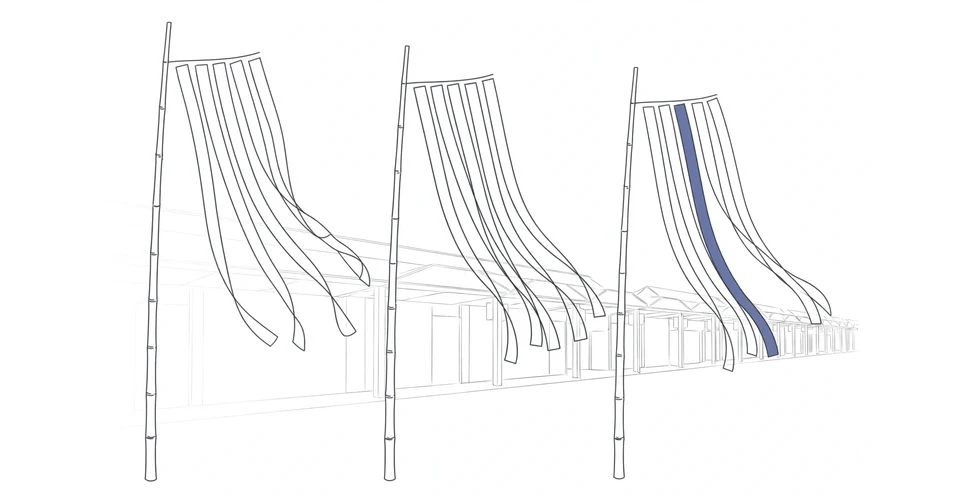
The name itself describes what you see. Fukinagashi means something blown and left to flow in the wind, and the streamers do exactly that. A fukinagashi does not hang still. The strips turn, lift and settle with every movement of air in the arcade, so the pattern above you is never the same twice. A visitor who stands still for a minute will see the whole street change colour as the strips catch the light one way and then another.
What a fukinagashi actually is
Strip away the festival and a fukinagashi is a simple object. It is a set of long, narrow strips of washi paper, fixed at the top to a round paper ball or a small frame, and hung from a bamboo pole that can be more than ten metres tall. The pole is cut in the mountains just two days before the festival, and the fukinagashi strips fall from near its top almost to the heads of the crowd. By custom, the streamers hang in sets of five, a number that repeats along every arcade in the city centre.
The scale is what turns a simple object into a spectacle. Discover Sendai, the city's official visitor guide, puts the length of each fukinagashi at about four metres, and counts more than 3,000 Tanabata decorations across the city during the festival. A single large decoration can weigh up to five kilograms, and the bamboo poles stretch across the street in rows so long that you cannot see the end of them from where you stand. One fukinagashi is a craft. A thousand of them is a landscape.
The fukinagashi is part of a larger decoration called a sasakazari, a bamboo decoration. The pole, the ball at its top, the five streamers and the smaller ornaments hanging among them all form one piece, and each shop makes its own piece from scratch. The kusudama, the round ball of paper flowers that now crowns many of the poles, is a newer addition, invented in Sendai around 1946 by a man named Mori Gongoro, who was inspired by the dahlias in his garden. Within a generation it had become as traditional as the streamers themselves, which tells you something about how this festival treats new ideas. It absorbs them.
It is worth saying plainly what a fukinagashi is not. It is not a flag, and it is not a banner carrying a message. No words are written on it. Its meaning is in its shape alone: long threads, falling straight down, moving in the wind. That is the whole message, and the festival trusts you to read it.
The weaver behind the threads
The threads belong to Orihime, the weaver of the Tanabata legend. In the story, Orihime wove beautiful cloth on the banks of the Milky Way until she met Hikoboshi, the herdsman, and fell in love. The two neglected their work, her father separated them across the river of stars, and they were allowed to meet only once a year, on the seventh day of the seventh month. That single night is Tanabata, and the whole festival is built around it.
The fukinagashi is the most direct picture of that story in the entire festival. The long strips of paper are the threads on Orihime's loom, let loose to fall through the air. When you walk under a fukinagashi, you are walking under the weaver's work, and the wish attached to them is the wish for skill in crafts of every kind. It is not a wish for love, or for a meeting with a lost sweetheart. It is a wish to be good with your hands.
That choice says a lot about the festival. Sendai Tanabata is often described as the most romantic of Japan's summer festivals, because of the lovers in its legend, but the decoration that dominates its streets asks for something unromantic and practical. A weaver's threads are a working person's symbol. The festival honours the lovers by asking, in effect, to be more like the weaver: patient, skilled, and devoted to a craft that takes years to learn.
There is a quiet honesty in wishing for skill rather than luck. Skill is the one wish on the list that you can actually answer yourself. A streamer that asks for better hands is really a reminder that the hands belong to you. I think that is why the fukinagashi has outlasted so many prettier decorations. It flatters nobody. It simply asks the city to keep practising.
The full story of the lovers, and of the bamboo wishes that go with it, belongs to the festival as a whole, and it is told in Sendai Tanabata Turns Three August Days Into Japan's Grandest Star Festival. But the fukinagashi is where the legend stops being a story and becomes something you can stand under. The threads are above you, in colour, in paper, in the wind. You do not need to know the legend to feel what they mean, and knowing it only makes the walk richer.
One streamer among seven wishes
The fukinagashi does not hang alone in meaning. It is one of the seven traditional decorations of Sendai Tanabata, the nanatsu kazari, and each of the seven carries its own wish. The fukinagashi is the largest of the seven, and the most visible, but the other six hang among them in smaller sets, and together they read like a list of what a town needs to live well.
| Decoration | Japanese | The wish it carries |
|---|---|---|
| Tanzaku | 短冊 | Progress in study and calligraphy |
| Kamigoromo | 紙衣 | Protection from illness and skill in sewing |
| Orizuru | 折鶴 | Health and long life for the family |
| Kinchaku | 巾着 | Good trade and prosperity |
| Toami | 投網 | Good catches and a rich harvest |
| Kuzukago | 屑篭 | Cleanliness and thrift |
| Fukinagashi | 吹き流し | The weaver's threads, and skill in crafts |
Look at that list and notice what it leaves out. There is no wish for fame, no wish for victory, no wish to be better than a neighbour. The wishes are for learning, health, honest trade, a full net, a clean house and skilful hands. The fukinagashi holds the last of those wishes, and in a sense it holds them all together, because every other wish on the list also depends on hands that know their work. A student needs a steady hand to write. A seamstress needs a skilled hand to sew. A fisherman needs a practised hand to cast a net. The weaver's threads are a wish for the skill that all the other wishes quietly assume.
The tanzaku is the only one of the seven that carries words. It is a strip of paper on which a person writes a wish by hand, and its story is rich enough to deserve its own telling, which is why Tanzaku Carries Japan's Wishes on a Strip of Paper follows the strip through its life as a poem sheet, a wish and a playing card. The fukinagashi works the opposite way. It carries no words at all, and it does not need them. A thread needs no explanation. Anyone who has ever sewn, woven, tied or mended something understands it at once.
How a fukinagashi is made
A fukinagashi begins months before the festival, in the back room of a shop. The work is done by hand, and it is done by the people who will hang the finished piece above their own shopfront. There is no factory line for this. Each shop makes its own decorations, new every year, and the designs are kept secret until the decorations go up on the first morning of the festival.
The main material is washi, Japanese paper made from plant fibre. Washi is light, strong and slightly translucent, which is exactly what a streamer needs. It must be light enough to move in a faint draught, strong enough not to tear when a crowd passes beneath it, and bright enough to glow when the light catches it. The paper is dyed in the festival's colours, red, gold, blue, green and purple, then cut into long strips and fixed to the frame at the top of each fukinagashi. The ball that crowns the piece, the kusudama, is built from bamboo and covered with paper flowers, each one folded or cut by hand.
The bamboo pole is the skeleton of the whole thing. Poles more than ten metres long are cut in the mountains just two days before the festival, which means the largest part of a decoration is also the freshest. The pole is carried into the city, raised across the arcade, and hung with its set of five fukinagashi and its smaller ornaments. A single large decoration can weigh up to five kilograms and cost hundreds of thousands of yen to create, paid for by the shop that hangs it. Those figures come from a detailed local guide to the festival, put together with the help of the festival organisers themselves, and they explain why the contest matters so much to the makers. When a shop spends that much on three days of paper, it wants the work to be seen properly.
The judging follows the same morning the decorations go up. Gold, silver and bronze plates are fixed to the winners before noon on the first day, and visitors make a game of finding the award winners among the rows. The judges look at how elaborate the designs are, how well the washi paper is used, and whether all seven traditional decorations are present in the piece. That last rule matters. A decoration can be as grand as its maker likes, but it must still carry the seven wishes, including the fukinagashi. The spectacle is not allowed to crowd out the meaning.
There is a second life for the paper after the festival. The city now runs a washi recycling experience during the festival period, where visitors can turn paper from past decorations into small accessories and ornaments. It is a modest event, held in one of the arcades, but it closes a loop that the festival left open for centuries. The threads that hung over the street for three days do not have to end as waste. They can be made into something a visitor carries home, which is a fitting end for a decoration that began as a wish for skilled hands.
The shops beneath the streamers
The most important fact about a fukinagashi is who makes it. It is not made by the city, and it is not made by a festival committee. It is made by the shop beneath it. The shoe shop, the grocer, the stationer, the cafe, each one builds its own fukinagashi and hangs it over its own doorway. That is why the fukinagashi look different from one another, and why the festival feels personal in a way that a centrally planned display never could.
This arrangement goes back to the revival of the festival. Sendai Tanabata faded badly after the switch to the modern calendar in 1873, and again in the slump after the First World War. In 1927 the merchants of Omachi revived the decorations to lift the spirits of the city, and in 1928 the festival was held on August 6 to 8 with a decoration contest, as part of the Tohoku Industrial Exposition. The merchants were the festival from the start of its modern life, and they still are. The contest they started is still part of the festival today, and the prizes still go to shops.
There is an economics to this that looks strange until you think about it. A shop spends months of labour and a large sum of money on something that will hang for three days and then come down, and it does this every year, knowing the rain might spoil it and the judges might pass it by. That is not a sensible business decision, and it is not meant to be. It is a gift to the street, made in public, and the street repays it with crowds. A shop proves it belongs to the city by making the city more beautiful, and the city answers by walking past its door.
The secrecy adds to the pleasure. Because designs are kept hidden until the first morning, the opening of the festival is a genuine reveal. Shopkeepers who have been working on their piece for months stand underneath it with their neighbours, seeing it in place for the first time, and seeing everyone else's at the same moment. A fukinagashi is made in private and judged in public, and that gap between the back room and the street is where most of the festival's excitement lives.
Walking under a river of colour
The best way to meet a fukinagashi is to walk under it, and the best place to do that is the covered arcades between Sendai Station and the old city centre. Step out of the west exit of the station and the shopping street is already hung with streamers, and the route runs from there along Chuo-dori and Ichibancho-dori, through arcades with names like Hapina Nakakecho and Vlandome Ichibancho. The arcades are covered, so the festival goes on whatever the weather does, and the roof turns the street into a tunnel of colour.
Timing changes everything. The decorations go up from around 10 in the morning on August 6, and the morning is the calmest time to walk the arcades and look properly at the work. From noon to evening the streets fill, and by the afternoon the crowd is shoulder to shoulder under the streamers, moving slowly, looking up. If you want photographs of the fukinagashi without the rush, go early. If you want the festival as the city experiences it, go in the afternoon, when the arcades are at their loudest and the streamers are brushing the heads of the crowd.
Look up, and then look closer. The five fukinagashi in each set are not identical. Some fukinagashi are cut straight, some are cut into fine fringes, some are layered so that one colour shows through another when the light hits them. The ball at the top may be covered in paper flowers, or folded into a pattern that only makes sense from directly below. The small ornaments of the seven decorations hang among the streamers, and finding all seven in a single decoration is a quiet game that the judges play seriously and visitors play for fun. The city's visitor guide notes that the fukinagashi hang in sets of five and form the centre of the seven decorations, and it lists the festival as the largest Tanabata celebration in Japan, with more than 3,000 decorations across the city. That scale is hard to grasp until you are standing under it, and then it is hard to forget.
There is also a sound to the arcades during the festival, or rather a lack of one. The paper moves without rustling, and the crowd under the streamers tends to talk more quietly than a festival crowd usually does. People look up. They point. They take a photograph and then lower the camera to look again with their own eyes. A fukinagashi does not demand attention the way a firework does. It rewards the attention you give it, which is a rarer and more generous kind of spectacle.
Beyond the arcades, the festival spreads across the city, with stages and food stalls in Kotodai Park, bamboo lanterns at Zuihoden in the evenings, and a fireworks display of about 16,000 shells on August 5, the night before the decorations go up. But the fukinagashi are the centre, and the city knows it. Everything else is arranged around them, like furniture arranged around a window.
Why the fukinagashi survived
The fukinagashi has survived because it has been remade, by hand, every year, by people with a practical reason to keep it. Its history is a history of interruptions and returns. It traces its roots to the time of Date Masamune, the first lord of the Sendai domain, who wrote eight waka poems about Tanabata, the earliest in 1618, and who promoted the festival as a wish for craftwork proficiency and an abundant harvest. That is the same wish the fukinagashi carry today, which means the fukinagashi has been asking for skilled hands for four centuries.
The festival faded, and then it came back. The merchants revived it in 1927. War emptied the streets again, but in 1946, the year after the war ended, 52 bamboo decorations stood in the burnt out Ichibancho district, put up by people who had almost nothing and still chose to make something beautiful. A year later, in 1947, about 5,000 decorations lined the route of Emperor Showa's visit to the city. The festival grew back from those 52 poles, year by year, until it became the event that now draws more than two million people.
The most recent interruption came in 2020, when Sendai Tanabata was cancelled for the first time since the postwar era. The shopping streets sold small Tanabata decorations and trinkets instead, to raise funds for future festivals, and the smaller scale 2021 festival helped the streets recover. The fukinagashi went back up, because the shops went back to making them. A tradition that depends on a committee can be cancelled by a committee. A tradition that depends on hundreds of shopkeepers, each making one decoration over their own door, is much harder to stop. It only needs enough of them to decide, separately, that this is the year they will make one again.
That is the real secret of the fukinagashi. It is not preserved in a museum, and it is not protected by a single institution. It is preserved by repetition. Every August, someone cuts paper into strips, ties them to a frame, and hangs them over a street. The act is small, the result lasts three days, and the habit has lasted centuries. Traditions that survive are rarely the grandest ones. They are the ones that ordinary people can remake with their own hands, in their own shops, one piece at a time.
A thread worth following
Stand under a fukinagashi long enough and the wish behind it starts to feel less like folklore and more like advice. The weaver's threads ask for skill, and skill is not a gift that arrives once a year. It is a habit, built the way the streamers are built, strip by strip, in a back room, months before anyone sees the result. The festival only shows the finished piece. The work is invisible, and the work is the point.
That is a useful thing for a visitor to carry home. It is easy to admire a street full of colour and forget the months of cutting, folding and tying that made it. It is easy, too, to wish for a better year and leave the wish hanging on a strip of paper. The fukinagashi does something braver. It hangs the wish where everyone can see it, in the shape of the work itself, and it asks the person underneath it to go and practise. A river of colour is a beautiful sight. A city that makes one by hand, every year, is something better.
More in Culture & Society
- Miyadashi Is the Moment the God Leaves Home
- Otabisho Is Where the God Rests on the Way Through Town
- Mikoshi Are the Portable Shrines Japan Carries on Its Shoulders
- Sanja Matsuri Turns Asakusa Into Tokyo's Loudest Weekend
- Waraji Straw Sandals Walked Japan for a Thousand Years
- Fujin Carries the Wind That Arrives Before the Thunder
Latest posts
- An Engawa Is Neither Inside nor Outside, and That Is the Point
- Nikko and the Shrines Hidden in the Cedar Forest
- Minka Are the Folk Houses Japan Built Around the Hearth
- The Orangutan and the Vanishing Forests of Borneo
- Hozomon Guards the Treasure House Behind Senso-ji's Main Hall
- Nakamise Is the Shopping Street That Has Fed Pilgrims for Centuries
- Kaminarimon Is the Thunder Gate That Opens Asakusa to the World
- Sony, the Tokyo Workshop That Taught the World to Listen
- Raijin Is the Thunder God Behind Japan's Summer Storms
- Tengu Is the Mountain Goblin Japan Still Meets on the Trail
- Kappa Is the River Imp Japan Still Warns Its Children About
- Calonarang Is the Night Rangda and Barong Finally Meet
- Yamata no Orochi Was Never Just a Monster to Slay
- Kit Kat Japan, the Flavours You Will Not Find Anywhere Else
- How Susanoo Slew the Eight-Headed Serpent and Won a Bride