Purikura, the Sticker Photo Booths That Invented the Selfie
· 10 min read
Purikura turned a 1995 arcade machine into Japan's first selfie ritual, and thirty years later teenage girls still queue for it.
Long before the front camera, before filters and stories and the word selfie even existed, Japanese schoolgirls were already posing, editing, and printing pictures of themselves in shopping mall arcades. The machine was called purikura, short for Print Club, and it quietly invented the selfie a full decade before smartphones made self portraits universal.
Purikura is a photo sticker booth. You step inside with friends, choose a background, pose for a few shots, then decorate the results on a touch screen with stamps, frames, and handwritten messages before the machine prints them as a sheet of tiny stickers. The stickers went onto notebooks, pencil cases, and phone cases, and they were traded like friendship bracelets. That small ritual, repeated millions of times, became one of the most durable pieces of Japanese pop culture.
The story starts in 1994, when Sasaki Miho, a young employee at the game company Atlus, noticed how obsessed schoolgirls were with collecting stickers and decorating their notebooks. She proposed a booth that would take photos and print them as stickers on the spot. Atlus first turned the idea down, then reconsidered, and developed it together with Sega. The first Print Club machine reached Japanese arcades in 1995, and within two years the craze was worth close to a billion dollars a year.
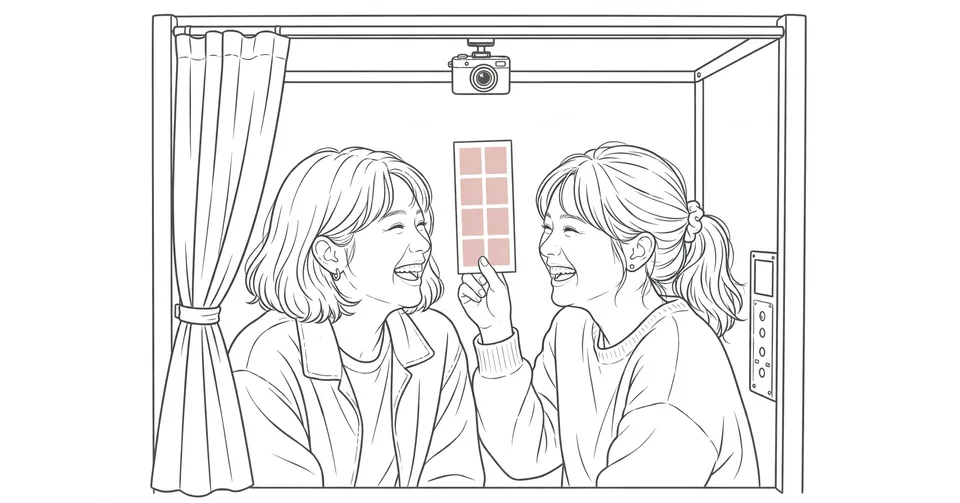
What made purikura different from an ordinary photo booth was that the customer became the editor. A passport booth gives you a picture. Purikura gave you a picture and then handed you the tools to change it, and that small shift turned a transaction into a creative act. Teenagers were not just taking photos of themselves. They were designing how they wanted to be seen, and they were doing it together, in public, laughing at the screen while the next group waited outside the curtain.
How purikura took over the arcades
The first machines were simple. You paid about 300 yen, the camera took a few shots, and you got a sheet of small stickers. But the idea spread fast, and the machines kept getting cleverer. By 1997, roughly 45,000 purikura machines had been sold, and Sega was earning an estimated 25 billion yen from purikura sales in that year alone, according to Wikipedia. Print Club went on to generate more than one billion dollars in sales for Atlus and Sega over its lifetime.
The pop group SMAP gave the craze its biggest push. When the group handed out Print Club photos of themselves to the audience of their television show in 1996, the machines became an overnight sensation. Other idols followed, and soon every game center in Japan had a row of booths, usually filled with schoolgirls. The arcade, which had been a mostly male space, suddenly belonged to teenage girls for whole afternoons. Some spent 400 yen, some spent 4,000, and the stickers piled up in dedicated albums called puricho.
Purikura also spread beyond Japan. The booths reached Taiwan, South Korea, Hong Kong, Singapore, Malaysia, the Philippines, China, Vietnam, and Thailand, and the format became the template for photo sticker machines across Asia. What started as a Japanese arcade novelty became a regional habit, and the word purikura traveled with it.
What a purikura session actually looks like
Walk into a game center in Shibuya today and you will still find them, usually on an upper floor, past the crane games. The modern machine is a small studio. The camera enlarges eyes, smooths skin, and brightens the whole image before you even pose. A green screen behind you lets the machine drop in any background, from a beach at sunset to a fantasy castle. You choose poses from a menu, the machine counts down, and then you move to a second screen to decorate.
The decoration stage is where the time goes. You draw with a stylus, add stamps and frames, write messages in bubble letters, and argue with your friends about which shot deserves the biggest frame. A session costs around 400 yen for a sheet of about 16 photos, and the machine now sends digital copies to your phone as well. The stickers are still the point, but the phone copy is what gets posted.
If you have never tried one, the etiquette is simple. Go with at least one friend, because purikura is a group activity and the photos are funnier that way. Pick a booth with a theme you like, since different machines have different filters and frames. And do not expect the result to look like you. That is the entire idea. The machine makes everyone look like a polished, wide eyed version of themselves, and nobody in the booth pretends otherwise.
Why purikura survived the smartphone
The obvious question is why anyone still pays for a photo booth when every phone takes better pictures for free. The smartphone should have killed purikura, and for a while it looked like it would. The market shrank from its peak, the number of machines fell from around 50,000 in 1997 to about 10,000 today, and only one manufacturer, Furyu, still makes the machines. Yet the booths never disappeared, and the numbers are surprising. Data from 2023 showed that 86 percent of teenage girls in Japan had still used purikura in the previous year.
Part of the answer is that a phone photo is private and a purikura session is social. You cannot queue with three friends for a phone camera. The booth gives you a reason to stand close together, to be silly on purpose, and to leave with the same physical object in four hands. The sticker sheet is a souvenir of an afternoon, not just an image file, and it cannot be deleted by accident or lost in a cloud backup. As the Bangkok Post reported, the booths remain hugely popular more than 25 years after they debuted, particularly with teenage girls, and the market has stabilised at about 10,000 machines across the country.
There is also nostalgia at work. In 2025, purikura celebrated its 30th anniversary, and the celebration coincided with a wave of Heisei era nostalgia among young Japanese. The booths that teenagers used in the 1990s are now retro, and the teenagers of today use them partly because their older sisters and mothers did. Sega even announced a new version of the machine for the anniversary, more than two decades after the original.
| Purikura then and now | 1995 | Today |
|---|---|---|
| Price per session | About 300 yen | About 400 yen |
| Machines in Japan | A few hundred at launch | About 10,000 |
| Main users | High school girls | Teenagers and young women |
| Output | Sticker sheet only | Stickers plus phone copies |
| Editing | Basic frames and stamps | Eye enlargement, skin smoothing, green screen backgrounds |
The table makes the survival look like a slow decline, but the second half of the story is adaptation. Furyu, which controls about 90 percent of the market, keeps updating the machines to match whatever teenagers care about that year. The filters change, the frames change, the backgrounds change, and the booth stays relevant because it is never quite the same machine twice.
What purikura says about kawaii culture
Purikura is often described as part of kawaii culture, and that is accurate but incomplete. Kawaii is usually translated as cute, but the culture around it is really about control over self presentation. A purikura photo lets you choose your eyes, your skin, your background, and your message, and then print the result as a small object you can give away. That is a lot of power for 400 yen, and it explains why the booths mattered so much to teenage girls in the first place. They were not just taking pictures. They were deciding, for once, exactly how the world would see them.
That is also why purikura feels different from a selfie. A selfie is usually taken alone, edited alone, and posted for strangers. A purikura session is taken together, edited together, and printed for the people in the room. The audience is not the internet. The audience is your friends, and the proof is a sticker on a notebook rather than a number on a screen. I find that distinction quietly hopeful. The most durable photo ritual Japan ever produced is the one that keeps the picture inside the friendship instead of broadcasting it.
The same spirit shows up elsewhere in Japanese entertainment. Karaoke, which I wrote about before, works the same way: a private room, a group of friends, and a performance that stays in the room. Purikura is the visual version of that idea, a small curtained space where you can be a brighter version of yourself for ten minutes and then go back to ordinary life with a sticker to prove it.
Where to try purikura in Japan
You do not need to hunt for purikura. Any large game center in a busy district will have them, and the best known clusters are in Shibuya, Harajuku, and Ikebukuro in Tokyo, and in Dotonbori in Osaka. Look for the floors with bright lighting and groups of teenagers, and follow the sound of the machines. The booths usually have English menus, and the staff at the counter can explain the pricing if you ask.
A few practical notes will save you confusion. Most machines take 400 yen in coins, so bring change. The photo stage and the decoration stage are separate, so do not walk away after the camera finishes. You usually get a few minutes to decorate, and the machine will warn you before time runs out. And if you want the digital copies, download the machine maker app before you start, since the transfer code expires quickly.
Purikura is also worth trying outside the big cities. Smaller arcades and shopping malls across Japan still keep a booth or two, and the experience is the same. The machines look slightly different from place to place, the frames reflect local tastes, and the sticker sheet you take home is a better souvenir than anything in the gift shop downstairs.
A small machine with a long shadow
Thirty years after a young Atlus employee wondered why nobody had turned stickers into photographs, purikura is still there, still humming in the corner of the arcade, still turning ordinary afternoons into small printed memories. The technology changed, the filters got smarter, and the market shrank to a tenth of its peak, but the core idea never needed updating. People like pictures of themselves with their friends, and they like those pictures even more when they can hold them.
The selfie did not kill purikura. It proved purikura right. Every front camera, every beauty filter, every sticker pack in a messaging app is a descendant of that 1995 booth in a Japanese arcade. The difference is that purikura never pretended the photo was the point. The point was always the ten minutes inside the curtain with your friends, and the sheet of stickers you carried out together. That is a hard thing to replace with a phone, and it is why, thirty years on, the booths are still full.
More in Culture & Society
- Miyadashi Is the Moment the God Leaves Home
- Otabisho Is Where the God Rests on the Way Through Town
- Mikoshi Are the Portable Shrines Japan Carries on Its Shoulders
- Sanja Matsuri Turns Asakusa Into Tokyo's Loudest Weekend
- Waraji Straw Sandals Walked Japan for a Thousand Years
- Fujin Carries the Wind That Arrives Before the Thunder
Latest posts
- An Engawa Is Neither Inside nor Outside, and That Is the Point
- Nikko and the Shrines Hidden in the Cedar Forest
- Minka Are the Folk Houses Japan Built Around the Hearth
- The Orangutan and the Vanishing Forests of Borneo
- Hozomon Guards the Treasure House Behind Senso-ji's Main Hall
- Nakamise Is the Shopping Street That Has Fed Pilgrims for Centuries
- Kaminarimon Is the Thunder Gate That Opens Asakusa to the World
- Sony, the Tokyo Workshop That Taught the World to Listen
- Raijin Is the Thunder God Behind Japan's Summer Storms
- Tengu Is the Mountain Goblin Japan Still Meets on the Trail
- Kappa Is the River Imp Japan Still Warns Its Children About
- Calonarang Is the Night Rangda and Barong Finally Meet
- Yamata no Orochi Was Never Just a Monster to Slay
- Kit Kat Japan, the Flavours You Will Not Find Anywhere Else
- How Susanoo Slew the Eight-Headed Serpent and Won a Bride