Subak and the Rice Terraces of Bali
· 9 min read
Subak is the thousand-year-old irrigation system that waters Bali's rice terraces, a network of canals, temples, and farmer councils that UNESCO listed as a World Heritage site in 2012.
Stand at the edge of a Balinese rice terrace at first light and the hillside looks like a staircase built for giants. Green steps fall away in every direction, each one holding a thin mirror of water. It is easy to think the beauty is an accident of geography. It is not. Every terrace you see is watered by Subak, a system of canals, temples, and farmer councils that has kept Bali fed for more than a thousand years.
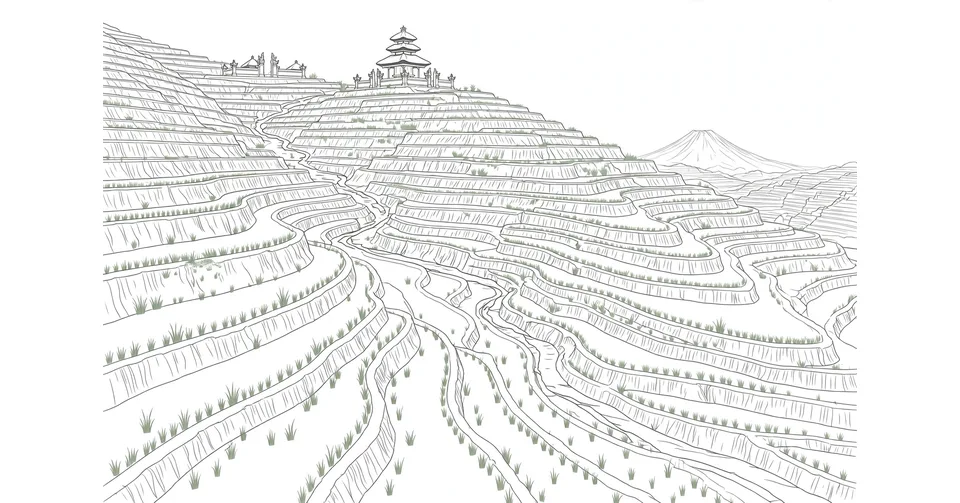
Subak is older than most of the kingdoms that once ruled the island. The Subak system began in the 9th century, when farmers carved channels from mountain rivers to hillside fields, and it grew into a network that now covers close to 20,000 hectares. The idea is simple and radical: water belongs to no one farmer, so everyone shares it, and the sharing is governed by temples, not by markets.
In 2012 UNESCO listed the system as a World Heritage site, under the name Cultural Landscape of Bali Province: the Subak System as a Manifestation of the Tri Hita Karana Philosophy. It is Bali's only World Heritage site, and it is also a working one. The terraces are not a museum. Farmers still plant them, temples still set the calendar, and the water still flows through the same channels. Here is how it works, where to see it, and how to visit well.
How Subak Moves Water Through Bali
Everything starts high up, in the crater lakes. Lake Batur, on the slopes of Mount Batur, is regarded as the ultimate origin of every spring and river on the island, and the water that leaves it is divided again and again as it runs downhill. Weirs divert it into canals, the canals feed the terraces, and the terraces drain into the next valley down, so one river can water a dozen villages before it reaches the sea. That is the first thing Subak gets right: water is treated as a shared inheritance, not a private asset.
The unit that manages all of this is the subak, a group of farmers who share a single water source. There are around 1,200 of these water collectives across Bali, each with between 50 and 400 farmers, and each one is democratic in a way that surprises visitors. The farmers elect their own head, the pekaseh, and a small committee that keeps the accounts and settles disputes. Caste, which matters in so much of Balinese life, is set aside inside the subak: what counts is how much water your field needs and when you planted.
The most important decision a subak makes is not how much water each farmer gets. It is when everyone plants. The temples set a shared calendar, and all the fields in one area flood, plant, and rest at the same time. The fallow period that follows is the system's secret weapon. With no rice standing anywhere nearby, pests have nothing to eat and their numbers collapse. It is pest control by scheduling, and it worked for centuries before pesticides arrived.
Tegalalang and Jatiluwih, Two Terraces, Two Moods
Two terraces dominate every Bali itinerary, and they could hardly be more different. Tegalalang sits just north of Ubud, about twenty minutes by car, and it is the most photographed rice terrace in Indonesia. A single steep valley of neat green steps. It is watered by its own subak, like every terrace on the island, but it is beautiful and busy. Swings, ziplines, and cafes have grown up around the viewpoint, and by mid-morning the paths are crowded with visitors taking the same photograph.
Jatiluwih is the opposite. It lies in Tabanan regency, on the southern slopes of Mount Batukaru, about an hour and a half from Ubud, and it covers more than 600 hectares, making it the largest rice terrace landscape in Bali. The fields roll across a whole hillside rather than filling one valley. Jatiluwih is part of the UNESCO listing, as the landscape of Catur Angga Batukaru, while Tegalalang is not. The name means truly beautiful, and the farmers here still grow a local red rice, Beras Merah Jatiluwih, grown here for generations.
| Tegalalang | Jatiluwih | |
|---|---|---|
| Location | Just north of Ubud | Tabanan, slopes of Mount Batukaru |
| Size | One steep valley | Over 600 hectares, the largest in Bali |
| UNESCO listing | No | Yes, part of the Subak landscape |
| Crowds | Busy from mid-morning | Quiet, with walking trails |
| Best for | A quick stop and a photograph | A slow walk through working fields |
Neither terrace is better than the other. They are the same Subak at two different scales, and the choice is really about how much time you have. If you have an hour, go to Tegalalang early, before the crowds arrive. If you have a morning, go to Jatiluwih and walk. The trails loop through the fields for an hour or two, and the further you walk, the more it feels like a farm, not a viewpoint.
The Water Temples That Govern Subak
The word subak describes the farmers' organisation, but the system runs on temples. Tri Hita Karana, the philosophy behind it, holds that life stays in balance when three relationships are kept in harmony: people with the gods, people with each other, and people with nature. The water temples are where those three meet: shrines at the points where Subak diverts water into canals, which also serve as meeting halls and the offices that set the planting calendar.
At the top of the chain stands Pura Ulun Danu Batur, the supreme water temple, on the shore of Lake Batur. Every subak on the island traces its water back to that crater lake, and the temple's priests and the farmers' councils coordinate the great decisions: when planting opens, how much water each river releases, and when the fields rest. Below it, each river and valley has its own temples, down to the small shrine each subak keeps for Dewi Sri, the goddess of rice.
Two other temples are worth knowing by name. Pura Taman Ayun, in Mengwi, is the royal water temple, an 18th-century complex that shows the Subak system at its most elaborate. And Pura Ulun Danu Bratan, the temple that appears on postcards of Lake Bratan, is a water temple too, dedicated to Dewi Danu, the goddess of lakes and rivers. It is not part of the UNESCO listing, but for most visitors it is the first water temple they ever see: a shrine standing in the water it protects.
When Bali Forgot Subak and Paid for It
For most of its history, nobody questioned the system. Then the Green Revolution arrived. In 1967 the Indonesian government launched BIMAS, a programme of high-yielding rice seeds, fertiliser, and pesticides, and it reached Bali in 1971. Farmers were encouraged to plant as often as possible, three crops a year, and to ignore the temple calendars. The new seeds grew faster than the old ones, and at first the harvests rose. The grain in a plate of nasi goreng comes from fields like these, and suddenly there seemed to be more of it than ever.
Within three years the trouble started. Reports from 1974 spoke of chaos in water scheduling and explosions of rice pests. With fields planted continuously and no shared fallow, the pests simply moved from one field to the next. By 1977 the new rice covered 70 percent of the terraces in South Bali, and in the late 1970s farmers were losing up to half their crop to pests. A World Bank study in 1988 found that pesticide use had pervasively polluted the island's soil and water.
That same year the government changed course. The directives that had forced continuous planting were revoked, and the subak regained its power to decide when its farmers planted. The coordinated calendars and the fallow periods came back, and the harvests began to recover. The anthropologist Stephen Lansing, who had arrived in Bali in 1979 to study the temples, later built a computer model of 172 subaks planting at random and letting each copy its most successful neighbour. Within a few simulated years the fields had sorted themselves back into the cooperating blocks the temple calendars had prescribed. The old Subak had not been superstition. It had been pest control, water management, and diplomacy, written as ritual.
How to Visit the Terraces Well
Under Subak, Bali traditionally grows two rice crops a year, with a secondary crop or a fallow in between, so the fields change colour with the season. The terraces are at their greenest in the weeks after planting, and at their most golden just before harvest. Morning is the best time: the light is soft, the air is cool, and at Tegalalang you get ahead of the crowds. Both terraces charge an entrance fee that can change, so check before you go rather than trusting an old blog post. The UNESCO page for the site and the background on how the irrigation system works) are worth reading before you go.
The one rule that matters most is the simplest. Stay on the paths. The terraces are working farmland, and every step into a paddy is a step into someone's crop and someone's income. A local guide is worth hiring at Jatiluwih, where the trails are long, and the guides are usually farmers themselves who can explain how the local subak divides its water. Dress modestly if you stop at a temple, and remember that the shrines are not scenery. People pray there. Ubud makes a good base for both terraces, and the town has changed so much that it is worth reading why Bali became the world's remote work capital before you judge it by the traffic alone. Borobudur is a different island's answer to the same idea: a sacred landscape built to be walked through, not just looked at.
What stays with me about the terraces is not the photograph. It is the idea that a thousand years ago, farmers on this island solved a problem we still struggle with: how to share something scarce without anyone taking too much. They did it with Subak: temples and calendars and meetings, not with fences and fines, and Subak outlasted kingdoms, colonial rule, and a revolution in farming that tried to replace it. Walk slowly through Jatiluwih, and you are walking through proof that cooperation can be engineered to last, a better souvenir than any photograph.
More in Food & Travel
Latest posts
- Japan's Population Decline and the Villages It Leaves Behind
- KRL Commuterline and the Trains That Move Jakarta
- Loma Linda's Long Lives Run on Saturdays
- Half the Old Springs in Japan Thank Kobo Daishi
- Tatamiishi Terraces Filter a River Through Stone
- Wasabi-Zuke Puts the Whole Plant in Sake Lees
- Konyoku Is Still Out There, Past the Last Train Station
- Karo Is the Tengger's Other Great Gathering
- Dry January Lasts a Month on Purpose
- Urashima's Dragon Palace Had a Name, Ryugu
- Petruk's Nose Arrives Before He Does
- Ikaria Runs on Island Time
- Why Nicoya Cooks Its Corn in Lime
- A Ngaben Can Take a Village Years to Prepare
- Juryo Is Where Sumo Starts Paying