Shio Koji, Japan's Salted Ferment That Seasons Everything
· 8 min read
Shio koji is a simple paste of rice koji, salt, and water that tenderises meat and fish, deepens umami, and quietly took the place of plain salt in Japanese home kitchens after its 2011 boom.
Some seasonings announce themselves. Shio koji does the opposite. It is a plain, pale paste of rice koji, salt, and water, left to ferment in a jar on the kitchen counter, and for the first few days it looks like nothing more than wet rice. Then the grains soften, the smell turns sweet and fruity, and that unremarkable jar becomes one of the most useful things in a Japanese kitchen.
Spread shio koji on chicken, fish, or vegetables and its enzymes go to work before any heat is involved, taking proteins apart into savoury amino acids and starches apart into gentle sugars. The food comes out tender and deeply flavoured, yet still recognisably itself, only more so. That is the whole trick, and it is a very good one.
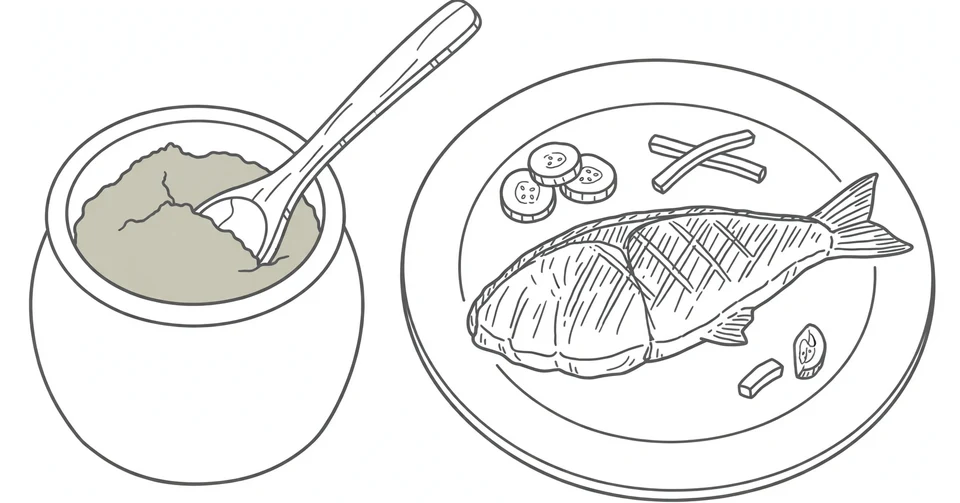
Shio koji had an enormous boom in Japan in 2011 and never really went away. Supermarkets now sell it as paste, liquid, and powder, but the homemade version is still just three ingredients and a little patience.
What shio koji actually is
The starting point is koji itself, steamed rice that has been grown with a helpful mould called Aspergillus oryzae. Miso, soy sauce, and sake all depend on it, and the koji mold behind them has been working in Japanese kitchens for well over a thousand years. Shio koji is what happens when that mouldy rice meets salt water and time. Shio simply means salt, so the name is a plain description: salted koji.
Making a jar is not complicated. A typical batch mixes about 100 grams of rice koji with roughly 30 to 35 grams of salt and enough water to keep the grains covered, then sits at room temperature for one to two weeks with a quick stir once a day. Warm kitchens finish faster, sometimes in about a week, while a cold winter batch takes the full two weeks. Recipes vary a little from house to house, but the method barely changes.
The daily stir is not busywork. In the first days the dried grains drink up the water and swell, sometimes rising above the surface, and a splash more water keeps them safely covered. Stirring evens out the salt, which likes to sink to the bottom, and keeps the surface from growing anything unfriendly. Underneath those small attentions, the shio koji changes steadily: the grains lose their hard edges, the colour warms from bright white to a creamy off white, and the whole jar starts to smell faintly sweet.
You know shio koji is ready when the grains have gone soft enough to squash between your fingers and the mixture has thickened into something like porridge. The smell is the real giveaway. A finished jar smells sweet and fruity, a little like amazake, and the taste runs salty first, then sweet, then savoury. It is mild, rounded, and much more interesting than the salt it contains.
The enzymes doing the quiet work
The reason shio koji seasons so well is that it is alive with enzymes, and two of them do most of the work. Protease cuts proteins into smaller pieces, ending with amino acids such as glutamate, which is the core of umami, the savoury fifth taste. Amylase works on starches instead, breaking them down into sugars. Between them, they explain almost everything shio koji does: the tenderness, the savoury depth, and the faint sweetness that surprises people the first time they taste it.
The tenderising is literal, not marketing. Resting in a shio koji marinade, the proteins in meat and fish are already partly dismantled before cooking starts, so the texture softens and the surface takes on flavour quickly. A plain chicken breast, which is usually the driest decision in the supermarket, comes off the grill moist. Fish firms up in flavour without drying out.
There is one limit worth knowing. Enzymes are fragile, and heat ends their work, so shio koji does everything it is going to do during the marinating stage, not in the pan. My own habit, learned after a few dark and sticky accidents, is to wipe most of the paste off before grilling. The sugars that amylase creates brown fast, and salmon is honestly the best argument for this seasoning: a short rest in shio koji, a careful wipe, and a few minutes under the grill give you fish that tastes like a better version of itself.
A boom in 2011 with roots in 1697
For something that feels ancient, shio koji is surprisingly young. Through the late twentieth century, Japanese families gradually stopped making miso and soy sauce at home, and the small koji shops that supplied them began to close. The turnaround, as Nagase Food Ingredients tells the story, started in Oita prefecture, where the owner of a koji shop founded in the Edo period went looking for a way to save her family business.
In an old recipe book from 1697, the Honcho Shokkan, she found a traditional pickle made with salt and koji, and she turned that idea into a ready to use seasoning. Shio koji was commercialised in 2007, and when the media picked it up in 2011 it became a nationwide boom almost overnight. Cookbooks, television segments, and supermarket shelves all followed. The honest summary is that the technique is old and the product is new: our grandmothers pickled with salt and koji, but nobody sold it in a pouch until this century.
I find that history reassuring rather than disappointing. Plenty of food trends are invented by marketing departments. This one was rescued from a three hundred year old book by a shopkeeper who needed her koji to matter again, and it worked because the paste genuinely makes weeknight cooking easier.
The boom did not stay inside Japan, either. In the years since, shio koji has travelled with the wider fermentation revival, turning up in restaurant kitchens in North America and Europe and in home fermenting guides written in English. A seasoning revived to save one family business now gets described abroad as a chef's secret weapon, which would have sounded unlikely back in 1697.
How to use shio koji at home
If you remember one number, make it this one. As a marinade, use shio koji at about 10 percent of the weight of the food, a rule set out clearly in KitchenNippon's guide to koji condiments. One tablespoon of shio koji weighs about 20 grams, so a 200 gram piece of fish or chicken needs roughly one tablespoon rubbed over it. Thirty minutes in the fridge is enough to feel the tenderising effect, and overnight gives a deeper flavour. Fish, being delicate, needs less time than meat.
The maths behind that rule is neat. A homemade shio koji is roughly 13 percent salt, so coating food with a tenth of its weight in paste lands the finished dish near 1 percent salt, close to the level our palates read as properly seasoned. It also explains why more is not better. Double the paste and the food turns harsh, while the enzymes, given far too long on delicate fish, can push the texture past tender into mushy. Shio koji rewards a light hand and a little respect for the clock.
Beyond marinades, shio koji quietly replaces salt almost anywhere. The usual swap is two teaspoons of shio koji for every teaspoon of salt in a recipe, which delivers far less sodium while tasting, if anything, more savoury. A teaspoon or so stirred into rice before cooking seasons the whole pot. Vegetables rubbed with shio koji and left for a few hours become quick pickles with real depth, and a spoonful disappears happily into dressings, soups, and stir fry sauces.
The seasoning also has a small family. Blend grated onion into the basic mix and you get onion shio koji, a ready made sauce base. Swap the water for soy sauce and ferment that instead, and you get shoyu koji, darker and stronger. Once the basic jar makes sense, the variations suggest themselves.
Keeping a jar
A finished jar of shio koji keeps well. In the refrigerator it stays good for about three months, slowly fermenting and mellowing as it sits, and it can be frozen for up to a year if you make a large batch. Research cited by Japanese cooking sources has even found that some commercial brands lose their enzyme activity during production, which is one more argument for the homemade jar: yours is alive, and it stays active for at least the first month in the fridge.
None of this asks much of the cook. Ten minutes of mixing, a stir a day for a week or two, and the jar repays you for months. Living in Shizuoka, where good fish is cheap and evenings are short, I have come to think of shio koji less as a recipe and more as a standing arrangement with a jar: I keep it fed with a little attention now and then, and it keeps ordinary ingredients tasting like somebody cared. That seems a fair trade.
More in Food & Travel
Latest posts
- Japan's Population Decline and the Villages It Leaves Behind
- KRL Commuterline and the Trains That Move Jakarta
- Loma Linda's Long Lives Run on Saturdays
- Half the Old Springs in Japan Thank Kobo Daishi
- Tatamiishi Terraces Filter a River Through Stone
- Wasabi-Zuke Puts the Whole Plant in Sake Lees
- Konyoku Is Still Out There, Past the Last Train Station
- Karo Is the Tengger's Other Great Gathering
- Dry January Lasts a Month on Purpose
- Urashima's Dragon Palace Had a Name, Ryugu
- Petruk's Nose Arrives Before He Does
- Ikaria Runs on Island Time
- Why Nicoya Cooks Its Corn in Lime
- A Ngaben Can Take a Village Years to Prepare
- Juryo Is Where Sumo Starts Paying