Hiroshima and the City That Chose Peace
· 9 min read
Hiroshima was destroyed in an instant on 6 August 1945, and it rebuilt itself around a message of peace. Here is what the Peace Memorial Park, the Atomic Bomb Dome, and the city today can teach a visitor.
Hiroshima is an ordinary Japanese city in the best sense. Trams run down its wide avenues, rivers cross it in six channels, and office workers eat lunch on the benches of a riverside park. Nothing about the morning commute hints at what happened here, and that is the point. Hiroshima chose to rebuild in plain sight, and to keep the memory of its worst day at the centre of the city.
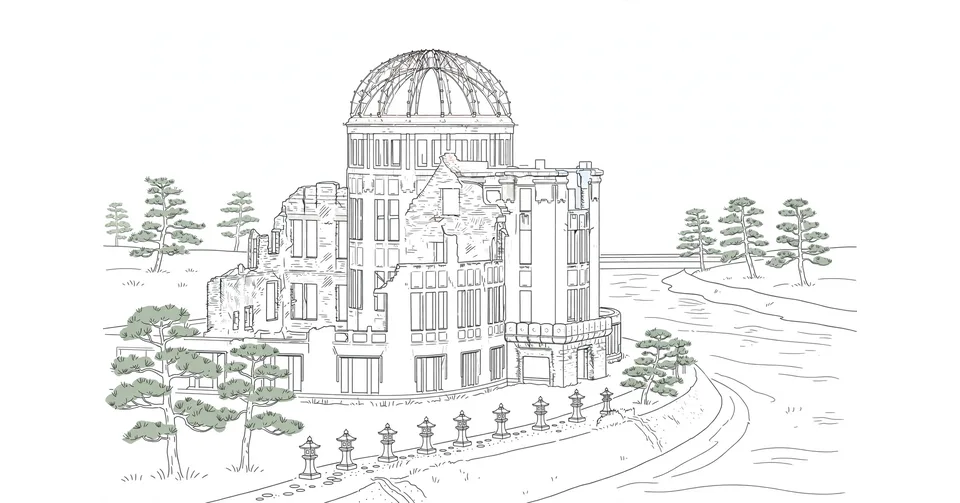
On 6 August 1945, at 8:15 in the morning, an atomic bomb exploded about 600 metres above Hiroshima. Historians estimate that 70,000 to 80,000 people died that day, and the City of Hiroshima estimates that about 140,000 people had died by the end of 1945, counting those who died in the months after from burns and radiation. The city was flattened across two kilometres in every direction from the blast. What stands in Hiroshima today is not the city that was destroyed. It is the city that was built after, deliberately, around a single message: never again.
This is a guide to that city, to the park where the memory is kept, to the girl whose cranes became its symbol, and to the living city around it.
The Morning That Changed Everything
The bomb was dropped from the B-29 bomber Enola Gay, a uranium bomb nicknamed Little Boy, the first atomic bomb ever used in war. The Aioi Bridge had been chosen as the aim point, but the bomb exploded almost directly above the Atomic Bomb Dome, about 160 metres away and 600 metres up.
The heat at ground level was enough to melt roof tiles and fuse sand into glass. The blast flattened almost every building within two kilometres, and the fires that followed burned through what was left standing. About 350,000 people were in Hiroshima that morning, and the dead included Korean labourers, students from China and Southeast Asia, and prisoners of war.
Three days later a second atomic bomb was dropped on Nagasaki, and Japan surrendered on 15 August, ending the Second World War. The attacks remain the only time atomic bombs have been used in wartime, and that fact shapes everything the city has done since.
The Dome That Refused to Fall
The most famous sight in Hiroshima is a ruin that was never repaired. The Atomic Bomb Dome was built in 1915 as the Hiroshima Prefectural Commercial Exhibition Hall, designed by the Czech architect Jan Letzel, and later renamed the Hiroshima Prefectural Industrial Promotion Hall.
When the bomb exploded almost directly above it, the building was the only structure left standing near the hypocentre. Its steel frame and some of its brick walls survived, though everyone inside was killed. After the war it stood abandoned, and for years people argued about whether to pull it down.
In 1966 the Hiroshima City Council voted to preserve it permanently, and in December 1996 UNESCO added it to the World Heritage List, as a symbol of world peace and the abolition of nuclear weapons. It is kept exactly as it was after the blast, held up by steel reinforcement hidden inside. You do not go inside it. You stand across the river and look at it, and that is enough.
A Girl and a Thousand Cranes
The most moving place in the park is not the ruin but a small statue of a girl holding a golden crane. Sadako Sasaki was two years old when the bomb fell on Hiroshima. She grew up healthy, a keen runner at school, until at eleven she was diagnosed with leukaemia, a late effect of the radiation. She was taken to hospital, and there a friend told her an old Japanese legend, that anyone who folds a thousand paper cranes, a senbazuru, will have a wish granted.
Sadako began to fold cranes from whatever paper she could find. The story most visitors hear is that she folded 644 cranes before she died on 25 October 1955, aged twelve, and her classmates folded the remaining 356, so that a thousand cranes were buried with her. Some accounts give different numbers, but the heart of the story is not disputed: a dying child folding paper birds, and her friends finishing what she could not.
Her classmates did not stop there. Thirty-nine of them raised money from schoolchildren across Japan, and in 1958 a statue was unveiled in the park on Children's Day, 5 May. It shows Sadako holding a golden crane above her head, and at its base are the words: "This is our cry, this is our prayer, peace in the world." Children from all over the world still send folded cranes to be placed beneath it, and the glass cases around the monument are never empty.
The Museum That Lets Objects Speak
At the far end of the park stands the Hiroshima Peace Memorial Museum, opened in 1955, ten years after the bombing, and given a major renovation that reopened its main building in April 2019. The museum does not argue. It shows.
Its main building is built around the personal belongings of the victims: a child's tricycle, a lunchbox still packed with scorched rice, a wristwatch stopped at 8:15, school uniforms, and photographs. The displays are arranged in four sections: the devastation of 6 August, the damage from radiation, the cries of the soul, and the lives the survivors went on to lead. The East Wing covers the wider story, the danger of nuclear weapons and the history of Hiroshima's recovery. Survivors, the hibakusha, have volunteered for decades to tell visitors what they saw, and recorded testimonies are still shown.
Some of what you see is distressing, and the museum says so plainly. That is the point of it. The objects are small and ordinary, and that is what makes them hard to look at. A lunchbox is not a statistic. It belonged to someone who packed it that morning and never came home.
| Place in the park | What it is |
|---|---|
| Atomic Bomb Dome | The ruined hall, the only structure left standing near the hypocentre, UNESCO World Heritage since 1996 |
| Children's Peace Monument | Sadako's statue, with paper cranes sent by children from around the world |
| Cenotaph | The arched memorial holding the register of the names of the victims |
| Peace Memorial Museum | Personal belongings, photographs, and survivor testimonies |
From the museum you look straight across the pond to the cenotaph, and through its arch to the dome beyond. The whole park was designed as one composition.
Hiroshima Today
Hiroshima today is a working city of about 1.2 million people, and the park sits at its centre like a quiet room in a busy house. Outside it, the city is trams and department stores, a baseball team, a car industry, and students on bicycles. Inside it, the pace changes. People lower their voices without being told.
Every year on 6 August the city holds its Peace Memorial Ceremony in the park, and at 8:15 the whole city falls silent for a minute. The register of victims' names kept inside the cenotaph is updated each year, and it now holds more than 350,000 names.
What strikes a visitor is not the scale of the ruin but the ordinariness around it. Hiroshima did not turn itself into a museum. It built a normal city and put the memory of the worst day at its heart, where no one can walk past it. I think that is the braver choice. A city that keeps its wound visible is saying something to the world every single day: this happened here, and it must never happen again.
A Day Trip to Miyajima
No visit to Hiroshima is complete without the island just offshore. Miyajima, officially Itsukushima, is about 35 minutes from Hiroshima Station, a short ride on the JR Sanyo Line to Miyajimaguchi and then a ten minute ferry. Its shrine, with its great vermilion torii gate standing in the water, is a UNESCO World Heritage Site and one of Japan's Three Views.
At high tide the gate appears to float on the sea, and at low tide you can walk across the sand to touch its pillars. Plan half a day, and check the tide table the night before, because the two versions of the gate are completely different sights. The full story, with the ferry times and the visitor tax, is in our guide to Miyajima, and the train ride itself is a good example of why Japanese trains are almost never late.
The Other Hiroshima on a Plate
Hiroshima has a second claim to fame, and it is a happier one. Hiroshima style okonomiyaki is a savoury stack built in layers on a hot griddle: a thin crepe, a mound of cabbage and bean sprouts, pork belly, a nest of fried soba or udon noodles, and an egg, finished with sweet Otafuku sauce and seaweed. It is a proper meal, roughly twice the volume of the Osaka version for the same footprint.
The difference is the method. Osaka style mixes everything into a thick batter and cooks it as one pancake, usually with no noodles. Hiroshima style layers each part separately, and the noodles are standard, not an extra. The dish grew out of the post-war years, when flour was rationed and cabbage was cheap, and cooks built a filling meal out of what they had. A standard one costs roughly 900 to 1,300 yen, and the best place to try it is Okonomimura, a four-floor building in the city centre packed with okonomiyaki stalls, each with its own small counter.
It is a fitting dish for this city. It was invented by people with almost nothing, it is built layer by layer, and it is generous. After a morning in the park, it tastes like the other half of the story, the part where Hiroshima got up and went back to work.
Hiroshima is not an easy place to visit, and it is not meant to be. It asks something of you: to look at a ruin, to read a child's story, to stand in front of a lunchbox and understand what it means. What it gives back is rarer than a good view, a city destroyed in a single morning that answered with decades of patience, and a message that has not changed since the park was built. Come and see, it says, and then go home and make sure it never happens again.
More in Culture & Society
Latest posts
- In Mamoiada, Two Hundred Families Still Make Wine at Home
- Shochu and the Quiet Spirit of Japan
- A Dried Shiitake Is Louder Than a Fresh One
- Loma Linda's Long Lives Run on Saturdays
- Maruten Numazu and the Towering Kakiage Bowl of the Port
- The Three Sisters Grow Better Together
- Tatamiishi Terraces Filter a River Through Stone
- Wasabi-Zuke Puts the Whole Plant in Sake Lees
- Konyoku Is Still Out There, Past the Last Train Station
- Dry January Lasts a Month on Purpose
- Ikaria Runs on Island Time
- Why Nicoya Cooks Its Corn in Lime
- Nobody Eats the Daidai, and That Is the Point
- There Are Only 105 Toshiyori Shares in All of Sumo
- Kasuzuke Pickles Almost Anything in Sake Lees