Kyushoku and the Japanese School Lunch
· 13 min read
Kyushoku is Japan's school lunch, a system where children serve each other, eat together in the classroom, and learn about food as part of the school day. Here is how it began, what sits on the tray, and why it works.
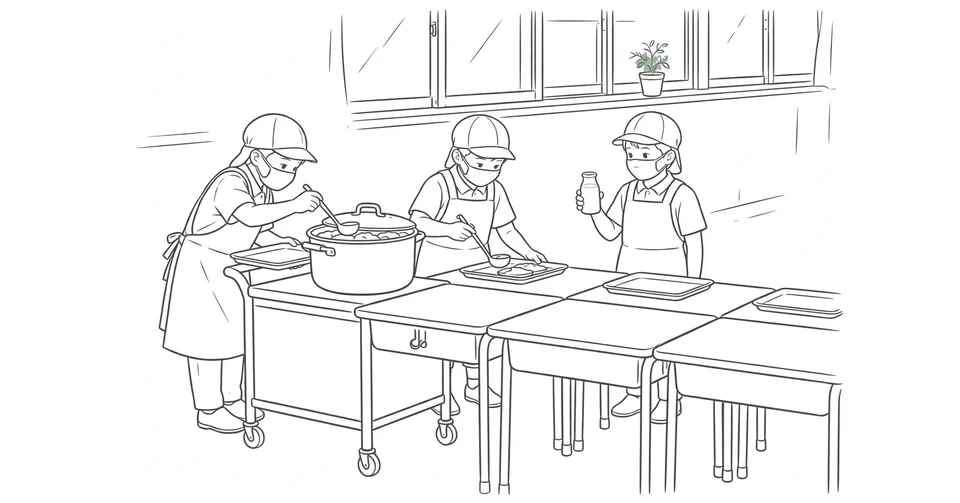
In Japan, lunch at school is not a break from learning. It is a lesson, and it happens every day, in the same classroom where the children study. There is no cafeteria queue, no tray line, and no choice of menu. At midday the desks are pushed into small groups, a team of children in white aprons and caps wheels in a cart of food, and the whole class eats the same meal together, teacher included. This is kyushoku, and it has been part of Japanese school life for more than 130 years.
The word means school lunch, and the system behind it is one of the most admired in the world. As of May 2021, kyushoku reached 99.7 percent of public elementary schools and 98.2 percent of public junior high schools in Japan. That coverage did not happen by accident. It is the result of a law, a profession, and a philosophy that treats food as something children should learn about, not just consume.
What makes kyushoku unusual is not the food itself. The meals are simple, and that is the point. What makes it unusual is the way the meal is made, served, and eaten. Children serve each other. They clean up after themselves. They learn where the ingredients come from, and they eat what is put in front of them, even the dish they do not like. For a visitor, the scene looks charming. For Japan, it is a deliberate piece of education, built over more than a century.
Kyushoku Began as Charity in 1889
The first kyushoku was served in 1889 at Chuai Elementary School, a small private school run by Daitokuji Temple in Tsuruoka, in Yamagata Prefecture. The meal was simple: rice balls, grilled salted salmon, and pickles. It was given free to children whose families could not afford to send them to school with food. The monks paid for it with rice and money collected door to door while chanting sutras. It was an act of charity, not a government programme.
Kyushoku spread slowly. In 1923, the Ministry of Education encouraged schools to provide lunch as a way to improve children's nutrition, and in 1932 the first government-subsidised school lunch was provided for children from poor families. Then war and food shortages forced kyushoku to stop. It resumed after the war, in 1946 and 1947, with relief supplies from overseas. The most memorable of these were wheat flour and powdered milk donated from the United States. By 1950, an American relief fund was paying for full meals, bread, milk, and side dishes, for 1.3 million urban schoolchildren twice a week.
The turning point for kyushoku came in 1954, when Japan passed the School Lunch Program Act. The law made school lunch a legal part of education, and it laid the foundation for the system that exists today. A later revision in 2008 and 2009 set out seven objectives for kyushoku, including sustaining health through proper nutrition, encouraging a social and considerate spirit, and promoting understanding of Japanese and local food culture. Kyushoku was no longer just feeding children. It was teaching them.
The food on the tray changed with the times. In the early postwar years, the staple was bread, usually a soft roll called coppe pan, with powdered milk. Rice did not become a regular part of school lunch until 1976. Today, rice is the most common staple, and the menu has grown into a monthly rotation of Japanese, Western, Chinese, and regional dishes. There is even a School Lunch History Museum in Kitamoto City, Saitama Prefecture, where visitors can see sample meals from each era, from the rice balls of 1889 to the curry rice of today. The Japanese government's own account of the programme traces the same path, from temple charity to national law.
What Sits on the Tray
A kyushoku tray follows a fixed pattern. There is a staple, usually rice, sometimes bread or noodles. There is a main dish, fish, meat, tofu, or egg. There is a vegetable side dish. There is soup. And there is a 200 millilitre carton of milk, served every day whatever else is on the tray. Milk is not optional. Each meal is designed to provide at least a third of a child's daily recommended calcium intake, and milk is the simplest way to deliver it. A detailed guide to Japanese school lunch menus describes the same structure in every school, a staple, a main dish, a side, soup, and milk, with the dishes changing daily.
Kyushoku menus are planned on a monthly cycle, with seasonal adjustments, and they change every day. A typical week might look like this.
| Day | Main dish | Soup and side | Staple |
|---|---|---|---|
| Monday | Grilled fish and simmered hijiki seaweed | Miso soup and pickled vegetables | Rice |
| Tuesday | Curry rice with salad | Fruit and a small dessert | Rice |
| Wednesday | Soft noodles with meat sauce | Vegetable soup | Noodles |
| Thursday | Fried chicken and boiled vegetables | Clear soup and rice | Rice |
| Friday | Agepan, deep-fried sweet bread | Vegetable soup and salad | Bread |
The table above is a typical example, not the menu of any one school. Real menus vary by city, season, and the school kitchen. What stays the same is the balance, and the rule that the meal is the same for everyone in the room.
Local ingredients play a large part. In the 2024 school year, local ingredients made up about 56.4 percent of school lunch food spending by value, and domestic ingredients about 89.4 percent. A school near the sea might serve fish caught that morning. A school in a farming town might serve vegetables from fields the children can see from their classroom windows. Regional dishes appear on the menu too, so children learn the food of their own place as well as the food of the country. It is the everyday end of a food culture whose formal end is kaiseki, the multi-course art of Japanese dining, and both belong to the same tradition of taking food seriously.
There are also dishes that every Japanese adult remembers from their own school days. Curry rice is the perennial favourite. Agepan, a deep-fried sweet bread roll, is the nostalgic one. Soft noodles with meat sauce divides opinion, and that is part of the memory too. Ask a Japanese adult about kyushoku and they will not talk about nutrition standards. They will name a dish.
The Children Who Serve Lunch
The most photographed part of kyushoku is not the food. It is the serving. There are no lunch ladies and no janitors in the dining hall, because there is no dining hall. The food comes to the classroom, and the children serve it themselves.
Each week, a rotating team called the kyushoku toban, the lunch duty team, takes charge. The children on duty put on white aprons, masks, and caps, fetch the food cart from the kitchen, and serve portions to their classmates. The rest of the class waits at desks arranged into small groups, facing each other. When everyone is served, the class says itadakimasu together, and then they eat. When the meal is over, they say gochisousama deshita, and the duty team collects the dishes and cleans up.
The teacher eats the same meal, at a desk in the same room. There is no separate staff lunch, and no child eats something different from the rest of the class. Packed lunches from home are not permitted in most public schools, except in cases of severe, documented allergy that cannot be safely handled. The rule is the point. Everyone eats the same food, at the same time, in the same room.
This is where kyushoku teaches its quietest lesson. Serving food to thirty classmates requires care, and it requires counting. A child who serves too much to the first few desks leaves too little for the last. A child who rushes leaves a mess. The duty team learns to work together, to be fair, and to clean up after itself. The habits look small, and they are, but they are the same habits that Japanese workplaces expect of adults. The salaryman who serves tea to a client before pouring his own, or who stays until the shared work is finished, learned the shape of that behaviour somewhere, and the lunch duty team is one of the places where it begins.
There is also a monthly newsletter, the kyushoku dayori, sent home to parents. It explains the month's menus, the featured ingredients, and the nutritional goals, so that families can see what their children are eating and talk about it at home. The lunch is not a secret between the school and the child. It is shared with the family too.
The Teacher Behind the Menu
Kyushoku menus are not put together by the kitchen staff alone. They are designed by a professional called a diet and nutrition teacher, or eiyo kyoyu. The system was created in 2005, and it is a distinct job. An eiyo kyoyu holds both a registered dietitian qualification and a teaching licence, which means they can plan menus, manage hygiene in the kitchen, and also teach classes about food.
As of 2017, there were more than 6,000 of these specialists working in Japanese schools. The staffing rule is one nutrition teacher for every 550 students in a school with its own kitchen, and one for every 1,500 students in a central kitchen that serves several schools. Their work is governed by national standards, the School Lunch Implementation Standards, which set targets for energy, protein, vitamins, and minerals in each meal. The standards were revised in April 2021, with lower sodium targets, in response to concern about children's long-term health.
This is what makes kyushoku different from a catering contract. The person who decides what the children eat is also the person who teaches them why. The same teacher who plans a menu around seasonal fish can walk into a classroom and explain where the fish came from, what it contains, and why it matters. Food education is not a poster on the wall. It is a person, in the building, every day.
Lunch as a Lesson
The word for what kyushoku teaches is shokuiku, food and nutrition education. The Basic Act on Shokuiku was passed in 2005, and it made food education a formal part of Japanese schooling. The idea is simple: a child who understands food will eat better, waste less, and make better choices as an adult.
Shokuiku shows up in small ways. A menu might feature a vegetable that is in season, with a note explaining where it was grown. A class might visit a farm, or a fish market, or the school kitchen. A lesson might trace a grain of rice from the field to the tray. The kyushoku tray itself is the textbook. Children do not study food in the abstract and then eat something unrelated. They study the food they are about to eat.
The system also teaches gratitude, in a practical way rather than a sentimental one. Before eating, the class says itadakimasu, which carries the meaning of receiving something with thanks. After eating, they say gochisousama deshita, thanks for the meal. The words are routine, and children say them without thinking, but the routine is the lesson. Food arrives through the work of farmers, cooks, and classmates, and the words mark that chain of effort before the first bite.
Other countries run school lunch programmes, and several do it well. Finland has served free school meals since the 1940s, and treats lunch as a right rather than a service. Brazil's programme, one of the largest in the world, requires a share of food to come from local family farmers. The United States runs a large programme built around cafeterias, choice, and free or reduced-price meals for children from low-income families. Kyushoku is different in one specific way. In most of these systems, lunch is a service that a school provides. In Japan, lunch is a subject that a school teaches. The food is the curriculum, and the classroom is the dining room.
And when the school day ends, the lesson stops at the gate but the eating does not. Many children stop at a konbini on the way home, and the contrast between a shelf of packaged snacks and the tray they ate at noon is itself a small lesson in what kyushoku is for.
What Kyushoku Gets Right, and Where It Strains
Kyushoku gets a great deal right. It feeds almost every public schoolchild in the country a balanced meal, designed by a professional, made from mostly domestic ingredients, at a cost that families can bear. It teaches children to serve each other, to eat together, and to think about where food comes from. It does all of this every school day, without ceremony, for more than a hundred years. That is a remarkable record, and it is why other countries study it.
Kyushoku also strains in places, and it is worth saying so plainly. The same rule that makes kyushoku work, everyone eats the same meal, can be hard on a child who cannot eat it. Allergies, religious requirements, disabilities, and sensory difficulties all have to be handled by the individual school, with the family and the nutrition teacher, and the arrangements are not always smooth. The expectation to finish everything can put pressure on a slow eater or a picky one, and a child who leaves food on the tray can feel it.
Cost is another strain. Parents pay for the ingredients, while the government covers facilities and staff, and the ingredient fee rises with food prices. Some cities have moved to free school lunch, but most have not, and the fee is a real part of a family's budget. The system is also labour intensive. It depends on kitchens, delivery, nutrition teachers, and the daily work of children themselves, and a school without a kitchen or a cook cannot run it the same way.
None of this makes kyushoku a failure. It makes it a real system, with real trade-offs, rather than a storybook. The honest view is that Japan built something rare, a school lunch that is also an education, and that it works because the country treats it as education, with a law, a profession, and a budget behind it. A country that copies only the tray, without the teacher and the law, would get a cheaper lunch and a thinner lesson.
I think the deepest lesson of kyushoku is not about nutrition. It is about responsibility. A child who serves lunch learns that food is not something that appears in front of you. Someone grew it, someone cooked it, and someone, today, carried it to your desk. Eating together, the same meal, teaches something that a menu with choices cannot: that a group is fed when everyone is fed, and that your share depends on someone else's care. That is a small lesson for a classroom, and a large one for a life. Japan has been teaching it through kyushoku at midday, every school day, since 1889, and the tray is still the best classroom the country has.
More in Culture & Society
Latest posts
- Kecap Manis and the Sweet Soy Sauce of Indonesia
- In Mamoiada, Two Hundred Families Still Make Wine at Home
- Shochu and the Quiet Spirit of Japan
- A Dried Shiitake Is Louder Than a Fresh One
- Loma Linda's Long Lives Run on Saturdays
- Maruten Numazu and the Towering Kakiage Bowl of the Port
- The Three Sisters Grow Better Together
- Tatamiishi Terraces Filter a River Through Stone
- Wasabi-Zuke Puts the Whole Plant in Sake Lees
- Konyoku Is Still Out There, Past the Last Train Station
- Dry January Lasts a Month on Purpose
- Ikaria Runs on Island Time
- Why Nicoya Cooks Its Corn in Lime
- Nobody Eats the Daidai, and That Is the Point
- There Are Only 105 Toshiyori Shares in All of Sumo