Capsule Hotels and Sleeping in a Pod in Japan
· 18 min read
Capsule hotels are Japan's pod hotels, a bed-sized room stacked two high with shared baths and lockers. Here is how a night works, what it costs in 2026, and who should try one.
You check in at a desk that looks like any other hotel front desk. You hand over your shoes, change into slippers, and receive a locker key and a small bag with loungewear and a towel. Then you walk down a quiet corridor, past rows of white boxes stacked two high, and climb into one. It is about as long as a bed, about as wide as a bed, and just tall enough to sit up in. You pull the curtain shut, and for the night, this box is your room. That is the strange, practical charm of capsule hotels, and it has been working in Japan since 1979.
Capsule hotels began as an answer to a very Japanese problem: a salaryman who missed the last train home and needed somewhere cheap to sleep until morning. The answer turned out to be one of the most recognisable ideas Japan ever exported. Today capsule hotels are no longer just an emergency bed for office workers. They are a budget choice for tourists, a design statement for a new generation of chains, and a rite of passage for anyone who wants to say they slept in a pod in Japan.
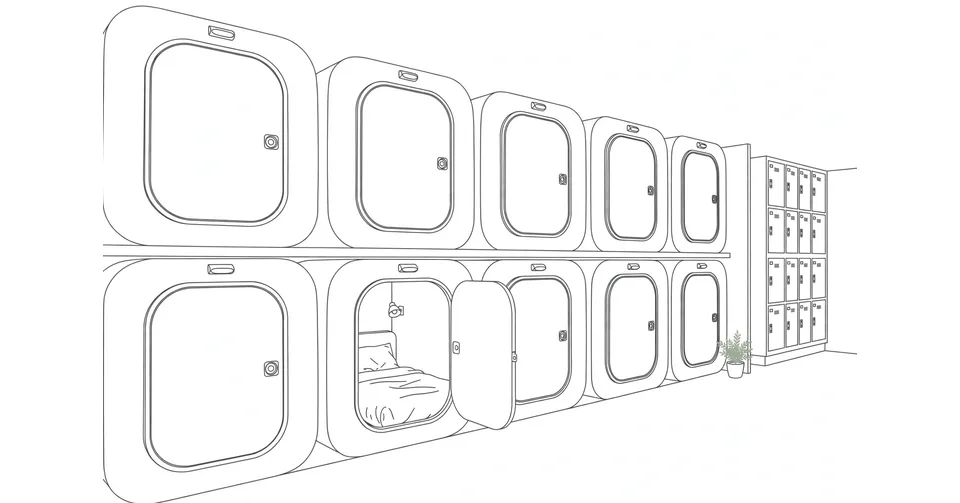
This guide covers how capsule hotels work in practice, from check-in to checkout, what a pod is actually like inside, what a night costs in 2026, and the etiquette that keeps a floor full of strangers sleeping peacefully side by side. If you are wondering whether capsule hotels are a clever bargain or a claustrophobic mistake, the honest answer is that it depends on what you expect, and most of the disappointment comes from expecting a hotel room.
The First Capsule Hotel Opened in Osaka in 1979
The world's first capsule hotel was Capsule Inn Osaka, which opened on 1 February 1979 in the Umeda district of Osaka. It was designed by Kisho Kurokawa, one of the founders of the Metabolist architecture movement, a school of thought that treated buildings as living things made of replaceable, modular parts. The idea came from Yukio Nakano, who ran a sauna in Osaka and wanted a cheap place for his customers to sleep. Kurokawa had shown a "residential capsule" at the Osaka World Expo in 1970, and the hotel was the idea made real.
The opening rate was 1,600 yen a night, and the slogan was "the business hotel of 2100". The original Capsule Inn Osaka is still open today in the same arcade, still men only, and in 2014 it was listed as part of Osaka City's Living Architecture Museum selection. A renovation in July 2025 added a new semi-private capsule tier. The hotel now holds up to 423 guests across 392 rooms, divided between four capsule tiers and 17 private rooms.
Kurokawa's best known capsule work was the Nakagin Capsule Tower in Tokyo, completed in 1972, a tower of 140 detachable living pods. It was demolished in 2022, which makes the survival of the Osaka hotel feel more poignant. The tower is gone, but the idea it carried, that a person needs only a small, well-designed space to sleep, is still checking guests in every night.
Capsule hotels spread quickly from Osaka to Tokyo, Nagoya, and every other big Japanese city. The original customers were exactly who you would expect: salarymen who had missed the last train and did not want to pay for a full hotel room, or to sleep in an internet cafe. The format fitted the Japanese working day, which you can read more about in our article on the salaryman and Japan's loyal office culture. A pod was cheaper than a room, more comfortable than a bench, and it came with a bath.
What a Night in a Capsule Hotel Actually Looks Like
A night in one of Japan's capsule hotels follows a routine that is almost the same everywhere, and knowing it in advance removes most of the anxiety. You arrive, usually from mid-afternoon, and check in at the front desk. You take off your outdoor shoes at the entrance and change into the slippers provided. This is not optional, and it is the first of several small rituals that keep the place clean and quiet.
At reception in most capsule hotels you receive a locker key and a small kit: loungewear to sleep in, a towel, and sometimes a toothbrush and razor. Your suitcase does not go to your pod. It goes into a large locker, or a luggage room, usually near the entrance or in the basement. You take only a small bag with your overnight essentials up to the sleeping floor. The pod has no room for a suitcase, and dragging one down a narrow corridor at midnight is the fastest way to make enemies of your neighbours.
The sleeping floors are separated by gender at almost every one of Japan's capsule hotels, usually with a keycard or a code that only opens your floor. Some older capsule hotels are men only, and a growing number are women only across the whole building. Couples who book together will sleep on separate floors, so if staying close matters, capsule hotels are the wrong choice.
Once on your floor, you change into the loungewear, store your day bag in a smaller locker, and head to the bath. Many capsule hotels have a sento-style communal bath, a large shared soaking bath that is one of the best parts of the stay. The rules are the same as at any public bathhouse: wash and rinse thoroughly at the shower stools before getting into the shared water, and keep soap, shampoo, and towels out of the bath. Our guide to sento, Japan's everyday public bathhouse, explains the routine in detail. Some modern chains, notably 9h nine hours, offer private shower stalls instead of a large bath, so check what your property has if a soak matters to you.
Then you climb into your pod. There is a reading light, a power outlet, usually a USB port, and sometimes a small television or a climate control panel. You pull the curtain or roll down the shutter, and that is your night. Checkout is usually by 10 or 11 in the morning, and many capsule hotels close the sleeping floors for cleaning during the day, often between 10 in the morning and 4 in the afternoon, so you cannot go back to your pod to rest midday.
Inside the Pod
A standard pod measures roughly 2 metres long, 1 metre wide, and about 1 metre to 1.2 metres high. That is enough room to lie down, sit up, and stretch out, but not to stand. Premium or deluxe pods are a little wider, around 115 centimetres, and may have a television screen and extra outlets. The pods are stacked two high along a corridor, and the upper tier is reached by a small ladder or steps.
The single most surprising thing for first-timers is that a pod in one of Japan's capsule hotels has no lock. Japanese fire law forbids a capsule from being locked from the inside, so the pod closes with a curtain or a roll-down shutter, never a key. That is why your valuables go in your assigned locker, not in the pod, and why passports and cash are often held at the front desk safe. The system works because the whole floor runs on quiet mutual respect rather than hard barriers, but it is worth knowing before you book.
Pods in capsule hotels are also not soundproof. They are made of fibreglass or thin panels, and every whisper, snore, and phone notification carries. After about 10 in the evening the floor should be treated like a library. Use headphones for everything, keep phone calls out of the pod, and pack and unpack your bag in the locker room rather than beside a sleeping stranger. If you are a heavy snorer, capsule hotels may not be the kindest choice for the people around you, or for you.
There is very little storage inside a pod: a shelf barely big enough for a phone and a pair of glasses, and a small hanging space. That is the whole point. The pod is a place to sleep, and everything else in the building, the lounge, the vending machines, the bath, the locker room, exists to handle the rest of your evening.
Capsule Hotels and Women
The question every solo female traveller asks first is whether capsule hotels are safe for women, and the answer is yes, provided you book a property with a dedicated women-only floor or a women-only building. Gender separation is standard across Japan's capsule hotels, and it is enforced more strictly than at a typical co-ed hostel. The women's floor usually has its own keycard elevator access, separate bathing facilities, and segregated locker areas.
A growing number of capsule hotels are women-only from top to bottom. Nadeshiko Hotel in Shibuya is women-only throughout, with saunas and skincare amenities aimed squarely at solo female travellers. Nine Hours runs a women-only branch called Woman Kanda in Tokyo, and Akihabara Bay Hotel is a women-only capsule hotel. Some chains split by branch: at Anshin Oyado, for example, several branches are men-only while others are women-only.
When you book, look for the words "women-only" in the room name on the booking site and confirm how the floors are split on the property's own page rather than assuming from the name. One detail worth checking is the bathing setup. At some properties the women's side has individual shower stalls rather than a full communal bath, so if a sento-style soak is part of why you booked, confirm it in advance or pick a property where both genders get full bath access.
Tattoos are the other issue that catches first-timers at capsule hotels by surprise. Many capsule hotels with public baths still bar visible tattoos in the bathing area, including small ones on a wrist or ankle, following the same traditional rules as public bathhouses. Our article on onsen tattoo rules in Japan and how they are slowly changing explains the background. Some properties now accept cover stickers, and private shower stalls avoid the question entirely, but check before you book rather than at the bathhouse door.
How Much Capsule Hotels Cost in 2026
Capsule hotels are no longer the rock-bottom bargain they were in 1979, when a night cost 1,600 yen, but they are still one of the cheapest ways to sleep in a Japanese city. Prices at capsule hotels have climbed with the tourism boom, and in 2026 a central Tokyo pod typically costs between 3,000 and 7,000 yen a night. The useful way to think about it is in three tiers.
| Tier | Typical price per night | What you get |
|---|---|---|
| Budget, older properties | 2,500 to 4,500 yen | Basic pod, communal bath only, simple lockers, often men-only or strict gender split |
| Mid-range, modern chains | 4,500 to 6,500 yen | Clean modern pod, sauna or large bath, English check-in, women-only floors common |
| Luxury poshtel | 7,000 to 10,000 yen | High-ceiling pod, social lounge, premium toiletries, free drinks, near business-hotel comfort |
Weekends cost more almost everywhere, typically 30 to 60 percent above the midweek rate, and peak seasons push further. During Golden Week, prices in Tokyo and Osaka commonly jump 60 to 100 percent above baseline, and a standard pod can pass 7,000 yen. The same pod can swing by thousands of yen between booking dates, so flexible timing pays off, and Japanese booking sites such as Rakuten Travel and Jalan often show lower rates than the international platforms.
A few named examples give the range a shape. Nine Hours Shinjuku-North, one of the best known modern capsule hotels, runs about 4,200 to 6,800 yen a night depending on the day. Green Plaza Shinjuku, one of the oldest capsule hotels still operating, opened in 1979 and prices weekday stays at about 3,900 to 4,600 yen, rising past 6,500 yen on Friday and Saturday nights. First Cabin, which uses larger cabin-style units, runs about 6,000 to 9,000 yen, closer to a budget business hotel than a classic capsule.
Most capsule hotels already include the locker, the bedding, and the use of the communal bath in the rate. What changes the price is the size of the unit and the season. Note that a Tokyo accommodation tax of 200 to 300 yen applies once the nightly rate passes 10,000 yen, though most capsule stays fall below that line.
The New Generation of Capsule Hotels
The most interesting thing about capsule hotels today is how far the idea has travelled from its origins. The chain everyone pictures is 9h nine hours, a pure white, spaceship-clean brand whose name refers to a tidy day: one hour to shower, seven hours to sleep, and one hour to dress. Nine Hours checks guests in at 3 in the afternoon and out at 11 in the morning, sets aside a daily cleaning period from 11 in the morning to 3 in the afternoon, and keeps its pods to showers rather than a large bath. Its Narita Airport branch is popular with early-flight travellers.
First Cabin is the other name worth knowing, and it is a hybrid rather than a pure capsule hotel. Its units are styled like first-class airline cabins, taller than a standard pod so you can stand up, with a proper door and, in the First Class tier, rooms closer to 2.5 to 5 square metres. First Cabin has no curfew, accepts children from 12 up, and prices run higher than a classic capsule. It shows how the format has split: at one end the cheap curtain pod, at the other a micro-room that borrows the capsule's efficiency without its austerity.
Between those poles sits a wave of design-led capsule hotels, the "poshtels", design-led capsule hotels with high ceilings, social lounges, premium toiletries, and free drinks. They cost 7,000 to 10,000 yen on weekends, which is close to a small business-hotel room, and at that point the choice stops being about price and starts being about the experience. Some travellers pick a poshtel the way they would pick a boutique hotel, for the design and the story, not for the saving.
The idea has also travelled abroad. Capsule hotels, known abroad as pod hotels, now exist in many countries, from Singapore to London, but none of them quite reproduce the Japanese original, because the original depends on things that are hard to export: a culture of quiet public behaviour, immaculate shared baths, and a booking system that assumes the guest will follow the rules without being told twice.
Capsule Hotels vs Hostels vs Business Hotels
The practical question is how capsule hotels compare with the other cheap ways to sleep in Japan. A hostel dorm bed in Tokyo costs about 2,000 to 4,500 yen a night, which can be cheaper than a capsule, but you share a room with several strangers and sleep in a bunk rather than a pod. A capsule gives you a defined private space, even if it is only a box, and that privacy is the main thing you are paying for.
| Stay | Typical 2026 price | Privacy | Private bathroom | Best for |
|---|---|---|---|---|
| Hostel dorm bed | 2,000 to 4,500 yen | Bunk in a shared room | No | Social travellers on a tight budget |
| Capsule hotel pod | 3,000 to 7,000 yen | Your own pod, no lock | No, shared bath | Solo travellers who want privacy cheaply |
| Business hotel single | 7,000 to 13,000 yen | Your own room with a door | Yes | Couples, families, anyone needing a room |
A business hotel single, the small, efficient room that is the default for domestic Japanese travel, starts around 7,000 yen and climbs past 13,000 yen in peak season. After the price rises of 2024 to 2026, a central pod at 4,000 to 7,000 yen often sits close to a dorm bed at a good hostel, and the capsule wins on privacy while the hostel wins on price and on meeting people. The capsule also wins on location: capsule hotels cluster near major stations, which matters when the last train has gone and you are already tired.
One more comparison matters. Capsule hotels are not hotel rooms, and the people who dislike them are usually the people who booked one expecting a room. If you want a door that locks, a bathroom of your own, space to open a suitcase, or a bed you can share with a partner, book a business hotel. If you want a clean, private place to sleep for one night, a bath, and a story to tell, capsule hotels are hard to beat for the price.
The Etiquette That Keeps a Pod Floor Liveable
Capsule hotels run on an unspoken social contract, and most first-timers trip over the same few rules. The first is noise. The pods are not soundproof, so after lights-out the floor is a library. Headphones for everything, phones on silent, no video with the sound on, and no phone calls inside the pod. Even rustling a plastic convenience-store bag at 2 in the morning can earn a polite warning from staff, and in Japan a polite warning is a serious one.
The second is food and smoke. Do not eat or smoke inside the pod. There is almost always a small lounge or a vending-machine corner for that, and the konbini downstairs sells everything you need. Speaking of which, capsule hotels and the convenience store are natural partners: the konbini is where you buy your evening meal and your breakfast, and our guide to konbini, Japan's convenience stores explains what to buy. Keep the food out of the pod and the smell out of the corridor.
The third is the bath. Wash and rinse thoroughly at the shower stools before getting into the shared water, keep towels out of the bath, and do not put soap or shampoo in it. The bath is for soaking, not for cleaning. If you have a tattoo, check the property's policy before you book, since many communal baths still bar visible ink.
The fourth is luggage. Your suitcase stays in the locker room or the luggage room, never on the capsule floor. The pod has no room for it, the corridor is narrow, and dragging a rolling case past sleeping strangers after a certain hour is exactly the kind of thing the rules exist to prevent. Pack a small bag with your overnight essentials and leave the rest downstairs.
There are a few more rules worth knowing. Some capsule hotels have a soft curfew or limited night access, and a handful lock the bath or the front area overnight, so check the last check-in time if you arrive late. Age limits are common: many capsule hotels are adults-only, Nine Hours takes children from around 6, and First Cabin generally asks for 12 and up, so families should check the specific property before booking. And if you are taller than about 190 centimetres, or claustrophobic, a standard pod will feel tight. The honest advice for both is to pick a premium pod, a First Cabin, or a business hotel instead.
Who Capsule Hotels Are For
Capsule hotels are best for a particular kind of traveller, and knowing whether that is you saves a bad night. They suit solo travellers who want privacy without paying for a room, people who missed the last train, early-flight travellers near an airport, and anyone curious enough to try a format that exists almost nowhere else. They suit light packers, quiet sleepers, and people who treat the bath as part of the evening rather than an afterthought.
They are a poor fit for couples, who will be split onto separate floors, for families with small children, for anyone who needs to work late on a phone call, and for travellers with large suitcases and no patience for locker Tetris. They are also a poor fit for anyone who needs a lock on the door to feel safe, because the pod will never have one.
I think the fairest way to see capsule hotels is as a trade. You give up space, a lock, and a bathroom of your own, and in return you get a clean bed in the middle of the city for a few thousand yen, a proper bath, and a small piece of Japanese design history to sleep inside. The trade is a good one for one night, and a tiring one for a week. Most people who love capsule hotels love them for a night or two, then happily check into a business hotel and stretch out. That is not a failure of the format. It is the format working exactly as it was designed to, as a clever, minimal answer to the question of where to sleep when all you really need is a bed.
So book one night, arrive with a small bag, take a bath, pull the curtain shut, and sleep. In the morning, check out by 10, walk out into the city, and you will understand why an idea from 1979 is still selling out in 2026.
More in Life & Style
Latest posts
- Kecap Manis and the Sweet Soy Sauce of Indonesia
- In Mamoiada, Two Hundred Families Still Make Wine at Home
- Shochu and the Quiet Spirit of Japan
- A Dried Shiitake Is Louder Than a Fresh One
- Maruten Numazu and the Towering Kakiage Bowl of the Port
- The Three Sisters Grow Better Together
- Half the Old Springs in Japan Thank Kobo Daishi
- Tatamiishi Terraces Filter a River Through Stone
- Wasabi-Zuke Puts the Whole Plant in Sake Lees
- Karo Is the Tengger's Other Great Gathering
- Urashima's Dragon Palace Had a Name, Ryugu
- Petruk's Nose Arrives Before He Does
- Why Nicoya Cooks Its Corn in Lime
- A Ngaben Can Take a Village Years to Prepare
- Juryo Is Where Sumo Starts Paying