Hara Hachi Bu, Okinawa's Rule of Stopping Before You Are Full
· 8 min read
Hara hachi bu is the Okinawan saying recited before meals that reminds people to stop eating when they are about 80 percent full. This is where the rule comes from, why it works in practice, and how much of the longevity claim it can honestly carry.
Before a meal in Okinawa, many older people still say three quiet words to themselves: hara hachi bu. It works less like a prayer and more like a reminder, delivered at the exact moment it is needed. Eat until you are about 80 percent full, then stop. Not full, not stuffed. Just no longer hungry, with a little room left over.
That small gap is the entire idea. Brian Wansink, who spent years studying how people decide they have eaten enough, described it as a difference in language. There is, he wrote, a significant calorie gap between the moment an American says "I'm full" and the moment an Okinawan says "I'm no longer hungry." Hara hachi bu is the habit of stopping at the second of those two moments, at every meal, for a lifetime.
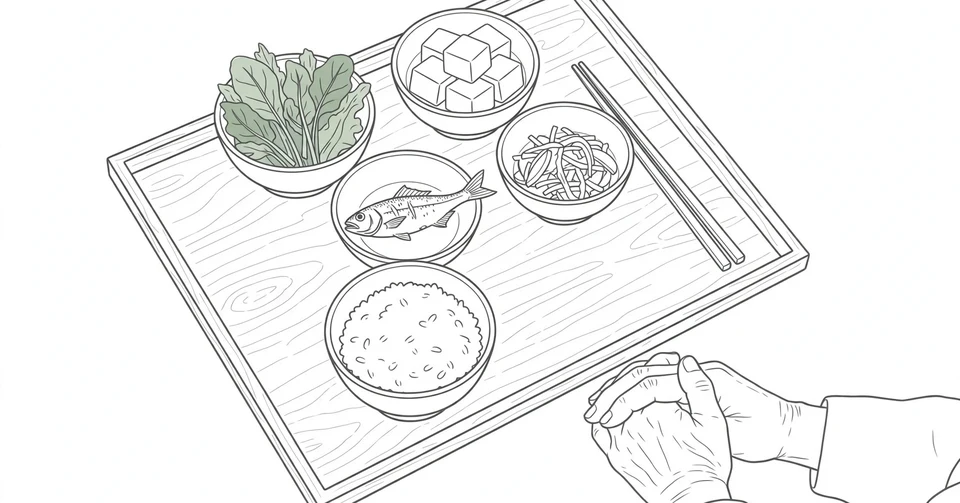
It is not a diet. Nobody following hara hachi bu weighs portions or counts calories, and no list of forbidden foods comes attached to it. It is a single sentence carried in the head, and its strength seems to lie in how ordinary it is. Rules that need equipment, apps or fresh willpower every January tend to collapse. This one needs only a pause before the first bite.
What hara hachi bu actually asks of you
The phrase is usually rendered as "eat until you are eight parts full." The image is of a stomach filled to eight tenths, with the last two tenths deliberately left empty. Dan Buettner's Blue Zones team describes hara hachi bu as a Confucian mantra some 2,500 years old, and the detail that matters most is when it is said. It is recited before the meal, not during it. The decision about where to stop is made before the first bite, while it is still easy to make. By the time the food arrives, the finishing line has already been agreed.
That timing is the practical genius of the rule. Fullness is a slow signal, and the stomach needs roughly twenty minutes to report to the brain that it has had enough. Anyone who eats until they feel completely full has therefore overshot by about twenty minutes of eating. Stopping at what feels like 80 percent is a way of aiming at the target the body will only confirm later. People who try hara hachi bu often notice that twenty minutes after setting down their chopsticks, the hunger they feared was coming simply never arrives.
The rule also quietly asks for attention. It is hard to notice you have reached eight tenths while eating quickly in front of a screen. The traditional setting helped: food served in small dishes, eaten slowly, with the meal treated as an event rather than a refuelling stop. Hara hachi bu is less about resisting food than about giving the body's own signals time to be heard.
In practice, people who take up the rule rarely measure anything. They serve themselves a little less than they think they want, eat more slowly, and pause before going back for more. The practical advice attached to the Blue Zones work points in the same direction: smaller plates and narrower glasses, no television or phone at the table, and food served from the stove instead of from shared dishes sitting within easy reach. None of it is heroic. Hara hachi bu survives because it can be done with an ordinary kitchen and an ordinary appetite, on a Tuesday, without telling anyone.
How the saying reached the rest of the world
Most people outside Japan first met hara hachi bu through the Blue Zones project, the work led by Dan Buettner that identified five places where people live unusually long lives. His November 2005 National Geographic article on longevity, "The Secrets of Living Longer," first put those regions in front of a worldwide audience, and the books that followed carried the Okinawan saying with them. Okinawa is one of the five, long described as home to the world's longest lived women, and when Buettner's team distilled the shared habits of these places into a list they called the Power 9, hara hachi bu appeared on it as the 80 percent rule. In their paper setting out those nine habits, the team writes that the 20 percent gap between not being hungry and feeling full could be the difference between losing weight and gaining it. They also note that people in these places tend to eat their smallest meal in the late afternoon or early evening, and nothing after that.
I went through the five places, and the argument about how solid their records really are, in my article on the blue zones. Hara hachi bu is the most portable item on that list. You cannot import an Okinawan village, its gardens or its grandmothers. You can import a sentence.
Why the small gap adds up
The arithmetic of hara hachi bu is unspectacular, which is exactly the point. The average daily intake of a traditional Okinawan eater was about 1,900 calories, against more than 2,500 for an average American man. No single meal in that comparison is dramatic. Nobody is fasting, and nobody is going hungry. But a modest daily difference, repeated across decades, compounds into a different body and a different old age. Buettner's account of the practice, adapted from his Psychology Today writing, makes the same point from the other side: weight tends to arrive insidiously, a little too much each day, eaten mindlessly.
Wansink's experiments show why a verbal rule helps. In his studies, people eating from a 34 ounce bowl ate 31 percent more than people eating from a 17 ounce bowl, without noticing any difference. Plates, packages and company quietly decide portions for us. Hara hachi bu functions as a counterweight, a decision made by a person rather than by the size of the bowl. The traditional Okinawan table supported it too, built around vegetables, tofu, beans and sweet potatoes, with meat appearing only a few times a month in small amounts. A rule about stopping early is easier to keep when the food itself is not engineered to make you continue.
It was never only about the food
It is worth remembering that hara hachi bu grew up inside a whole way of eating, not as a standalone trick. Meals in old Okinawa were social, unhurried and shared. The same culture produced the moai, the circles of friends who commit to each other for life and still meet to eat and talk. Eighty percent is much easier to notice at a table where conversation slows the meal down and nobody is eating alone over a sink. I suspect the saying has survived for so long partly because it was never carrying the whole load by itself. It sat inside a pattern: modest food, eaten slowly, with people who expected to know each other for a century.
That context is also a gentle warning against extraction. Lifted out of Okinawa and sold as a hack, hara hachi bu becomes one more rule to fail at by Friday. Kept as the Okinawans kept it, as a quiet sentence before a shared meal, it asks for almost nothing and gives the body time to answer.
What hara hachi bu cannot promise
Honesty requires a smaller claim than the one on the book covers. The evidence connecting hara hachi bu to long life is association, not proof. No study has isolated the saying from everything else in the traditional Okinawan pattern, the gardening, the walking, the purpose, the friendships, and measured its effect on its own. As I noted in the blue zones article, even the underlying longevity records for Okinawa have been debated by demographers, and the prefecture's own position has changed with time. By 2020, Okinawan women ranked 16th for life expectancy among Japan's 47 prefectures and Okinawan men 43rd, a long way from the dominance the older generation once held, as younger Okinawans have adopted mainland eating habits.
None of that makes the rule useless. It makes it a habit with a plausible mechanism rather than a guaranteed route to a hundred years. Stopping before you are full needs no exotic ingredient and carries no obvious risk for most healthy adults, and the twenty minute lag in fullness signals is simple physiology, not folklore. Hara hachi bu does not need the strongest version of the Okinawa story to be worth borrowing.
There is something appealing about a health practice whose entire technology is a sentence. Before the meal, say the words; during the meal, enjoy the food; near the end, stop while it is still enjoyable, and let the last fifth take care of itself. Hara hachi bu will not do the work of a whole life, but as rules go, few have ever asked so little and lasted so long.
More in Life & Style
Latest posts
- Every Prefecture Argues About What Goes in Ozoni
- Japan's Population Decline and the Villages It Leaves Behind
- Kecap Manis and the Sweet Soy Sauce of Indonesia
- In Mamoiada, Two Hundred Families Still Make Wine at Home
- Shochu and the Quiet Spirit of Japan
- A Dried Shiitake Is Louder Than a Fresh One
- Maruten Numazu and the Towering Kakiage Bowl of the Port
- The Three Sisters Grow Better Together
- Half the Old Springs in Japan Thank Kobo Daishi
- Tatamiishi Terraces Filter a River Through Stone
- Wasabi-Zuke Puts the Whole Plant in Sake Lees
- Karo Is the Tengger's Other Great Gathering
- Urashima's Dragon Palace Had a Name, Ryugu
- Petruk's Nose Arrives Before He Does
- Why Nicoya Cooks Its Corn in Lime