Moai, Okinawa's Lifelong Circles of Friends
· 8 min read
A moai is a small circle of friends in Okinawa, often formed in childhood, whose members meet for life and quietly hold each other up. Here is how a moai began as a way to share money, what its members still do for each other, and why researchers keep coming back to it.
In Okinawa, friendship has an institution. A moai is a small group of friends, traditionally about five people, who are placed together as children and then simply never stop meeting. They eat together, drink together, and grow old together, and when life turns hard for one of them, the others step in. Some of these circles have been running for more than ninety years.
It sounds like a charming custom, and it is, but that undersells it. It is closer to a second family that you did not choose and cannot easily resign from. The members commit to each other for life, and the commitment is the point. Help inside a moai is not a favour you have to ask for. It is a standing arrangement you belong to.
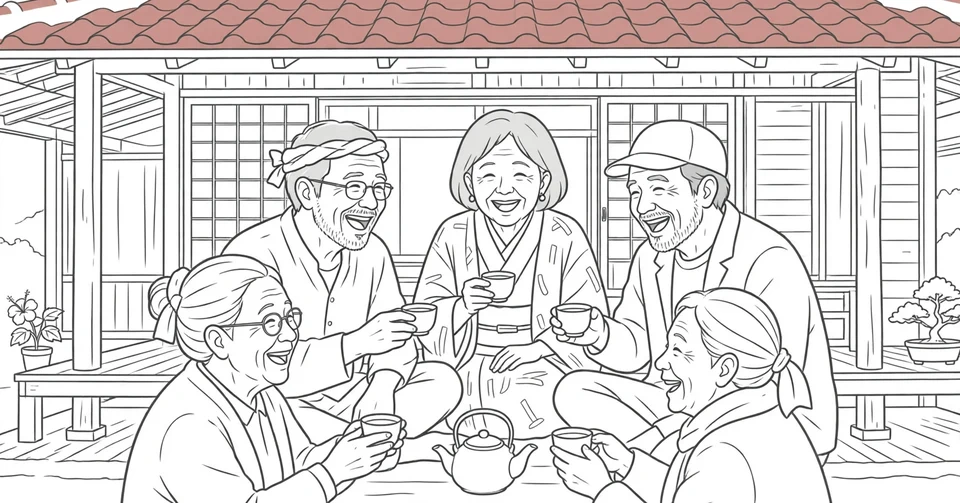
That is why the word keeps surfacing in writing about Okinawa's famous longevity. When this site looked at ikigai, the Japanese idea of a reason to live, the honest summary was that a long life there comes from many things at once: diet, lifelong social groups called moai, daily activity, and a sense of purpose. Of those four, the circle may be the most ordinary, and the hardest to copy.
What a moai is, up close
Traditionally, a moai begins in childhood. A handful of children in the same neighbourhood, often about five, are grouped together, and the group becomes a fixed point for the rest of their lives. In small neighbourhoods across Okinawa, members still meet for a common purpose, sometimes daily and sometimes a couple of days a week, to talk, share advice, and catch up on each other's lives.
Blue Zones, the research project that popularised Okinawa's longevity traditions, describes a moai as a social support group that can run from childhood into a person's hundreds. By its account, about half of Okinawans still take part in one, and many belong to more than one. One woman its researchers met was, at 77, the youngest member of her group, whose combined age passed 450.
It started as a way to pool money
The word is old, and its first job was financial. Hundreds of years ago, a moai was a village's way of pooling resources. If a family needed capital to buy land, rebuild after a storm, or get through an emergency, there was no bank down the road to ask. The community collected the money itself, a little from everyone, and handed it to the person who needed it.
The arrangement worked by rotation. Every member put an agreed sum into the pot at each meeting, one member took the whole amount home, and the next meeting served somebody else. Across a full cycle, everyone had given roughly what they had received. There was no contract and no interest. What held it together was reputation, plus a set of account books called moaichoubo, which Okinawan stationery shops still sell today.
Researchers who have watched moai evenings describe how the money still changes hands. Friends in their late sixties fill an izakaya table with food and drink, and only at the end of the night does each person place a banknote, often 10,000 yen, into the middle of the table. The pile goes to one member, toward an urgent bill or an important expense. And the queue is not rigid. If a typhoon has just torn the roof off your house, the group can move you to the front of it.
After the war, when Okinawa's banking system lay in ruins, this habit mattered even more. These circles financed small businesses, construction, travel, and schooling, sometimes even working in dollars while local currency was scarce. The finance was real. But something else was being built alongside it: a circle of people who had been meeting, and trusting each other, for decades.
What members do for each other
The modern version asks for less accounting and more presence. Stripped down, the duties look like this:
- Meet on a rhythm fixed in advance, not arranged whenever people happen to feel like it.
- Keep the pot going, or its modern echo: contribute when the group collects for a member in trouble.
- Show up in person when someone is sick, widowed, or short of money.
- Notice when a member goes missing, and go and find out why.
One Okinawan woman quoted by Blue Zones reduced the whole arrangement to a single sentence: it is much easier to go through life knowing there is a safety net. That net is deliberately small. Five people cannot replace a family, a pension, or a state. But five people who have known you since childhood can notice early that you have stopped eating properly, stopped coming to the door, or started to withdraw. The circle is often the first to know.
Why researchers link moai to longer lives
The claim made for the moai is usually about longevity, and it deserves the same care this site gave ikigai. Okinawa is one of the world's Blue Zones, places where people live unusually long lives, and researchers there count the moai among the contributing reasons. The mechanism they point to is not mysterious. Lisa Berkman, a Harvard professor who studied social ties and survival, found that the type of connection mattered less than the bond itself. A spouse, close relatives, or a tight circle of friends all seemed to protect people in similar ways.
There is also a plainer mechanism, and to me it is the most convincing one. Abel Polese of Dublin City University, who studied moai in Okinawa, noticed that the money is what makes the meetings unmissable. You can cancel a dinner with friends when you are tired, and friendship forgives you. Skipping a moai meeting means failing to pay people who are counting on the pot, so tired people show up anyway, and then usually enjoy the evening. Repeat that small act of showing up for fifty years and you have built something no app can imitate. Loneliness never gets a long, uninterrupted run at you.
None of this proves that a moai adds years to a life. The honest reading is the one Okinawa itself suggests: long lives there rest on diet, movement, purpose, and people together, and the moai is the people part, organised. What the evidence does support is narrower and still valuable. Strong social ties are consistently associated with better survival and steadier mental health, and a moai is a machine for keeping ties strong into exactly the years when they usually fall apart.
The tradition most of Japan let go
Rotating savings circles once existed across Japan, under names such as tanomoshi and mujin. In most of the country they went into decline after the war, as commercial banks and social security grew and community bonds loosened. Okinawa kept its version, and bent it further toward friendship. The rest of Japan is not obviously better off for the trade. This is also the country that gave the world the hikikomori, people who withdraw from society for months or years at a time.
The contrast is instructive. The hikikomori's problem is not a shortage of people in Japan. It is the absence of a small, fixed group that expects him and would come looking. A moai makes disappearance difficult. Somebody holds your place in the rotation, somebody keeps your seat at the table, and somebody will eventually walk over and ask where you have been. Obligation sounds like a burden. In this design, it is the safety feature.
What the rest of us can borrow
Nobody outside Okinawa can import the real thing. A moai works because it starts in childhood, grows inside a village culture of mutual obligation, and runs for seventy years without anyone calling it a wellness practice. A group chat started next week is not that, and pretending otherwise would be dishonest.
What can be borrowed is the engineering. Keep the group small, around five people. Fix the meeting rhythm in advance, so attendance does not depend on energy or mood. Give the group a shared task, even a small shared pot, because a task gives people a reason to appear on the evenings when friendship alone would not. And make the commitment explicit: these are the people who step in when a spouse dies, when money runs out, when the roof leaks. In my own experience, the friendships that survived distance and busy decades were rarely the most intense ones. They were the ones with a rhythm.
A moai is, in the end, an answer to a question most of us only ask in a crisis: who, exactly, will show up? Okinawa's answer is to settle the question early and then spend a lifetime keeping the answer true. The money was the original excuse. The meetings were the real inheritance.
More in Life & Style
- Gensen Kakenagashi, the Onsen Water That Never Circles Back
- Sumadori, Japan's Smart Drinking for People Who Do Not Drink
- Capsule Hotels and Sleeping in a Pod in Japan
- Kashikiri, the Private Onsen Bath You Book by the Hour
- Hara Hachi Bu, Okinawa's Rule of Stopping Before You Are Full
- Konbini and Why Japan's Convenience Stores Rule Daily Life
Latest posts
- Fuji Ko, the Pilgrim Societies That Climbed Mount Fuji Together
- Dashi, the Quiet Stock Under Almost Everything Japan Cooks
- Ayu, the Sweetfish That Rules Japan's Clear Rivers
- Shiko, the Leg Stamp That Starts Every Sumo Day
- Semar, the God Who Chose to Work as a Servant
- Kyushoku and the Japanese School Lunch
- Sake Kasu, the Sake Lees Japan Cooks With Instead of Throwing Away
- Bureiko, the Drinking Party Where Rank Is Left at the Door
- Kagami Biraki, Japan's Ceremony of Breaking Things Open
- Kopi Tubruk and the Indonesian Way to Drink Coffee
- Subak and the Rice Terraces of Bali
- Hiroshima and the City That Chose Peace
- Shinnenkai, Japan's New Year Parties That Start the Year Over
- Nara Deer and the Sacred Animals of the Old Capital
- Punakawan, the Clown Servants Who Steal Every Wayang Show