How Supersemar Borrowed the Authority of a God
· 11 min read
The Supersemar order of 11 March 1966 took its name from its date, yet historians hear the wayang god Semar inside the word supersemar. This is the story of the letter, its missing original, and the authority its name borrowed.
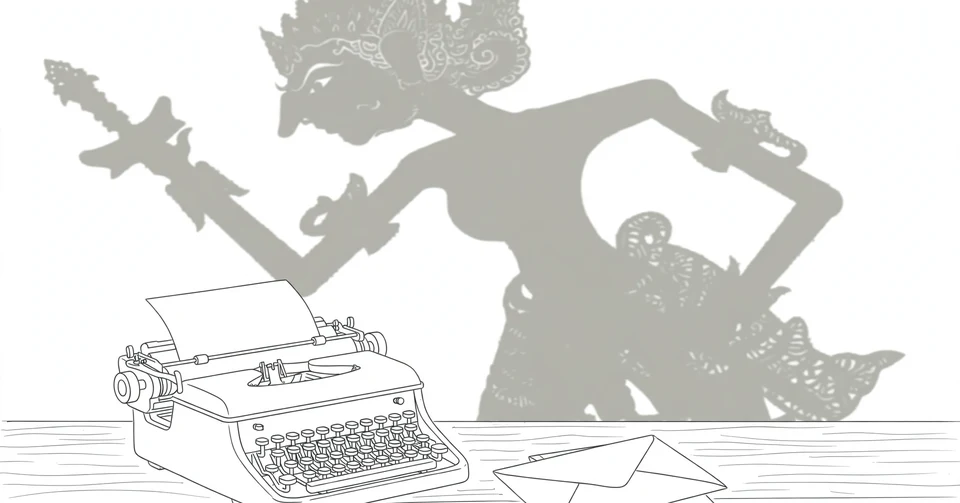
On 11 March 1966, the president of Indonesia signed a short order that reshaped the country for the next three decades. The document became known as supersemar, and officially its name is nothing more than its date: Surat Perintah Sebelas Maret, the Order of the Eleventh of March, compressed into a single word. Yet for many Indonesians the word has always carried a second echo, because sitting inside it is Semar, the oldest and most quietly powerful god of the Javanese wayang stage.
The historians Claire Holt and David Bourchier conclude that the echo was deliberate, a piece of borrowed authority aimed at a Javanese public that had revered Semar for centuries. Whether the naming was craft or happy accident is still argued over, like nearly everything else about this letter. Its original is missing, its surviving copies disagree with each other, and its real meaning has been debated for sixty years.
The sequence of events that followed supersemar, at least, is not in doubt. The order handed sweeping powers to an army general named Suharto. Within a day it was used to ban the Indonesian Communist Party, then the largest communist party outside the Soviet Union and China. Within two years the letter had become the legal bridge from Sukarno's Indonesia to the New Order that Suharto ruled until 1998.
A name built out of a date
Indonesian officialdom loves the syllabic abbreviation, a word assembled from the first syllables of a longer phrase, and supersemar is a textbook example. Su comes from Surat, Per from Perintah, Se from Sebelas and Mar from Maret. Read plainly, the word supersemar says no more than this: an order, issued on the eleventh of March. The official name contains a date, a document type and nothing else. On paper, there is no god in it at all.
But abbreviations do not land in a vacuum. They land in a culture, and they are heard by people who already know certain sounds by heart. Anyone in Java who heard the word supersemar in 1966 heard its ending first. Semar is not an obscure figure from a forgotten manuscript. He is the character ordinary audiences have always loved most in wayang, the one whose arrival on screen settles a scene, the guardian whose name carries warmth, patience and an almost parental protection. A political document that happened to end in his name arrived, whether by design or by luck, wrapped in that feeling.
The old god inside supersemar
To understand what the name borrowed, it helps to know who Semar is. In the wayang tradition he is Sang Hyang Ismaya, a god older than the kings he serves, who came down to earth and lives as a humble attendant. On stage he appears as a round bellied clown among the punakawan, the servant clowns who steal every wayang show, yet everyone in the audience knows the clown is the most powerful being in the story. He advises the Pandawa knights, guards them on their journeys, and is the one voice allowed to scold a king to his face and be thanked for it.
His authority is of the invisible kind. Semar holds no throne, commands no army and issues no orders. Javanese tradition treats him as a guardian of the land itself, a presence who protects rulers only for as long as they rule justly, and who withdraws that protection when they stop listening. He is, in other words, legitimacy imagined as a person: quiet, patient, impossible to buy and impossible to fool. This site has told his story on its own terms, as the god who chose to work as a servant, and it is worth holding that picture in mind while reading the history of supersemar, the political order that borrowed his name.
The morning the palace emptied
The letter was born in a crisis. On the night of 30 September 1965, a group calling itself the 30 September Movement kidnapped and killed six senior army generals in Jakarta. Suharto and the army defeated the movement within days and accused the Indonesian Communist Party, the PKI, of standing behind it. What followed was a period of mass violence against communists and suspected communists, alongside a slow political siege in which President Sukarno's authority ebbed month by month while the army's grew.
On the morning of 11 March 1966, Sukarno chaired a cabinet meeting at the presidential palace in Jakarta while army protected student demonstrations filled the streets outside. During the meeting, troops without insignia surrounded the palace. Sukarno was advised to leave, and he flew by helicopter to the presidential palace at Bogor, some 60 kilometres south of the capital. That afternoon, three army generals followed him there: Basuki Rahmat, M. Jusuf and Amir Machmud. They met the president, who was accompanied by three of his deputy prime ministers, and they returned to Jakarta carrying a signed order addressed to Suharto, who had stayed behind in the capital. The order was supersemar.
Fewer than two hundred words
For a document that changed a nation, supersemar is remarkably short, fewer than 200 words in total. In it, Sukarno instructs Lieutenant General Suharto, as Minister and Commander of the Army, to act in the president's name. Suharto is ordered to take all measures he deems necessary to guarantee security and calm, to protect the safety and authority of the president himself, to coordinate with the commanders of the other armed services, and to report back on everything he does. The stated purpose, repeated through the text, is the stability of the government and the progress of the revolution.
Read coldly, the letter is a security instruction with unusually wide wording. Supersemar does not mention any transfer of the presidency. It does not authorise the banning of political parties, an act that Indonesian law reserved to the president. It does not say how long the mandate lasts. Almost every later argument about supersemar is an argument about that width: about the distance between the general power to restore order, which the text clearly grants, and the specific acts that were carried out under its cover in the days that followed.
A mandate stretched past its edges
The stretching of supersemar began at once. On 12 March, the day after the signing, Suharto used the authority of supersemar to ban the PKI. On 18 March, fifteen ministers loyal to Sukarno were arrested. Sukarno, by the account of his friend and ambassador A. M. Hanafi, responded with an Order of 13 March clarifying that the March order was technical and administrative in nature, not political, and warning Suharto not to act outside its scope. The clarification had no visible effect. In his Independence Day speech on 17 August 1966, Sukarno publicly thanked Suharto for carrying out the order, yet said in the same speech that its implementation had gone beyond its intended limits.
The historian Sri Margana of Universitas Gadjah Mada has pointed out that dissolving a political party was never within a general's authority, since that power belonged to the president alone, and he treats the ban as the clearest case of the mandate being exceeded. The assembly that might have settled the question instead settled it in Suharto's favour. In its general session of June 1966, the Provisional People's Consultative Assembly, the MPRS, elevated supersemar into a formal resolution that Sukarno himself could not revoke. In March 1967 the same assembly stripped Sukarno of his powers and named Suharto acting president. In 1968 the word acting was removed. A one page security order named supersemar had become the founding legal instrument of a regime that lasted 32 years.
The original that nobody can find
There is an obvious place where the argument about supersemar should end, and that is the document itself. It cannot end there, because the original document no longer exists, or at least cannot be found. When Vice President Megawati Sukarnoputri ordered the Indonesian National Archives to locate it, the archives reported that they held only copies of supersemar, including one issued by the Army Information Centre and another by the State Secretary, and that there were significant differences between them. Historians discussing supersemar at Universitas Gadjah Mada note that the archives preserve three versions, from the State Secretariat, the Army Information Centre and the Akademi Bangsa Foundation, none of them the signed original.
The differences between the versions are small, and that is exactly the problem. One version runs to two pages while the others fit on one. Small grammatical markers appear in some copies and not in others. Sukarno's signature, with its characteristic flourish, is not identical across versions. For most documents such details would be trivia. For supersemar, whose entire historical weight rests on its precise wording and on the single signature at its foot, they keep the door of doubt permanently open. The full text of the order and reproductions of the surviving versions can be examined on the Supersemar page at Wikipedia, and reading them side by side shows how much history can hang on a missing sheet of paper.
Even the afternoon of the signing of supersemar is remembered in incompatible ways. Hanafi recounts that Sukarno told him the three generals had brought a document already prepared for his signature, and that he signed feeling cornered. Sukarno's bodyguard commander, Martoidjojo, remembers the order being typed at Bogor by the president's adjutant, Brigadier General Sabur. Claims that surfaced in 1998, alleging that pistols were pointed at the president, have been denied by the accused generals and are treated by historians as unverified. Margana's summary is the careful one: because the original has never been found, coercion claims remain interpretations, not established facts.
What historians argue the letter meant
Two broad readings of supersemar have competed ever since. The first treats it as what its text says: an emergency security order from a president whose government was losing control of the streets, issued to the general best placed to restore order. On this reading, the letter was later stretched, step by step, into something its signer never intended, and Sukarno's August 1966 speech is the key evidence. The second reading, which became the official account during the New Order years, treats the letter as the moment executive power passed from Sukarno to Suharto, a transfer dressed in the language of security. On this reading, the ban on the PKI and the arrests were not excesses but the order working as meant.
The honest position, sixty years on, is that the surviving evidence about supersemar supports the events completely and the intentions only partly. We know what the letter said, what was done with it, and how the assembly converted it into a foundation. What Sukarno believed he was signing, and what Suharto believed he had been handed, rest on memoirs written by interested parties and on a text that exists only in differing copies.
The naming question sits on top of all this, and it is where the god re-enters the story. Summaries of the scholarship note that the Semar echo in supersemar was presumably intended to draw on Javanese mythology in support of Suharto's legitimacy during the transition. Holt and Bourchier, as noted at the start, go further and call it deliberate. I find their conclusion persuasive for a plain reason: governments fighting for recognition rarely leave symbolism to chance, and a regime that carefully managed school textbooks, monuments and official history for three decades is unlikely to have missed the god hiding in its founding word. But persuasive is not proven, and it is worth saying plainly that no surviving document records anyone choosing the name for that purpose.
A name that outlived the paper
There is an irony in the borrowing that time has only sharpened. The Semar of wayang lends his protection to rulers conditionally, and his deepest loyalty is not to any palace but to the land and the ordinary people in it. A letter called supersemar, which borrowed his name, promised, by association, continuity rather than rupture: the old guardian still watching, the familiar order of things preserved through a dangerous season. What the letter actually inaugurated was a thorough changing of the guard, and the servant god's name ended up attached to the paperwork of his master's removal.
Perhaps that is why supersemar remains such a charged word in Indonesia, revisited by historians in anniversary years and argued over by each new generation. The document at its centre is missing, its copies quarrel with each other, and its meaning was contested from the week it was signed. What survives intact is the name, still doing quiet work after sixty years, still inviting every listener to hear two things at once: a date in March, and an old god who was supposed to guard the country through whatever came next.
More in Culture & Society
Latest posts
- Kombu Is the Quiet Half of Dashi
- Manza Onsen Bathes at 1,800 Metres
- Every Prefecture Argues About What Goes in Ozoni
- KRL Commuterline and the Trains That Move Jakarta
- Kecap Manis and the Sweet Soy Sauce of Indonesia
- In Mamoiada, Two Hundred Families Still Make Wine at Home
- Shochu and the Quiet Spirit of Japan
- A Dried Shiitake Is Louder Than a Fresh One
- Loma Linda's Long Lives Run on Saturdays
- Maruten Numazu and the Towering Kakiage Bowl of the Port
- The Three Sisters Grow Better Together
- Tatamiishi Terraces Filter a River Through Stone
- Wasabi-Zuke Puts the Whole Plant in Sake Lees
- Konyoku Is Still Out There, Past the Last Train Station
- Dry January Lasts a Month on Purpose