Jamu, Indonesia's Herbal Medicine in a Bottle
· 9 min read
Jamu is Indonesia's thousand-year-old herbal drink, sold door to door by women with baskets on their backs, and UNESCO recognised it as world heritage in 2023. This is what is in the bottle, and why Indonesians still drink it every morning.
Every morning in Java, before the traffic builds and the food stalls open their shutters, a woman walks down the street with a basket of small brown bottles on her back. She calls out her wares in a sing-song voice, and neighbours come out with empty glasses. What she sells is jamu, Indonesia's herbal medicine in a bottle, and most of her customers have been drinking it since they were children.
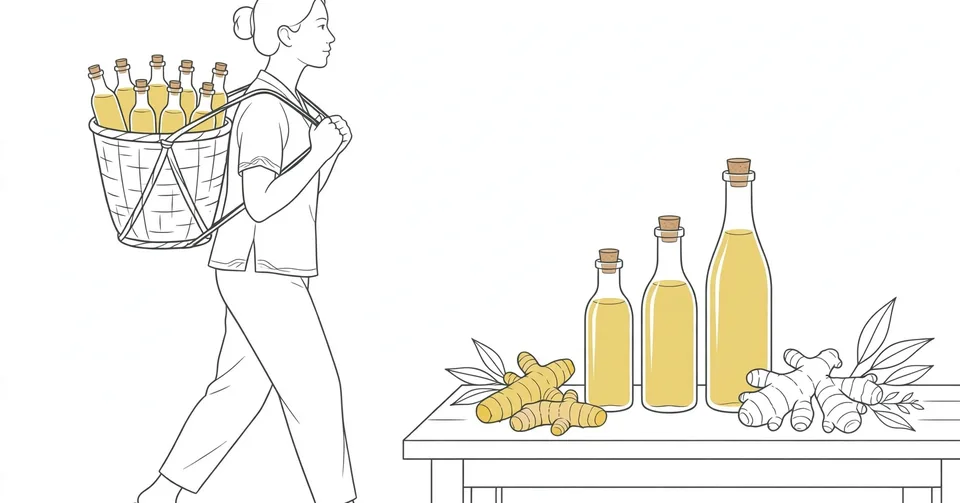
Jamu is not a health fad, and it is not a medicine in the pharmacy sense. It is a daily habit, a family recipe, and, since 6 December 2023, a UNESCO-recognised piece of the world's intangible heritage. The drink is made from roots, rhizomes, leaves and bark, ground and boiled into tonics, bitter, sweet, and sometimes fiery. Indonesians drink it the way other people drink morning coffee: not to fix something broken, but to start the day right.
What jamu actually is
Jamu is a family of herbal drinks made from plants that grow in Indonesia: turmeric, ginger, temulawak, tamarind, aromatic ginger, betel leaf, and dozens more. The ingredients are ground, boiled, strained, and sweetened, usually with palm sugar or honey. Most Indonesian children learn to drink it with a grimace before they learn to like it.
There is no single jamu recipe. Every family has its own version, every seller has her own blend, and every region has its favourites. A maker in Yogyakarta will grind her turmeric differently from one in Solo, and both will insist theirs is right. That variation is part of the point. The drink is closer to home cooking than to pharmacy: a practice passed down by hand, not a formula written in a book.
The name covers a whole world. It can be a drink, a powder, a paste rubbed on the skin, or a pill rolled by hand. But when Indonesians say "jamu", they usually mean the drink: a small glass taken in the morning, often before breakfast, as a daily act of care for the body.
A thousand years in a bottle
The culture is believed to have existed since the 8th century AD. The evidence is carved in stone. Reliefs at Borobudur Temple show people grinding herbs and preparing remedies, and old Javanese manuscripts such as the Kakawin Ramayana and the Serat Centhini describe herbal drinks and healing practices in detail. The Serat Centhini, written in 1814, records jamu recipes alongside poetry and court life.
For centuries, jamu belonged to everyone. Royal courts in Yogyakarta and Surakarta kept their own makers and guarded their recipes, but the same drinks were sold in village markets and carried from house to house. It was women's knowledge in particular, passed from mother to daughter, and the sellers became a familiar part of daily life.
On 6 December 2023, UNESCO inscribed "Jamu wellness culture" on the Representative List of the Intangible Cultural Heritage of Humanity. It was Indonesia's 13th inscribed intangible heritage, joining batik, wayang, gamelan, and the other traditions the world has recognised as belonging to all of humanity. The listing does not honour one drink or one recipe. It honours the whole practice: growing the plants, mixing the drinks, selling them, and sharing them. You can read the story of the inscription in this report on the UNESCO decision.
That recognition matters, but it is worth being clear about what it does not mean. UNESCO did not declare that the drink cures disease. It declared that the culture around it is worth protecting: the knowledge, the sellers, the morning ritual, and the community that keeps it alive.
The jamu gendong sellers
The most loved figure in this world is the jamu gendong, the woman who carries her stock on her back. Gendong means to carry on the back, and a seller walks her route every morning with a woven basket holding a dozen or more bottles, each one a different drink. She knows her customers by name, what each one drinks, and who needs something for a cold or an upset stomach.
The gendong sellers are the reason jamu survived. Long before bottled brands and health cafes, these women kept the tradition moving from door to door. They are usually older women, and many learned the recipes from their mothers. Their work is part shopkeeper, part neighbour, and part healer. A customer does not just buy a drink. She stops for a chat, asks for advice, and pays a few thousand rupiah for something made that morning.
Gendong sellers are getting rarer in big cities, where young people buy bottled drinks from cafes or supermarkets instead. But in Yogyakarta, Solo, and the towns of Central Java, the sellers are still out every morning, and their baskets are still full. If you visit, the best way to try it is not from a fancy bottle. It is from a gendong seller, in a small glass, on her usual street.
The classic drinks
Every jamu seller carries a small menu of classics, and three drinks appear in almost every basket. They are worth learning by name, because they are the gateway to the whole tradition.
| Drink | Main ingredients | What it is for |
|---|---|---|
| Kunyit asam | Turmeric and tamarind | A daily tonic, often drunk by women, sharp and sour |
| Beras kencur | Rice and aromatic ginger | Energy and appetite, sweet and warming |
| Wedang jahe | Ginger, palm sugar, sometimes lemongrass | Warming the body, soothing colds and tired muscles |
Kunyit asam is the most famous of the three. Turmeric gives it a deep golden colour, tamarind gives it a sour edge, and palm sugar rounds it off. It is the one sellers recommend first to visitors. Beras kencur is sweeter and gentler, made from rice and aromatic ginger, and it is the drink people reach for when they feel weak or have lost their appetite. Wedang jahe is less a medicine and more a comfort: hot ginger tea, dark with palm sugar, the kind of drink that makes a rainy evening feel shorter.
Beyond the classics, the list goes on: temulawak for the liver, kencur for coughs, brotowali so bitter that sellers warn you before you drink it. Part of the pleasure of jamu is learning which bottle is yours.
What the science says
It is fair to ask what jamu actually does, and the honest answer is more careful than the sellers' claims. Some of its ingredients have real, studied effects. Curcumin, the active compound in turmeric and temulawak, has been widely studied for its anti-inflammatory properties. Ginger has good evidence for easing nausea. But a small glass is not a laboratory dose.
Indonesia's regulator, BPOM, sorts herbal products into three tiers based on evidence. The lowest tier is Jamu itself: products based on traditional use only, with no clinical testing required. The middle tier is Obat Herbal Terstandar: products tested in animals, with a standardised extract. The highest tier is Fitofarmaka: products proven in human clinical trials. Most of what is sold on the street sits in the first tier, and that is what it claims to be: traditional, not proven.
That distinction matters, and it should not embarrass anyone. Jamu does not need to pretend to be modern medicine. Its value is different. It is a daily habit of attention to the body, a set of plants that people have used for centuries, and a culture of care that is worth keeping. The danger is not the drink itself. The danger is anyone who sells it as a cure for serious illness, or who adds hidden drugs to make it work faster. Buy from sellers you trust, and see a doctor when you are actually ill. You can read more about how Indonesia classifies these products in this overview of the UNESCO listing and what it covers.
How to drink jamu
If you want to try it, the rules are simple. Drink it in the morning, usually on an empty stomach, in a small glass. Start with kunyit asam or beras kencur, the two friendliest classics, and drink it daily for a week before you decide what you think. Jamu is a habit, not a one-off cure, and any effect comes from repetition.
You can find jamu almost anywhere in Java now. Gendong sellers still walk the streets of Yogyakarta and Solo. Traditional stalls sell it by the glass in markets. Modern cafes in Jakarta and Bali serve it in pretty bottles with English labels, and big brands sell it in supermarkets across the country. The cafe version is sweeter and more expensive. The street version is cheaper, stronger, and closer to the real thing.
One thing to remember: it is part of Indonesian food culture in the same way rendang is. Both are recipes that travelled from royal courts and village kitchens into everyday life, and both are now recognised far beyond Indonesia. If you have read about why rendang was named the world's best food, you will recognise the pattern: a dish, or a drink, that ordinary people kept alive long enough for the world to notice.
It also sits beside batik in the story of Indonesian heritage. Batik was inscribed by UNESCO in 2009, jamu in 2023, and both are crafts that live in daily use rather than in museums. You can read about batik, Indonesia's wearable art, and you will see the same idea: a tradition survives because people use it, not because someone preserves it behind glass.
The best advice for a first-timer is simple. Find a seller, ask what she recommends, and drink it where she stands. Pay fairly, because her basket is her shop, and her knowledge is the product as much as the drink. The drink is cheap, but the woman carrying it is not selling a cheap thing. She is selling a thousand years of mornings, one small glass at a time.
Jamu will not fix your life, and it will not cure what a doctor should treat. What it offers is smaller and, in its own way, better: a daily pause, a bitter taste that wakes you up, and a reminder that care can be simple. A small glass in the morning, a seller who knows your name, and a tradition that has lasted twelve centuries. That is enough.
More in Life & Style
- Onsen Tattoo Rules in Japan and How They Are Slowly Changing
- Sento, Japan's Everyday Public Bathhouse
- Ryokan, Japan's Traditional Inns
- Shibuya Crossing, the Busiest Intersection on Earth
- Why Japanese Toilets Are the Most Advanced in the World
- Chakubarai, the Japanese Way to Make the Receiver Pay for Delivery
Latest posts
- Love Live Sunshine and How Anime Changed Numazu
- Numazu Deep Sea Aquarium and the Creatures of Suruga Bay
- Numazu Himono and the Art of Dried Fish
- Numazu Imperial Villa and Japan's Seaside Imperial Retreat
- Numazu Port and the Freshest Seafood in Shizuoka
- Disaster Vending Machines in Japan That Give Their Drinks Away
- The E33G Remote Worker Visa and How to Legally Work from Bali
- Wabi-Sabi and the Japanese Beauty of Imperfect Things
- Bullet Climbing Mount Fuji, the Overnight Ascent Japan Is Trying to Stop
- Women Only Train Cars in Japan and the Problem They Answer
- Climbing Mount Semeru, Java's Highest Volcano
- Maneki Neko and Japan's Beckoning Lucky Cat
- Tamago Sando and Japan's Konbini Egg Sandwich
- The Baduy People and Life Without Modern Technology
- The Salaryman and Japan's Loyal Office Culture