Yumomi Stirs a Bath Cooler With Boards and a Song
· 9 min read
Yumomi is Kusatsu's centuries old way of cooling bath water by stirring it with long wooden boards in time to a folk song, so the spring water is never diluted. The chore survives today as a show at Netsu-no-Yu, performed six times a day.
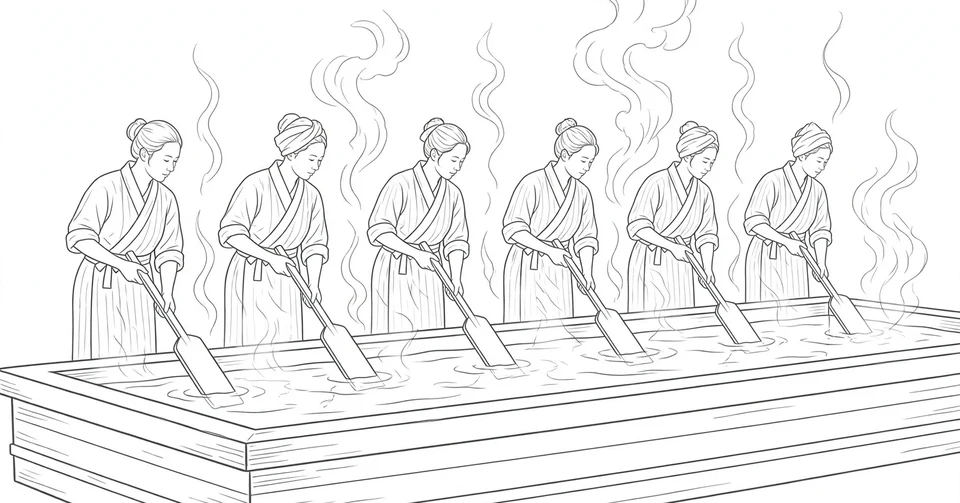
In Kusatsu, the bath water arrives too hot to touch, and the town's answer is not a cold tap. It is yumomi: a line of women standing along the edge of a wooden bath, driving long boards through the water in unison until the steam thins and the temperature drops to something a body can bear.
The stirring is done to a song, and it has been done this way since the Edo period. Nothing is added to the water and nothing is taken away. What reaches the bather is exactly what came out of the ground, only cooler.
It sounds like folklore, but it began as plumbing. Kusatsu sits about 1,200 metres up in the mountains of Gunma Prefecture, its combined springs produce more hot water than any other resort in Japan, and that water comes up far hotter than anyone can bathe in. The town needed the heat gone and the water unchanged, and yumomi was the tool it built for the job.
Why Kusatsu refuses the cold tap
The obvious way to cool a bath is to run cold water into it, and almost everywhere else in the world that is what happens. Kusatsu has always refused, for a reason that is part chemistry and part pride. The springs are strongly acidic and famous for their healing reputation, and the local belief, repeated in every guide the town has ever produced, is that diluting the water weakens the very thing people travel to Kusatsu for. A bath topped up from a tap is just hot water. A bath cooled by stirring is still the spring itself, and that difference is the entire reason yumomi exists.
That stubbornness fits the wider Japanese ideal of gensen kakenagashi, source water that flows straight from the ground to the bath without being stored, reheated or treated along the way. Kusatsu simply extends the logic one step further. If the water must not be recycled or reheated, it should not be watered down either. The heat has to leave by some other route, and the only route left is the surface of the bath itself.
The scale of the problem is worth pausing on. Across the town's many sources, the water emerges at temperatures that the Japanese government's own guide to Gunma puts anywhere between about 50 and 90 degrees Celsius. Nobody bathes at the top of that range, and even the bottom of it is fierce by onsen standards, in a country where bathers already like their water hot. Cooling was never a finishing touch in Kusatsu. It was the central technical problem of the whole town.
What yumomi does to a bath
The equipment could hardly be simpler. Each stirrer works a flat wooden board, an ita, that the Rurubu guide measures at about 180 centimetres long, long enough to reach deep into the bath while its handler stays on dry ground. A yumomi board is less a paddle than a lever for moving the whole volume of a bath. Six or so women stand shoulder to shoulder along the side of a wide wooden tub, plunge their boards in together, and pull them through the water in long, matched strokes.
Stirring cools water for unglamorous physical reasons. A still bath loses heat slowly, mostly from its top layer. Working the boards folds that hot surface down and hauls cooler water up, so the whole volume keeps meeting the cold mountain air, and every stroke throws off steam, which is heat leaving in visible form. Done hard and done together, yumomi turns a passive wait into active work, and the temperature falls in minutes rather than the long, uneven cooling of a bath left to sit.
Historically the stirring was only the first act of a stricter ritual. Nippon.com's account of Kusatsu describes jikan-yu, the timed bathing method the yumomi performance still reproduces: after roiling the bath with the planks, bathers poured bucket after bucket of the hot water over themselves, then climbed in and soaked up to the neck for exactly three minutes. In that world yumomi was also a warm up, a way of preparing the body, and the bather, for water that stayed scalding even after it had been stirred. In the Meiji period a leader, then called a taicho and now a yucho, supervised the stirrers, and when the work was done the women themselves took a brief turn in the water, ladling it over their heads. The job and the reward were the same bath.
The song is the metronome
Every account of yumomi mentions the singing, and it is not decoration. Six boards in one bath have to move together or they clash, splash and work against each other, and the Kusatsu-bushi, the town's folk song, is what holds the strokes in a single rhythm. Nippon.com puts it plainly: the song is sung during yumomi so that everyone stirs in the same tempo. The lyrics praise Kusatsu and urge the listener to come and visit at least once, which makes the work song a piece of advertising the town has been singing to itself for generations.
I find something quietly brilliant in that arrangement. A metronome would do the timing job and nobody would remember it. A song does the same job and becomes the thing visitors carry home in their heads, humming a tune whose whole purpose was once to keep six wooden boards from colliding in near boiling water. The culture did not settle on top of the labour afterwards, like icing. The culture was the tool that made the labour possible. Ask a Kusatsu local to explain yumomi and there is a fair chance they will start by singing.
The water is cooled twice before anyone sings
Yumomi is the final adjustment, not the whole system. Before any board touches a bath, Kusatsu's water has already travelled through the yubatake, the great wooden channel field at the centre of town, shedding heat to the open air as it runs. I wrote about that first stage separately: a yubatake cools a spring with nothing but wood and gravity, and it is worth seeing the two as one long argument. The channels cool the water in bulk, outdoors, for the whole town. The boards then cool it precisely, indoors, for one bath and one group of bathers, minutes before they get in.
Set against the alternatives, the Kusatsu way looks almost deliberately difficult. Most hot spring towns blend cold water in and accept the dilution. Some run their water through long open channels or cooling works before it reaches a bath, which handles quantity but not the last few degrees at the point of use. Yumomi is the only method I know that treats the bath itself as the cooling device, powered by people, timed by music, at the exact moment of bathing. It survives because Kusatsu's identity is built on never compromising the water, and once a town decides that, singing while you stir stops looking quaint and starts looking inevitable.
From bathhouse chore to stage show
Today most visitors meet yumomi as an audience. Across the square from the yubatake stands Netsu-no-Yu, a Taisho roman style hall where the Yumomi and Dance Show recreates the old routine. The Rurubu guide to the show traces it back to 1960, which means the performance tradition is now old enough to have its own history. Performances run six times a day, three in the morning and three in the afternoon, each lasting about twenty minutes, with tickets sold at the door shortly before each show; admission was 700 yen at the guide's last check, though times and prices are worth confirming on the day.
The format is simple and effective. A short introduction and a dance to the Kusatsu-bushi come first, performed by three women in traditional dress. Then six performers, known as the yumomi musume, the yumomi daughters, take up the long boards around the central bath and stir in earnest to the song, building to a climax of splashing that the front rows feel as much as see. Visitors are invited to try a board themselves at some performances, and the government's Gunma guide notes that participants can even receive a certificate. Having watched people attempt it in videos, I can report that the boards are heavier and the rhythm harder to hold than the performers make either look.
What saves the yumomi show from being mere theatre is that nothing in it is fake. The water is real spring water, the boards are the real tools at the real length, and the technique is demonstrated at working speed by people who train at it. It is a demonstration in the honest sense: a town showing you exactly how it solved its problem, rather than a costume version of a method nobody uses any more.
A slower way to reach the same bath
Plenty of traditions are preserved by being frozen, put behind glass and explained on a plaque. Yumomi was preserved by being sung, six times a day, in a hall built for the purpose, and there is a lesson in the difference. Boards wear out and get replaced. Songs do not, and yumomi has always travelled inside the song. Kusatsu could have hidden its cooling problem behind plumbing decades ago and quietly joined every other resort in turning a tap. Instead it kept the boards, kept the song, and turned an awkward daily chore into the emblem of the town. The water still arrives too hot, the women still stand in a line, and the temperature still falls for no reason more modern than rhythm, teamwork and steam.
More in Life & Style
Latest posts
- Shimekasu Was Herring You Never Ate
- A Hana Donko Wears Its Cracks Like Flowers
- Hashigo-Nori Is Riding a Ladder Someone Else Holds
- At a Goma, Prayers Are Written to Be Burned
- The Sekaa Teruna Builds the Monsters
- A Lembaga Perkreditan Desa Is a Bank the Village Owns
- Every Melasti Goes to Fetch Tirta Amerta
- Kuki Is the Spring the Sea Turned White
- When the Kulkul Stops Sounding for You
- A Caru Is an Offering for the Ones You Fear
- Tatsuko Wished for Beauty and Became a Statue
- Warangan Is the Wash That Reveals the Pattern
- Every Village Writes Its Own Awig-Awig
- Umaji Refused to Disappear
- Rwa Bhineda Keeps Opposites From Going to War