Krama Is What Makes You a Full Member of the Village
· 11 min read
In Bali, krama is the status that turns a resident into a full member of a desa adat, with a voice in its meetings, a share of its land, and a long list of duties to carry.
Ask a Balinese villager who belongs to the village and the answer will not be a list of addresses. It will be a word: krama. A krama is a full member of a desa adat, the customary village that governs temple life, land, and ceremony in Bali. To be krama is to hold a place in the village that no outsider can buy and no visitor can borrow.
The word sounds simple, but the status is not. Becoming krama means accepting a bundle of rights and duties that arrive together and cannot be split apart. A krama gets a voice in the village meeting, protection for the family and its land, and a place in the temple. In return, the krama owes the village unpaid work, contributions, and presence at its ceremonies, year after year. The village does not ask for a fee and hand over a card. It asks whether you are willing to carry your share.
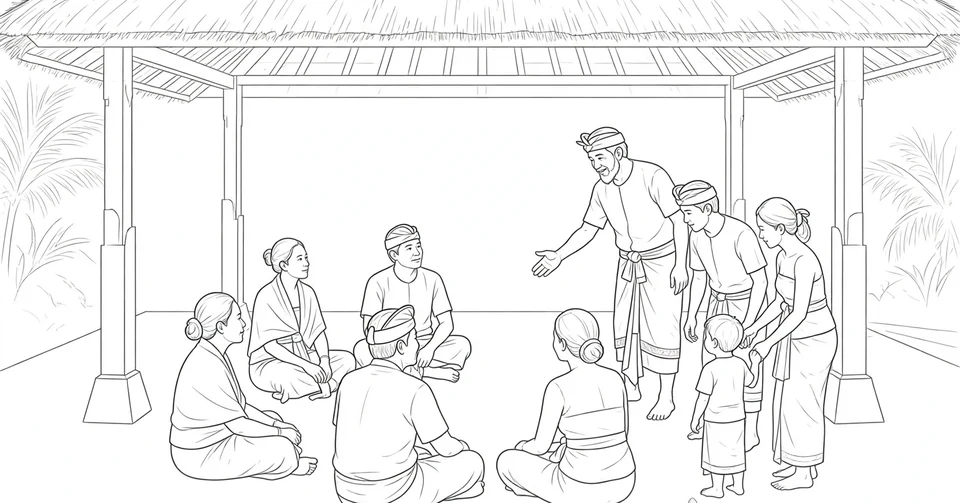
That bargain is written down, village by village, in the awig-awig, the customary code each desa adat writes for itself. The code names who counts as krama, what a krama must do, and what happens when a krama stops doing it. One village's code, the revised awig-awig of Desa Adat Bale Agung Kerambitan in Tabanan, devotes a whole chapter to the subject, and it reads less like a membership form than like a contract between a family and a place.
What a krama actually is
At its simplest, krama is a status that belongs to a household, not to an individual. The Kerambitan code defines a krama as a Hindu family that has settled and made its home inside the territory of the desa adat. Everyone else who lives there, the code says plainly, is a krama tamiu, a guest member. The distinction matters because the village treats the two groups differently, and the line between them is drawn in the code, not in conversation.
In the highland Bali Aga villages, the household idea is even more literal. In Sukawana, the village assembly counts 740 male members, and each one stands for a household, a hearth the Balinese call a kuren. A man joins the assembly only after he marries, when the third stage of the marriage ritual is complete, and his name enters the village register. From that day his rank among the other members is fixed by the date he joined, and he climbs the ladder of rank only as the men above him die or retire. The register, once kept on bamboo tags strung on a cord, is now kept in a notebook, but the principle has not changed: a krama enters as a household, and the household is the unit the village counts.
How you become krama
There are three ordinary roads into krama status, and the Kerambitan code lists them without ceremony. The first is simply to settle in the village and earn a living there. The second is marriage. The third is arrival from another village: a Hindu family that moves in and means to stay must register as krama and pay an entry contribution, called pamogpog, set by the village's own decisions. Nobody becomes krama by accident. The newcomer must report to the head of the banjar, the neighbourhood ward, and the village records the change.
Marriage is the road most villagers actually walk. In the Bali Aga villages, a marriage is not valid until the village elders have witnessed and confirmed it, and the groom's family makes a payment to the village. In Sukawana the payment is two pigs, one for the groom and one for the bride, and it is called tumbakan. In other villages it is called bakatan, and it is said to compensate the village and the ancestors for releasing a young woman from her duties as a village virgin. The payment makes the point plainly: marriage is not only a private affair between two families. It is a transfer of membership, and the village is a party to it, as described in an ANU Press study of the highland village assembly.
Women's membership follows the same household logic, but on a different path. A woman who marries into the village becomes krama through her husband's household, and a woman who marries out leaves her birth village and joins her husband's. The formal seat in the village assembly, in most desa adat, belongs to the household and is held by its head, usually the husband, while women carry their own ritual roles in the temple and the community, as girls in the sekaa daa and as mothers and elders in the life of the banjar. The rules differ from village to village, and any honest account has to say so. What does not differ is the principle: the village counts households, and every household is represented.
What a krama gets
The rights of a krama are real, and the Kerambitan code lists them under a plain heading: what a krama receives. First is protection. The village shelters the krama and the family in the rites of life, in the sanctity of the family temple and the house yard, and in the safety of their property. The protection extends even to guests: a visitor in the village is entitled to the same shelter for person, religion, and property. Second is a place in the ritual life of the desa adat, including worship at the village temple, which is the reason the village exists at all.
Third is land. A krama who has carried out the duties has the right to hold karang desa, village land, under the village's protection, and a study of Desa Adat Tumbu in Karangasem found the same bargain at work: fulfil the obligations and the land is yours to hold, legally and with the village behind you. The same study notes that a member who dies is given land too, a burial plot in the village cemetery. The land is not a gift. It is the village's half of the deal, and it is held on the condition that the duties keep being done. A separate study of karang ayahan, the village land a krama may hold as a place to live, makes the same point from the other side: the desa adat has the authority to set the terms, and the terms are written in the awig-awig.
Fourth is a voice. The krama takes part in the paruman, the village meeting, where the big decisions are made: the appointment of officers, the use of village money, the settling of disputes. The Kerambitan code sets the rules plainly. A meeting needs more than half of those who should attend before it can proceed, decisions are sought by consensus, and only if consensus fails does the majority vote decide. The meeting opens with a prayer, and the officers must report on how they have run the village. A krama does not only obey the village. A krama helps to decide what the village does.
What a krama owes
The other half of the bargain is heavier, and the village does not hide it. Every krama owes ayah-ayahan, unpaid work for the village and its ceremonies. The Kerambitan code sorts the duty by the shape of the household: a full household carries the full duty, and a widowed household carries a lighter one, adjusted to whether the widow still has small children or grown ones. The work itself is the familiar labour of Balinese village life, preparing the temple festival, cleaning the channels, carrying the offerings, standing guard. A study of Desa Adat Tumbu found the same two obligations at the centre of village life: paying the temple festival contribution and turning up, in person, for the communal work.
The code is not blind to hardship. A member who is chronically ill, or who has passed seventy, can be released from the duty by a village decision. A member who cannot attend can send a representative, a son or daughter over seventeen, or can ask for the duty to be postponed, for government service, for illness, for a move away to find work. The village officers themselves are released from some contributions while they serve, and the temple priests from more. The system bends, but it bends by decision, not by neglect. A member who simply stops turning up is a different matter.
The guest beside the member
Not everyone who lives in a Balinese village is a full member, and the village is careful to say so. The Kerambitan code gives the guest a name of their own: krama tamiu, the guest member. A household that takes in a guest for the night must report it to the head of the banjar. If the guest stays more than a week, the head must check the guest's needs and papers. If the stay stretches to a month or years, the guest must be entered in the village book and must share in the village's joys and sorrows, its celebrations and its funerals. A host who fails to report a guest can be fined. The guest is protected, but the guest is also watched, and the village knows exactly who is sleeping under its roofs.
The Bali Aga villages draw the line further. In Sukawana, landless sharecroppers, called desa giringan, are classed as newcomers and hold a marginal status. They can be called on for unpaid ritual labour and must pay a quarter of a normal household's share towards the village's ritual expenses, but they are excluded from formal decision making. The few newcomers who do own farmland must join the village assembly, yet they are barred from rising above its lowest rank, and the village keeps separate membership lists, one for the descendants of the founders and one for newcomers. The rule is frank about its purpose: newcomers must not be able to take control of the village by outnumbering its old families. The same study notes that some such stratification is found in most Bali Aga villages, though the details vary.
When the membership ends
Membership in a desa adat is not for life by default. In the Bali Aga villages it ends when a man's last born child, or his first born grandchild, marries, and if one partner dies the survivor retires too. The average age of retirement in Sukawana is about fifty, which means most members leave the assembly long before they could reach its highest rank. In Kerambitan the code is blunter: membership ends when a family leaves the village territory, when it defies the village decisions, or when it is fined out of membership. A family that leaves loses its rights to village property, to the cemetery and the temple, and the village withdraws its protection. The door out is as clearly marked as the door in.
That is why the village's heaviest sanction is not a fine but an exclusion. A member who refuses the duties altogether can be declared kasepekang, cut off from the village's help while still living in its territory, the temple closed to them and the communal labour withdrawn. The sanction works because membership in the village is not a privilege the village hands out. It is the village itself, and to be cut off from it is to be cut off from the only community that counts.
A krama is not a person with a village identity card. A krama is a household that has agreed to be counted, to be called on, and to be held to account, in exchange for a voice, a temple, a piece of land, and a community that will bury its dead. The bargain is old, and it is demanding, and it is the reason the Balinese village has outlasted kingdoms, colonial administrations, and tourist booms. A village does not survive because its members love it. It survives because its members carry it, one unpaid day of work at a time, and because the work is shared by everyone who claims the name.
More in Culture & Society
- Suka Duka Means the Banjar Shows Up for Joy and Grief Alike
- Tabuh Rah Spills Blood So the Ground Stays Calm
- The Bendesa Adat Speaks for a Village That Has Two Governments
- Catur Brata Is Four Silences Kept at the Same Time
- Your Weton Is the Day You Were Born, Counted Two Ways
- Rahu and Ketu Still Chase the Sun and Moon Across the Sky
Latest posts
- On Koyasan the Founder Is Said to Be Still Meditating
- Hiwatari Asks You to Walk Across the Fire
- Ngembak Geni Is the Morning Bali Starts Talking Again
- Karang Ayahan Is the Plot of Land a Village Trusts You With
- On Tumpek Landep Bali Blesses Everything Made of Metal
- Sudachi Is the Sharpest of Japan's Sour Citrus
- Shugendo Turns a Mountain Into a Place of Testing
- A Canang Sari Is Made Fresh Every Morning and Gone by Night
- The Aling-Aling Wall Exists Because Spirits Walk in Straight Lines
- Oi-Nishin Sent Tohoku Farmers Chasing Herring Every Spring
- The Nishin Goten Were Palaces Paid for by Fish
- The Tobi Were Edo's Daredevils Before They Were Its Firemen
- Kabosu Is Oita's Gentle Answer to Yuzu
- A Yamabushi Trains Where the Mountain Is the Temple
- Tri Hita Karana Holds a Village in Three Balances