Nobody Made the Jimat Klontong, and Every Village Keeps It
· 9 min read
The Jimat Klontong is the Tengger people's sacred bundle of bamboo poles, buffalo horns, stone axes and old banknotes, an heirloom believed to have arrived by itself and kept by a different highland village each year.
High in the Tengger highlands of East Java, there is a bundle of old objects that no village will claim to have made. It is called the Jimat Klontong, and the people who guard it are firm on one point: nobody crafted it. In their belief it arrived by itself, and everything that has happened since is simply the long work of looking after it.
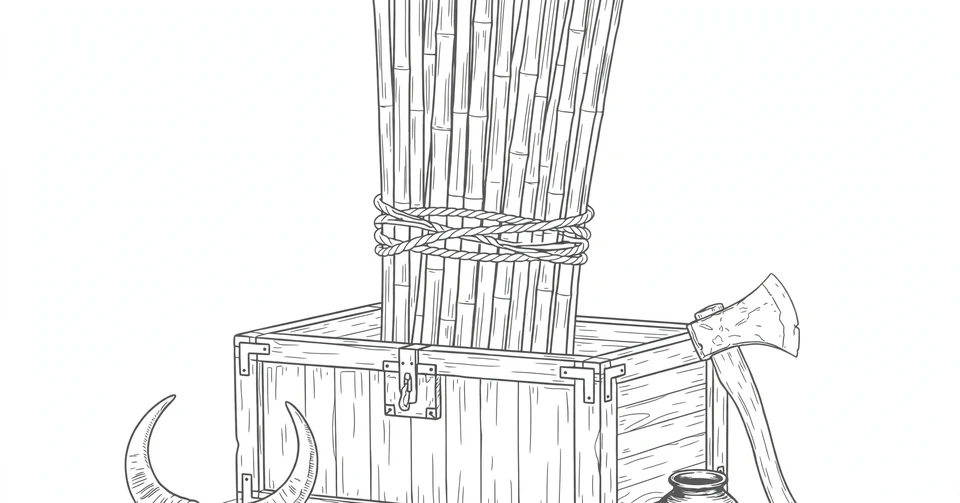
The bundle is solid enough. It holds bamboo poles darkened as if scorched, black buffalo horns, stone axes of great age, and a squat bamboo tube filled with banknotes from currencies that no longer circulate. Once a year the Jimat Klontong is carried out of its storage shrine, ritually cleansed, and honoured through a day of sacred dancing. Then it is wrapped away again, and its keeping passes quietly to another village.
That passing on is the heart of the matter. The Jimat Klontong has no permanent home and no single owner, and the Tengger do not seem to treat this as a gap in its history. They treat it as the history.
What the bundle holds
The most careful inventory of the Jimat Klontong comes from the East Java provincial library's archive of Tengger tradition, drawn from a government cultural survey of the late 1970s. It lists the heirloom piece by piece, and the list is worth taking slowly, because each object in it is stranger than the last.
First come eight poles of apus bamboo, each about three metres long and no thicker than a broom handle. Their colour is blackish, as though they had been held in a fire, and coconut fibre is tied around each pole at two points. These are the sodor, the poles that give the sodoran dance its name, and they are the working end of the Jimat Klontong, clashed, carried and handled all through the day of the festival.
Beside them rests a ritual vessel called a pengaron, ringed on the outside with circles drawn in chalk and marked on the inside with chalk drawings spaced at even intervals. There are four black buffalo horns, and a small black earthenware flask, a kendi, of the kind still used for drinking water across Java.
Then there is the piece that stops a modern reader short: a bamboo tube with a wooden lid, twenty centimetres across and twenty centimetres tall, holding old banknotes. The archive identifies them as ORI notes, the money of the young Indonesian republic, together with a few Japanese notes from the occupation years. Somewhere along the way, someone decided that the Jimat Klontong should also keep the cash of passing empires, and nobody since has seen fit to take it out.
The last items are the oldest: two monolithic stone axes, tools from a Java so distant that the villages keeping them have no story old enough to explain them. In the dance, nearly every piece of the Jimat Klontong has an assigned task. The exceptions, the archive notes, are the money tube and the kendi, which attend the proceedings without being used, the way elderly relatives attend a wedding.
The Jimat Klontong arrived by itself
The Tengger have a precise term for the bundle's condition. The Jimat Klontong is a jimat tiban, an heirloom that came by itself, its origin unknown. Jimat means a charm, a sacred object of power. Tiban carries the sense of something that has arrived unbidden, fallen into the world rather than been placed in it.
This matters more than it might seem. Most treasured objects borrow their authority from a maker: a king who commissioned them, a saint who carried them, a hero whose name they keep. The Jimat Klontong borrows its authority from the opposite direction. Because no one made it, no one can claim it as a family possession or a village trophy. Its lack of an origin story is not a weakness in its credentials. It is the credential.
I find that a quietly radical idea, and a practical one. A sacred object with a known owner can be fought over, inherited, sold or stolen. An object that simply arrived belongs to whoever is currently caring for it, and only for as long as the caring lasts. The mystery is load bearing. Remove it, give the bundle a maker and a birthplace, and the whole arrangement of shared custody would lose its logic.
Two finders, and no verdict
Ask where the Jimat Klontong was found, and the highlands give you two answers, delivered without embarrassment by neighbours who can see each other's settlements across the caldera. Around Ngadisari, on the Probolinggo side, people say the bundle was first found by a priest named Kyai Dadap Putih. The archive is careful to note that this belief belongs mainly to Ngadisari and its surroundings.
Around Tosari and Wonokitri, on the Pasuruan side, the story is different. There, the Jimat Klontong was discovered by two hermits, Kyai Tunggak and Kyai Tompo, who came upon it after forty days of meditation. Neither version apologises for the other. They circulate side by side, each attached to its own slope of the mountain, and the Jimat Klontong travels between the villages that hold them without anyone demanding a ruling.
The disagreement runs deeper than the finding. The two sides also remember the sodoran dance itself differently. Around Ngadisari, it commemorates two loyal servants whose obedience was tested over a sacred trust. Around Tosari and Wonokitri, it honours Ajisaka, the culture hero of Javanese legend, and his followers. A 2022 study of the sodoran dance by researchers at Universitas Negeri Surabaya records the version in which the sodor poles stand for an heirloom of Ajisaka, guarded by one servant on his master's orders and demanded by another on the same orders, until loyalty itself became the tragedy. Honour, the study concludes, is what the dance exists to defend.
One strand of the Ngadisari telling adds a detail I keep returning to. Kyai Dadap Putih, it says, stored a sacred garment called the Ontokusumo at Tosari, while its vessel was kept at Ngadisari. Even the heirloom's own clothing, in other words, was divided between villages from the very beginning, as if the Jimat Klontong had arrived already knowing it would never live in one place.
Brought out once a year
For most of the year the Jimat Klontong rests in a storage shrine, a sanggar, in whichever village currently holds it. Its one public season is Karo, the great festival of the second month in the Tengger calendar. On the sixteenth day of that month, at the full moon, the bundle is taken down and cleansed, and the villages gather for sodoran, the sacred dance performed in its honour.
During the dancing, the pieces of the bundle go to work. Dancers take up the sodor poles in pairs, advancing and retreating to the gamelan. At the end of each round, when the leader calls Sarak, the dancers lift the buffalo horns, which have been filled with water, and pass them among the participants. Researchers describe the horns and poles of the Jimat Klontong as emblems of the Tengger themselves, signs that the tribe endures. The stone axes, the vessel and the quiet tube of old money witness it all from their place of honour.
When the day closes, in the middle of the afternoon, the dukun, the Tengger ritual priest, recites the mantra that sends the invited spirits home. The Jimat Klontong is returned to its place, made ready for the move to the village that will host the next Karo. Absence, for this heirloom, is not neglect. It is the normal state of things, interrupted once a year by joy.
Kept by turns, received like in-laws
The keeping of the Jimat Klontong rotates between villages, and so does the hosting of the festival, and the Tengger frame the meeting in the strongest social language they have. A sodoran gathering is treated as a besanan, a meeting between two families joined by marriage. The host village head and the guest village head stand to each other as in-laws, and a third village attends as escort, so that honour is never a transaction between only two parties.
The archive preserves the casting across the decades, and it reads like a lesson in fairness. In 1955 the head of Ngadisari hosted, the head of Wonotoro came as the honoured in-law guest, and Jetak escorted. In 1978 the wheel had turned: Jetak hosted, Ngadisari arrived as guest, and Wonotoro escorted. Ngadisari, Jetak, Wonotoro and Ngadas all belong to this circle of hosts, and the circle keeps turning.
Consider what this arrangement prevents. No village holds the Jimat Klontong long enough to fold it into its own glory. No village is excused from the duty of keeping it. Custody is an honour that expires, hospitality is a debt that rotates, and the bundle at the centre of it all asks for nothing more than to be cleansed once a year and carried carefully to its next home.
Most heirlooms gather a family's memory into one house and one line of descent. The Jimat Klontong does the opposite, scattering its keeping across a mountainside of villages that cannot even agree on who found it, and yet it has been kept, continuously, by all of them. Perhaps that is the real teaching of the jimat tiban. A thing that arrived by itself, belonging to no one, can end up belonging to everyone willing to take their turn.
More in Culture & Society
Latest posts
- Shimekasu Was Herring You Never Ate
- A Hana Donko Wears Its Cracks Like Flowers
- A Lembaga Perkreditan Desa Is a Bank the Village Owns
- Kaburiyu Is How You Talk Your Body Into the Bath
- Kuki Is the Spring the Sea Turned White
- Tatsuko Wished for Beauty and Became a Statue
- Warangan Is the Wash That Reveals the Pattern
- Ganbanyoku Is Bathing Without Water
- The Obuki Throws Out Nine Thousand Litres a Minute
- Every Village Writes Its Own Awig-Awig
- Sainokawara Is a Bath You Share With a Hundred Strangers
- Umaji Refused to Disappear
- Rwa Bhineda Keeps Opposites From Going to War
- Kasepekang Is Exile Without Leaving Home
- Jamasan Washes a Blade Thinner Every Year