Pathet Tells a Wayang Audience What Time of Night It Is
· 9 min read
In an all-night Javanese wayang kulit performance, the gamelan mode pathet changes as the hours pass, and listeners who know the music can read the time of night from its sound alone.
There is no clock on the wall of the pavilion, and for most of wayang history there was no need for one. In a traditional Javanese wayang kulit performance, the gamelan orchestra keeps time in two senses at once. It keeps the rhythm of the puppets, and it keeps the hour, because the mode the musicians play, called pathet, changes as the night deepens. A listener who has been attending since childhood does not need to ask what time it is. The music has already answered.
Pathet is the system of modes that organises Javanese gamelan music, and in the theatre it works like a clock with three faces. The long night of shadow puppets is divided into three great movements, and each movement belongs to a different pathet, with its own melodic character, its own family of pieces, and its own feeling. As the modes change, the story changes with them, from the ordered world of the early evening to the strange middle of the night and the resolution that arrives with the first light.
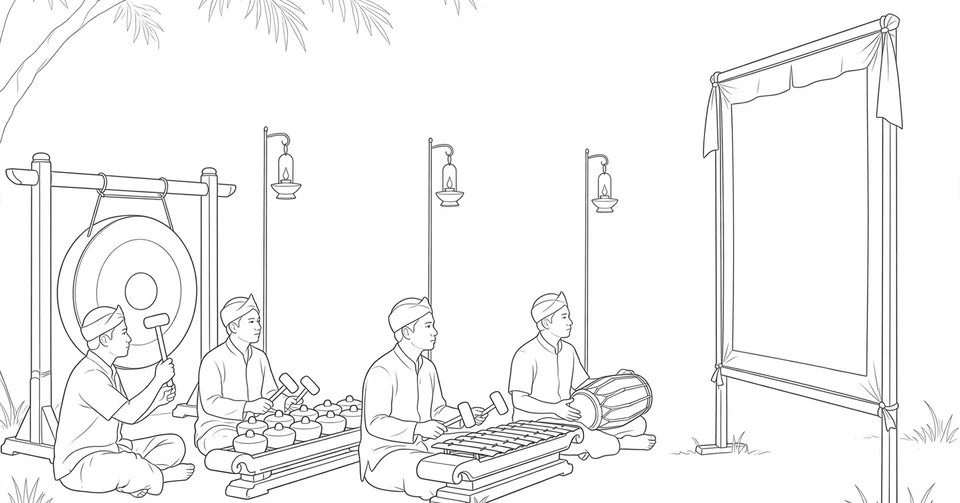
A full traditional performance begins after dark, around nine in the evening, and runs until just before dawn, some nine hours later. That is a very long time to hold an audience with leather puppets and a sheet of cloth, and the structure of pathet is one of the main tools the tradition uses to make those hours feel shaped rather than endless. The night is not one long stretch. It is three countries, and you cross the borders by ear.
The scene itself has barely changed in centuries. The puppets, carved from buffalo hide, stand planted in a banana trunk at the puppeteer's feet, and their shadows fall on a stretched linen screen lit by an oil lamp, though most lamps today are electric. Singers sit with the orchestra, the women called pesindhen and the men wirasuara, ready to carry the songs the puppeteer leaves to them. UNESCO recognised the weight of the tradition in 2003, proclaiming wayang a Masterpiece of the Oral and Intangible Heritage of Humanity.
Three pathet divide the night
The first movement of the night is played in pathet nem. This is the world still in order: a royal court at peace, councils and audiences in the palace, the hero introduced at home among his family before anything has gone wrong. In the standard account of wayang kulit, this first phase, in which the characters are introduced and the conflict is launched, lasts until midnight. Musicians describe pathet nem as the most serene of the three slendro modes, the lowest in range and the calmest in character, and that calm is exactly what a court scene needs. Nothing has broken yet, and the music says so.
The second movement moves into pathet sanga, and the world comes loose. The hero is on the road now, in exile or on a quest, meeting demons, hermits and dangers in the forest. The battles and intrigues of this middle phase run for about three hours, deep into the night, and pathet sanga is audibly more animated than what came before it. The third movement, in pathet manyura, carries the story through its final battles to reconciliation, and it ends as dawn comes. Pathet manyura sits highest of the three and is the liveliest in character, music for a world being put back together at speed.
The sequence is not arbitrary decoration. The sections of a wayang performance are traditionally associated with the stages of a human life and with a range of emotions, and the fit is easy to feel even for a first time listener. Pathet nem has the steadiness of youth under a father's roof, pathet sanga the turbulence of the adult world, and pathet manyura the settling of accounts that comes near the end. Whether or not a listener could name the modes, the body learns the pattern after a few performances. When the music turns to manyura, people begin to stir, stretch, and look for the first grey in the sky.
The hinge at midnight belongs to the clowns
Deep inside pathet sanga, close to the point where the night turns toward its final movement, the performance does something no Western epic would dare. It stops. Around midnight the hero rests in the forest, the plot is set down, and four clown servants take over the screen for the gara-gara, an improvised hour of jokes, songs and village news that the puppeteer invents on the spot.
Its placement inside pathet sanga is practical as well as poetic. Midnight is when an audience that has been watching since nine starts to fade, and laughter is the tradition's chosen alarm clock. The clowns wake the crowd, deal with the world the crowd actually lives in, and hand everyone back to the epic refreshed for the long final stretch. I have always loved the honesty of this arrangement. The tradition does not pretend that attention is infinite. It builds the remedy for tiredness into the score, at the exact hour when tiredness arrives.
One pair of hands keeps the whole clock
All of this timing rests on a single performer. The dalang sits behind the screen for the entire night, working every puppet, voicing kings, demons and clowns in turn, and conducting the gamelan while he does it. He knocks on the puppet chest beside him as a drum, works a small cymbal with his foot to cue the musicians, and sings the mood songs, called suluk, that settle the atmosphere of a scene before a word of dialogue is spoken.
Those songs matter to pathet more than they might seem. Each pathet has its pathetan, short melodies in free rhythm that are said to express the very essence of the mode, and in the theatre the pathetan grow out of the melodic shape of the dalang's own singing. When the night turns from one pathet to the next, it is the dalang who turns it, choosing the moment when a scene has ripened enough to move on. The clock of the wayang night is not a machine. It is a judgement call, made hour by hour by a tired man behind a screen, and the audience trusts it the way sailors once trusted a captain's sense of the weather.
Pathet is larger than the puppet stage
It would be a mistake, though, to treat pathet as nothing more than a programme for the theatre. In the theory of Javanese gamelan, pathet is one of the music's central organising ideas, a system of tonal hierarchy that holds far beyond any single performance. There are six pathet in all, three for each of Java's two tuning systems: nem, sanga and manyura in slendro, and lima, nem and barang in pelog. Very early wayang used slendro alone, but modern performances move between both tunings, and the pelog modes follow the same nightly order, from lima through nem to barang.
What a pathet actually controls is emphasis. Within a pathet, certain notes are strong and certain notes must land at the ends of phrases, the points musicians call seleh, while other notes are avoided or saved for special effect. The old Javanese explanation of the word is usually translated as to damp or to restrain, and one poetic description calls pathet the couch or bed of a melody, the place where a tune lies down and rests. Each pathet leaves a fingerprint in the cadence formulas of its pieces, and skilled players choose their improvised elaborations, the cengkok patterns, to fit the mode they are in. In practice the borders are porous, pieces are often heard as mixtures of pathet, and musicians transpose works from one mode to another, but the framework underneath holds. The fingerprints are precise enough to write down. In slendro, the cadence formulas that close a phrase run 6, 5, 3, 2 in nem, 2, 1, 6, 5 in sanga, and 3, 2, 1, 6 in manyura, each mode literally ending its sentences on different notes.
The same clock also runs when there are no puppets at all. In klenengan, the concert setting where a gamelan plays purely for listening, musicians still choose pieces to suit the hour, opening an evening in the low, serene pathet and letting the music climb toward the livelier modes as the night wears on. Even the framing melodies obey the same order: the free rhythm pathetan that open and close pieces are played softly by rebab, gender, gambang and suling, stating the essence of the mode before the full ensemble commits to it. The bond between a mode and a time of night is older than any single story a dalang might choose to tell. Wayang simply gives that bond a plot to carry.
Listening for the hour
For a modern listener raised on phone screens, the strangest part of all this is how little information the old audience needed. No programme notes, no announcements, no intermission bell. A grandfather in the third row could doze through a battle, surface during the clowns, and know from the sound of the bronze alone whether he had slept for twenty minutes or two hours. The pathet told him. Music was not the accompaniment to the night. It was the instrument by which the night was measured.
There is something worth keeping in that arrangement, beyond nostalgia. The wayang night assumes that time should be felt rather than counted, that an audience can be trusted to read subtle changes of mood the way farmers read a sky. Screens have made us precise about minutes and careless about hours. Pathet works the other way. It cannot tell you the minute, and it was never meant to, but after a night inside it you know exactly where in the darkness you are, and that turns out to be the knowledge that matters.
More in Culture & Society
Latest posts
- Shimekasu Was Herring You Never Ate
- A Hana Donko Wears Its Cracks Like Flowers
- A Lembaga Perkreditan Desa Is a Bank the Village Owns
- Kaburiyu Is How You Talk Your Body Into the Bath
- Kuki Is the Spring the Sea Turned White
- Tatsuko Wished for Beauty and Became a Statue
- Warangan Is the Wash That Reveals the Pattern
- Ganbanyoku Is Bathing Without Water
- The Obuki Throws Out Nine Thousand Litres a Minute
- Every Village Writes Its Own Awig-Awig
- Sainokawara Is a Bath You Share With a Hundred Strangers
- Umaji Refused to Disappear
- Rwa Bhineda Keeps Opposites From Going to War
- Kasepekang Is Exile Without Leaving Home
- Jamasan Washes a Blade Thinner Every Year