Bonenkai, Japan's Year-End Parties Where the Year Gets Forgotten
· 8 min read
A bonenkai is a December drinking party where Japanese colleagues, clubs and friends formally forget the hardships of the year just ending, and it is still the biggest night in the office calendar, even as it quietly changes shape.
Every December, workplaces across Japan set aside one evening for a task no business plan would ever list. They gather to forget the year. The party is called a bonenkai, and forgetting is not a side effect of the drinking. It is the official purpose of the night.
A bonenkai is a year end drinking party, held through December by companies, departments, sports clubs, school circles and groups of friends. Whatever went wrong in the past twelve months, the lost client, the failed project, the quarrel nobody apologised for, is meant to be set down at the table and left there.
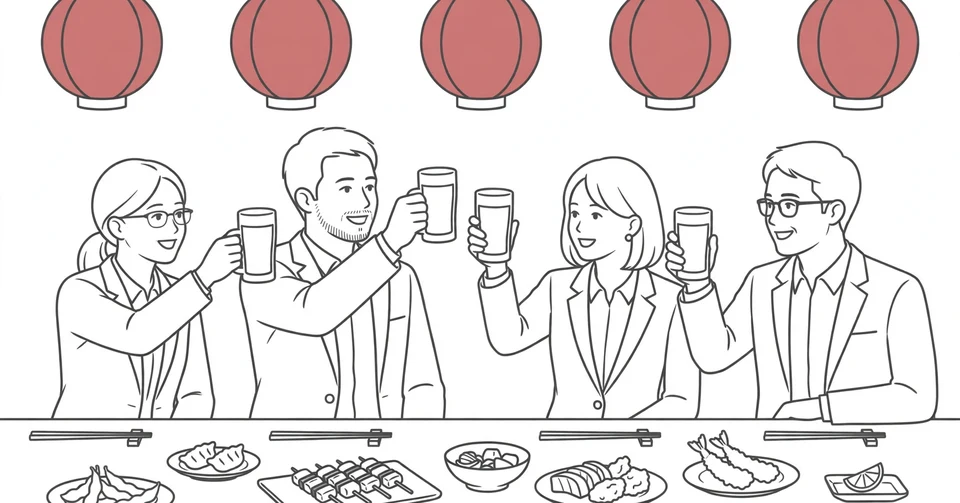
If the ordinary after work party, the nomikai, is small and routine, the bonenkai is its December final. It is bigger, louder and booked far in advance, and it is still the one invitation in the Japanese office calendar that carries real weight.
The name is the whole point
Bonenkai is written with three characters. Bo means to forget, nen means year, and kai means a gathering. The name is not a metaphor that gathered meaning over time. It is a plain description of what the evening is for, closer to an instruction than a title.
That makes the bonenkai a small act of collective housekeeping. One person forgetting a hard year is just tiredness. A whole department agreeing, out loud and over drinks, that the year is finished and its troubles will not be carried into January is something closer to a ritual. Coto Academy's guide to the bonenkai describes the party as a time to reflect on the hardships of the past year while moving forward to a fresh start, and both halves of that sentence matter.
The custom is older than the office it now belongs to. Year end gatherings of this kind reach back to the 15th century, when samurai held noukai, formal occasions of poetry and feasting that marked the year's achievements. The Edo period loosened the format into drinking and entertainment. In the Meiji era the habit spread beyond the old classes, and after the Second World War it attached itself to the company, in the decades when a job was for life and the firm was expected to provide the celebrations too.
What happens at a bonenkai
Scale is the first difference from an ordinary work party. A company bonenkai can run to a whole department or a whole firm, in a rented room at an izakaya or a hotel banquet hall. Because every workplace in the country wants the same few December evenings, the courses are reserved well ahead of time, and the organizer's real work is done weeks before anyone lifts a glass.
Nor is one bonenkai per person the limit. The company holds one, the department holds another, and the sports club, the school circle and the old friends each hold their own. A sociable employee can spend December moving from party to party, wearing the same suit and tie straight from the office, forgetting the same year several times over with different witnesses.
The format is fixed and familiar. There is a set course of shared dishes, most often with a nomihodai plan, all you can drink for a fixed window of usually 90 to 120 minutes. The set fee commonly runs from about 2,500 to 5,000 yen a head. A workplace bonenkai is often paid for, fully or in part, by the company, while clubs and friend groups split the bill evenly.
The evening opens formally. The boss, or the most senior person present, gives a short speech thanking everyone for the year's work. The first glass is almost always beer, poured from large shared bottles so that the toast is uniform, whatever people switch to later. Glasses are filled and held, untouched, until the whole room calls kanpai together. Only then does the drinking start. Between courses there may be games, a quiz about the year, or karaoke and small staged performances teasing the months gone by. At large parties the night formally ends with sanbon-jime, a pattern of rhythmic clapping led from the front of the room. After that, whoever is still standing drifts toward a nijikai, a second party somewhere smaller, and some groups keep going to a third round or beyond.
Forget in December, greet in January
The bonenkai has a mirror image a few weeks later. In January the same groups gather again for a shinnenkai, a new year party that welcomes the year instead of burying the old one. The tables look much the same, but the direction is reversed. Where the bonenkai closes accounts, the shinnenkai opens them, sometimes with New Year rituals of its own, such as kagamiwari, cracking open a barrel of sake with a wooden mallet and sharing it around the room.
I have come to like the honesty of the pairing. December admits that some of the year is only worth forgetting, and January, rested, is allowed its optimism. Most workplaces I know in other countries try to do both jobs in a single December party and end up doing neither.
The season outside the party room
December in Japan runs at a higher volume than the rest of the year, and the bonenkai season is a large part of why. Offices finish their work in a rush, shops fill, and in the evening the party crowds pour into the streets and stations, many of them several drinks past careful. The last trains of the night carry the season home.
The season has left marks on the city itself. It was complaints about drunken men groping women on late night trains during the bonenkai season that led Keio Electric Railway to trial late night women only cars in December 2000, the first of the modern women only train cars. The trial became permanent the following March, and the cars never left.
The bonenkai is getting smaller, and ending earlier
The pandemic years broke the habit, and the repair has been partial. In the first year end season after COVID-19 was downgraded to a routine illness, a Tokyo Shoko Research survey found 54.4 percent of companies planning year end or New Year parties, while 21.8 percent had held them before the pandemic and were dropping them, most often citing low demand or reluctant employees. The parties that survived grew tamer too. Restaurant operators reported fewer late customers than before, and closing times that had crept earlier by half an hour or more. The recovery was uneven rather than absent. One major restaurant chain told the Asahi Shimbun that its December reservations had run to about three times the previous year, and the Imperial Hotel in Tokyo reported large year end parties, averaging around 150 guests, back to roughly 90 percent of their pre-pandemic number. The grand party survived. It was the obligatory one, repeated at every level of every company, that thinned out.
The surprise in the surveys is who still wants to go. A 2024 Job Soken survey reported by Nippon.com found that 68.8 percent of employees in their twenties wanted to attend a year end party, well ahead of those in their forties, at 51.9 percent, and their fifties, at 40.3 percent. Many in their twenties started work on video calls and are short of exactly what a bonenkai provides, an evening in the same room as their colleagues. It is often their managers, now responsible for everyone's behaviour and mindful of what counts as harassment, who have lost the appetite.
The party is also escaping the evening. Some workplaces now hold a lunch bonenkai instead: a set meal at midday, little or no alcohol, an end time nobody has to negotiate, and no last train to miss. It keeps the year's closing ritual and drops most of what made people dread it. Underneath all of this, Japan is simply drinking less. Per capita alcohol consumption was 75.4 litres in fiscal 2022, a quarter lower than thirty years earlier. Even the brewers have adjusted. Since 2022, Asahi has run a bar in Shibuya built around smart drinking, serving drinks at 0, 0.5 and 3 percent alcohol, aimed at people who want the room and the company without the forgetting being done for them by the beer.
Forgetting, together
Nobody at a bonenkai really forgets the year. The failed project is still failed in January, and everyone at the table knows it. What the party actually does is smaller and more useful. It lets a group of people say, together, that the year is over and they are not carrying it any further than tonight. The bonenkai is shrinking, sobering up and moving into daylight hours, but the need it answers was never really about the beer. It was about ending the year in company, on purpose.
More in Culture & Society
Latest posts
- Katsuobushi Is a Fish You Shave Like a Block of Wood
- Why Kagami Mochi Is Never Cut With a Knife
- Narazuke Pickles Spend Years Asleep in Sake Lees
- Tomozuri Sends a Living Fish to Do the Fishing
- Fuji Ko, the Pilgrim Societies That Climbed Mount Fuji Together
- Dashi, the Quiet Stock Under Almost Everything Japan Cooks
- Ayu, the Sweetfish That Rules Japan's Clear Rivers
- Gensen Kakenagashi, the Onsen Water That Never Circles Back
- Shiko, the Leg Stamp That Starts Every Sumo Day
- Semar, the God Who Chose to Work as a Servant
- Kyushoku and the Japanese School Lunch
- Sumadori, Japan's Smart Drinking for People Who Do Not Drink
- Sake Kasu, the Sake Lees Japan Cooks With Instead of Throwing Away
- Bureiko, the Drinking Party Where Rank Is Left at the Door
- Kagami Biraki, Japan's Ceremony of Breaking Things Open