Coelacanth and the Living Fossil of the Deep Sea
· 9 min read
The coelacanth was declared extinct for 66 million years, then caught alive in 1938, and today the only frozen specimens on public display anywhere wait in a cold room at Numazu in Japan.
On 22 December 1938, a fishing trawler working off the east coast of South Africa pulled up a fish that science had already buried. The crew could not name it. The museum curator who came to look at it could not name it either, but she knew she had seen its shape before, in stone. It was a coelacanth, a creature the fossil record said had died out with the dinosaurs, about 66 million years earlier.
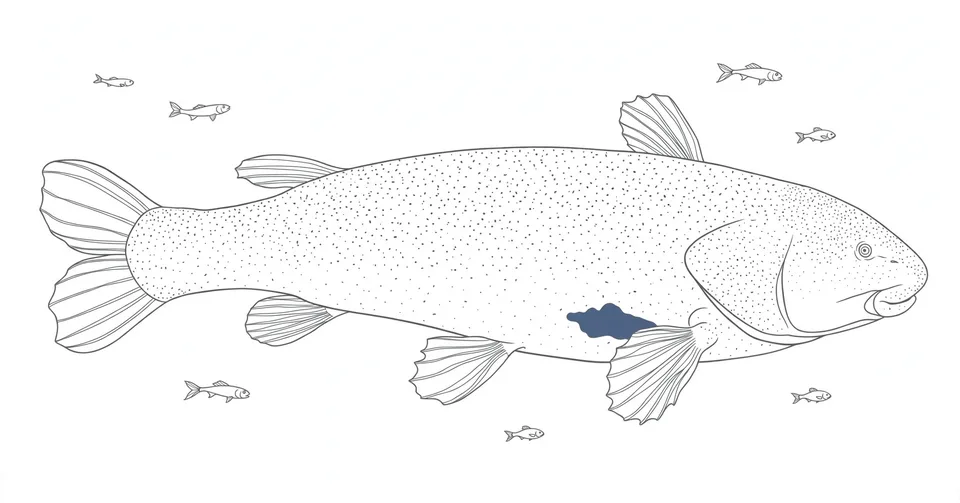
That one fish, about 1.5 metres long and weighing 58 kilograms, rewrote a chapter of natural history in a single afternoon. It proved that a whole lineage could hide from science for tens of millions of years, alive in dark water beyond the reach of nets. The coelacanth is still out there, still rare, and one of the few places where you can stand face to face with one is a small aquarium in Numazu, Japan.
This is the story of that fish, from a South African dock in 1938 to a frozen display case in Shizuoka, and of what it teaches us about time, patience, and the ocean we have barely begun to see.
The Day a Dead Fish Came Back to Life
The trawler was the Nerine, and its skipper was Hendrik Goosen. The catch came up near the mouth of the Chalumna River, in about 70 metres of water, and the fish was still alive when it reached the deck. Goosen called the one person who always asked to see anything unusual, Marjorie Courtenay-Latimer, curator of the small museum in East London.
Courtenay-Latimer made a habit of visiting the docks to check the day's catch. In the pile she spotted a fin, and under it a fish she had never seen alive, only in pictures of fossils. She later called it the most beautiful fish she had ever seen, pale mauvy blue, with faint flecks of whitish spots, four limb-like fins, and hard scales that felt more like armour than skin.
She had the fish taken to the museum, sketched it, and sent the sketch and some scales to J. L. B. Smith, a fish specialist at Rhodes University. Smith recognised the pattern at once, but he could not travel to see the fish for almost two months. When he finally stood before it on 16 February 1939, he had no doubt left, as Smithsonian Magazine retells the story. It was a true coelacanth. He named the species Latimeria chalumnae, for the curator who had saved it and for the river near where it was caught. It went on display in East London the same month, and 1,527 people came to see it.
It took another 14 years before a second living coelacanth turned up, off Anjouan in the Comoros in 1952. By then scientists had learned something humbling. The fishers of the Comoros already knew the animal well. They called it gombessa and caught it at night often enough to have a name for it. The 1938 fish was not the first coelacanth a human had ever met, only the first one Western science had noticed, and the gap between those two facts says a lot about how science finds things.
What a Coelacanth Actually Is
A coelacanth is a lobe-finned fish, a member of the group called Sarcopterygii. Most fish you know are ray-finned, with thin fins made of bony rays. A coelacanth is built differently. Its paired fins are fleshy stalks of muscle and bone, and they move in a diagonal rhythm, front left with rear right, the way a walking animal moves its legs. That detail made the coelacanth famous, because the same group includes the ancestors of every land vertebrate.
Look closer and the strangeness grows. The tail has three lobes, not two, with a small third lobe sticking out of the centre like a tuft. The second dorsal fin and the anal fin are lobed too, and they can move on their own. There is no bony spine, only a hollow tube of cartilage called a notochord, the structure that appears briefly in the embryos of other vertebrates before bone replaces it. In the coelacanth, the notochord stays for life.
Its snout holds a rostral organ, a jelly-filled chamber that senses weak electric fields, letting the fish hunt in near-total darkness by feeling the faint signals of prey. The African species is deep blue scattered with white speckles, and researchers use the pattern to tell one individual from another, the way people are told apart by fingerprints.
The phrase living fossil follows the coelacanth everywhere, and it deserves a careful look, because it is only partly true. The lineage is about 410 million years old, older than the dinosaurs, older than trees. But the fish alive today is not a fossil that failed to change. It is a modern species that kept evolving, slowly, in the dark. A genome study published in 2013 showed that the living fish closest to land vertebrates is the lungfish, not the coelacanth. It is a cousin on a very old branch, not a grandparent frozen in time.
Two Species in One Small World
Today scientists recognise two living species of coelacanth, both in the genus Latimeria, both living in a small corner of the Indian Ocean.
| Species | Where it lives | When it was found |
|---|---|---|
| Latimeria chalumnae | The Comoros, East Africa, and Madagascar | 1938, South Africa |
| Latimeria menadoensis | The waters around Sulawesi, Indonesia | 1997, Manado fish market |
The second species was found by accident, in the most ordinary place imaginable. In 1997, the American biologist Mark Erdmann spotted a strange fish in a market in Manado, Sulawesi, and recognised it as a coelacanth. It was described as a new species in 1999. The Indonesian coelacanth tends to be brownish grey rather than deep blue, and it lives around the volcanic slopes of northern Sulawesi.
Neither species is common. The African coelacanth is listed as Critically Endangered, and both are protected under the Washington Convention, the treaty that controls trade in endangered wildlife. A fish that survived the end of the dinosaurs can still be pushed toward extinction by a single generation of careless fishing.
A Life in Slow Motion
The coelacanth is most often found between about 100 and 700 metres down, resting in caves and along steep rocky slopes during the day, usually at 150 to 250 metres. At night it drifts out to hunt, moving slowly and spending as little energy as possible, because in the deep sea hurry is expensive and food is scarce.
Everything about the animal runs on a slow clock. A 2021 study that counted fine growth marks on scales found that a coelacanth can live for about 100 years, matures at around 55, and carries its young for about five years, one of the longest pregnancies known in any fish. Females give birth to live young, pups about 35 centimetres long, between three and 30 in a litter. Earlier estimates had put the lifespan at only 20 years.
There is something quietly rebuking about that pace. We live in a world that measures value in speed, and here is a creature that survived 410 million years by refusing to rush. It did not outrun its predators or outbreed its rivals. It simply kept going, slowly, in the dark. I find that more impressive than any record of speed. Survival does not always belong to the fastest. Sometimes it belongs to the patient.
The Frozen Coelacanths of Numazu
That patience is on display, quite literally, in Numazu. The Numazu Deep Sea Aquarium is the world's first aquarium devoted entirely to the deep sea, opened in December 2011 by a local fishery company. On its second floor sits the Coelacanth Museum, holding five coelacanths, two frozen and three taxidermied, caught by a Japanese academic research team in South Africa in 1981. The largest is about 1.8 metres long.
The frozen pair is the reason people travel to see them. They are kept at minus 20 degrees Celsius behind thick glass, and visitors can walk a full circle around them, studying the lobed fins, the thick scales, and the inside of the mouth with a realism no stuffed specimen can match. The aquarium says this is the only place in the world where frozen coelacanth specimens are on public display, because international rules now restrict their capture so tightly that no new frozen specimens can be brought in. In Japanese the fish is called shīrakansu, written シーラカンス, and the museum is part of the Numazu Port waterfront, a short bus ride from the station and a short walk from the fish market and seafood restaurants of Numazu Port.
It is a small room for such a large idea, and that is part of its charm. There are no shows and no bright lights, only a cold room, five quiet fish, and panels explaining what you are looking at. Admission for adults is 2,200 yen, revised in August 2025, so check the aquarium's own site before you go. The frozen coelacanths reward a slow look, and the building is small enough that a crowd fills it fast.
Why the Coelacanth Still Matters
The coelacanth matters for two reasons, and only one of them is science. The scientific reason is plain. Its body carries clues about how fins became limbs and how vertebrates left the water, and its genome helps researchers sort out deep branches of the family tree that includes us.
The other reason is harder to measure and easier to feel. The coelacanth is proof that the world still keeps secrets, and that a creature written off as extinct can be alive in a place nobody thought to look. For almost a century, textbooks said the last coelacanth had died 66 million years ago, and they were wrong, not because the authors were careless but because the ocean is large and dark and patient with its mysteries. If a fish two metres long can hide for that long, what else is down there?
That is why a small museum in Numazu matters more than its size suggests. It keeps five specimens where anyone can see them, not locked in a store room, and it lets a visitor stand before an animal older than the dinosaurs and feel the scale of deep time. A century of life, five years of pregnancy, 410 million years of lineage, all of it in a cold room by a fishing port. It is worth the bus ride, and it is worth the slow look.
More in Culture & Society
Latest posts
- Dashi, the Quiet Stock Under Almost Everything Japan Cooks
- Ayu, the Sweetfish That Rules Japan's Clear Rivers
- Gensen Kakenagashi, the Onsen Water That Never Circles Back
- Sumadori, Japan's Smart Drinking for People Who Do Not Drink
- Sake Kasu, the Sake Lees Japan Cooks With Instead of Throwing Away
- Bureiko, the Drinking Party Where Rank Is Left at the Door
- Kopi Tubruk and the Indonesian Way to Drink Coffee
- Capsule Hotels and Sleeping in a Pod in Japan
- Subak and the Rice Terraces of Bali
- Shinnenkai, Japan's New Year Parties That Start the Year Over
- Nara Deer and the Sacred Animals of the Old Capital
- Punakawan, the Clown Servants Who Steal Every Wayang Show
- Kashikiri, the Private Onsen Bath You Book by the Hour
- Nomi-Hara, When After-Work Drinks in Japan Turn Into Harassment
- Shio Koji, Japan's Salted Ferment That Seasons Everything