Tomozuri Sends a Living Fish to Do the Fishing
· 13 min read
Tomozuri is Japan's decoy method for catching ayu, in which an angler sends a live sweetfish into another fish's territory and lets the angry resident hook itself. This is how the trick works, where it is said to have been born, and why it still fills Japan's rivers every summer.
Most fishing methods try to fool a fish. A fly pretends to be an insect, a lure pretends to be a smaller fish, and the hope is always the same, that the fish will bite before it thinks. Tomozuri does something stranger and, to my mind, cleverer. The tomozuri angler does not offer the fish food at all. He offers it an enemy.
The bait in tomozuri is a living ayu, a real sweetfish swimming on a line, and it is sent deliberately into the patch of river that another ayu has claimed as its own. The resident fish does not inspect the intruder or weigh its options. It charges, head first, and in that charge it meets the hooks trailing around the decoy. The fish the angler wants is caught not by hunger but by temper.
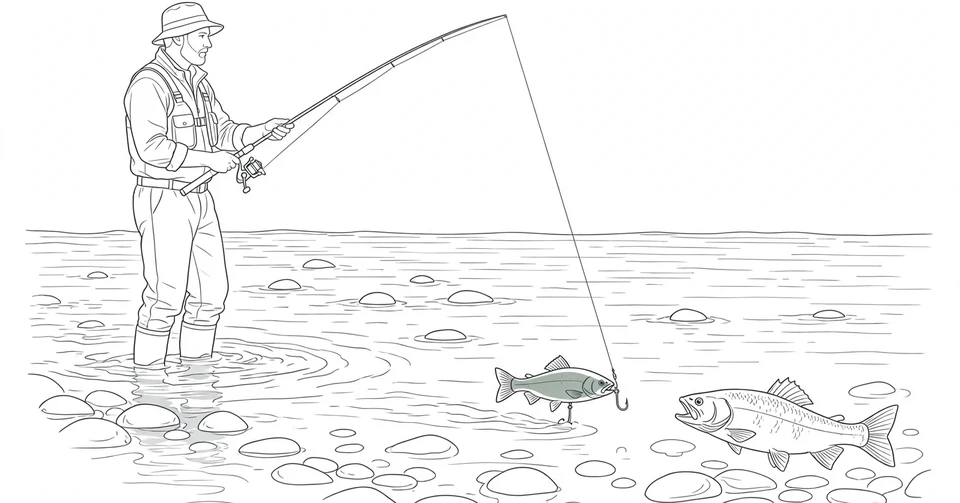
Spend a June morning on a good ayu river in Japan and you will see the tomozuri anglers standing in the current, long rods held high, looking less like fishermen than like puppeteers. In a sense that is exactly what they are. What follows is how the puppet show works, why the ayu makes it possible, and why one river in Shizuoka, the Kano, is said to be where it all began.
What tomozuri asks of the decoy
The decoy fish is called the otomo ayu, the companion fish, and the day usually begins with buying one. Tackle shops near famous ayu rivers sell live decoys at the start of the season, kept in tanks for exactly this purpose. Once the angler has caught a wild fish of his own, the arrangement improves, because the freshest, strongest fighter makes the best decoy, and a caught fish is typically promoted straight into the job.
The otomo ayu is fitted with a slim ring through its nose, and the line runs from that ring. Around and just behind the decoy hang small hooks, fine treble hooks on short traces, placed where an attacking fish is most likely to brush against them. The decoy itself is not hooked through the body in the way most people imagine live bait. It swims, and it has to swim well, because a tired or damaged decoy convinces nobody.
This is the part of tomozuri that takes practice to even picture. The angler wades into the river and works the decoy the way you might walk a dog through a park, except the park is a fast, cold current and the dog is five inches of silver. Using a very long rod, he steers the otomo ayu across the current and holds it over one particular stone, inside one particular territory, and waits for the owner of that stone to come home angry.
The resident ayu attacks by ramming. It slams its body into the intruder to drive it off the feeding ground, and in that moment of contact the trailing hooks do their work. A good tomozuri angler feels the strike through the rod, lifts, and suddenly has two fish on his hands, the decoy and its furious landlord. The wild fish goes into the keep net, or, if it looks stronger than the current decoy, it takes over the nose ring and the old otomo ayu gets to rest.
Spare decoys are kept alive in a container sitting in the river itself, a perforated box or basket in the current, so the water flowing through it keeps the fish fresh and ready. Everything about tomozuri is built around keeping one small fish alive, lively and apparently carefree, because the whole performance collapses if the decoy stops behaving like a rival and starts behaving like a victim.
A fish that defends its dinner
None of this would work on an ordinary fish. Tomozuri exists because the ayu is not ordinary. The ayu spends its summer grazing, scraping algae off river stones with a mouthful of fine, comb like teeth, and the algae on a good sunlit stone is valuable enough to fight over. Adult ayu in the river season stake out feeding territories, often around a single prized rock of roughly a square metre, and they defend those territories against any ayu that wanders in.
You can read the evidence of this life on the stones themselves. Where ayu have been grazing, the rocks carry pale scrape marks where the teeth have combed the algae away. The territory holders grow larger and more confident than the fish that travel in schools, develop a yellow patch along the flank, and acquire a reputation among anglers as the fish worth catching. The school fish are many, but the landlord fish is the prize, and tomozuri is aimed precisely at him.
The rest of the ayu's story explains why this drama is squeezed into a single summer. The ayu is an annual fish, written in Japanese with characters that can be read as year fish. It hatches in the lower river in autumn, drifts to the sea as a larva, winters in coastal water, and runs back up the river in spring at about six centimetres long. By summer it has reached fifteen to thirty centimetres, it is grazing, fighting and fattening, and by autumn it will spawn and, in most cases, die. The standard reference on the ayu describes this one year life and the decoy method side by side, because the two belong together. A fish with only one summer cannot afford to share its food, and that urgency is what the angler exploits.
If you want the fish's own biography rather than the fishing method, our account of the ayu, the sweetfish that rules Japan's clear rivers, follows it from the sea to the stones. Tomozuri is best understood as the final chapter of that biography, the moment the ayu's character becomes its undoing.
There is one more thing the territory explains, and that is the taste. A fish that lives on algae in clean, fast water, and defends its grazing like a small farmer, ends up with flesh that is famously clean and sweet, with a scent people compare to melon or cucumber. The table is the reason all this effort exists. Nobody would invent so elaborate a trick for an ordinary fish.
The tackle of tomozuri is mostly patience
The rod is the first surprise. A tomozuri rod is a telescopic pole of eight to nine metres, and some run to ten, with no reel at all. The line is fixed, fine and only a little longer than the rod. To a fisherman used to casting, this looks like a handicap. In tomozuri it is the whole point. The long rod lets the angler lower the decoy into the current far from his own shadow and boots, and then hold it steady, or walk it slowly along a line of stones, with the delicacy of someone moving a chess piece.
Everything else is light for the same reason. The decoy must appear to swim naturally, which means the line cannot drag it, the nose ring cannot exhaust it, and the hooks must hang near invisibly in the flow. The angler reads the water the way a gardener reads a slope, looking for the stones where algae grows thickest in the sun, where a territory holder is most likely to be in residence. Choosing the stone matters more than working the rod. Send the decoy over an empty rock and you can wait all day. Send it over the right one and the argument begins in seconds.
The skill, veterans will tell you, is in the manoeuvring. The decoy has to arrive in the territory still fresh, still swimming with confidence, and the strike, when it comes, is a ram rather than a bite, so the hooking is a matter of geometry as much as reflexes. This is why tomozuri is often described as the most demanding form of ayu fishing, and why beginners are usually pointed towards simpler methods, like drifting bare hooks through the riffles, before they are trusted with a living decoy.
I have stood on a bank in Shizuoka and watched an experienced angler work a stretch of river this way, and what struck me was the stillness of it. There is no casting, no retrieve, no visible excitement until the rod suddenly bends. The angler is less a hunter than a stage manager, arranging a meeting between two fish and letting them settle it themselves.
The Kano River says tomozuri was born there
Every famous method acquires a birthplace, and tomozuri's is claimed by the Kano River, the 46 kilometre river that runs from the Amagi mountains of Izu, through Numazu, and out into Suruga Bay. The claim is not made by the river alone. Japan's transport ministry, in its official portrait of the river, says the Kano is said to be the birthplace of tomozuri, and a guide to the Kano River's ayu repeats the tradition that the technique was born in these waters and taught from here to the rest of the country. Said to be is doing honest work in that sentence. The exact place and moment of invention cannot be pinned down, and the careful version is that the method is generally dated to the 18th century, with the Kano among its earliest and proudest homes.
There is, however, one piece of paper that gives the Kano claim real weight, and it is a complaint. In the Edo period, village leaders along the Kano River signed a petition asking the authorities to ban tomozuri as a hobby. The professional fishermen of the valley, who caught ayu with the traditional yana trap method and supplied the busy hot spring inns of the area, were struggling. The amateurs with their decoys were simply catching too many fish. The petition was granted, which may be the most convincing evidence of effectiveness any fishing method has ever received. Nobody petitions to ban a technique that does not work.
The setting helps the story, too. The upper and middle Kano, all clean gravel and fast bright runs through the hot spring valley of Yugashima, is textbook tomozuri water, stone after stone of it. Our history of the Kano River, the river that shaped Numazu, covers its floods, its old cormorant fishing and its fireworks, but the ayu are its flavour, and the decoy anglers, wading in line along the current when the season opens, are as much a part of the summer river as the lantern festivals.
Today the Kano's ayu season opens in late May, a little ahead of most Japanese rivers, and the fishing proper peaks in June and July, when the territory holders are at their most aggressive. Anglers travel from across the country for it. Mecca is a word travel writing uses too easily, but for tomozuri the Kano has about as good a claim as any river in Japan.
A short summer, run by the cooperatives
Tomozuri is a summer method because it depends on a summer mood. A territorial ayu is a warm water ayu. Most Japanese rivers open their ayu season in June, midsummer brings the strongest fish and the clearest water, and by September or October the season closes as the fish turn their minds to spawning. The whole sport is compressed into the same brief window as the fish's adult life.
It is also a regulated sport, and the regulation is local. Japan's rivers are managed by fishery cooperatives, and an angler buys a ticket, for a day or for the season, from the cooperative that governs that stretch of water. On the Yura River at Miyama, to take one documented example, the fishery union sells a day pass for 3,600 yen and a season pass for 13,800 yen, and even runs classes for beginners. The Kano has its own cooperative and its own fees, but the principle is the same everywhere. The ticket money funds the river, including the release of young ayu in spring to supplement the wild run.
The stocking matters because the honest background to tomozuri is decline. Rivers were concreted for flood control, gravel beds and algae covered stones were lost, and wild ayu numbers fell hard in the modern era. Cooperatives responded with releases and habitat work, and anglers, to their credit, mostly accepted the tickets and the rules as the price of keeping the tradition alive. The decoy method itself is old, but the careful management around it is modern, and the two now depend on each other.
An uneasy bargain with a small fish
Honesty requires a word about the decoy. Tomozuri asks a great deal of the otomo ayu. It is ringed through the nose, worked in the current for hours, and used as the target for attacks it cannot escape, and the method has its critics for exactly that reason. I find the unease reasonable and worth sitting with. All fishing makes use of a fish, one way or another, but tomozuri is unusually candid about it. It does not pretend the decoy is anything but a tool with a heartbeat.
And yet the same anglers who work a decoy hardest are often the fiercest defenders of the river, the ones funding the stocking, cleaning the banks and policing the poachers. The tradition holds both things at once, an old intimacy with the ayu and a willingness to spend one fish to catch another. Perhaps that tension is why tomozuri has kept its hold on the Japanese summer for three centuries. It is not a trick played on the river from outside. It is a negotiation with the river's own rules, conducted on the river's terms.
Stand on the Kano in June, or on any clear river where the stones carry scrape marks, and watch long enough, and you will see it happen. A silver fish holds its station over a rock, certain of its rights. Another silver fish drifts in, apparently careless. The water barely moves, and then, all at once, it does. Tomozuri sends a living fish to do the fishing, but in the end the river does most of the work. The angler just arranges the introduction.
More in Food & Travel
Latest posts
- Japan's Population Decline and the Villages It Leaves Behind
- KRL Commuterline and the Trains That Move Jakarta
- Loma Linda's Long Lives Run on Saturdays
- Half the Old Springs in Japan Thank Kobo Daishi
- Tatamiishi Terraces Filter a River Through Stone
- Wasabi-Zuke Puts the Whole Plant in Sake Lees
- Konyoku Is Still Out There, Past the Last Train Station
- Karo Is the Tengger's Other Great Gathering
- Dry January Lasts a Month on Purpose
- Urashima's Dragon Palace Had a Name, Ryugu
- Petruk's Nose Arrives Before He Does
- Ikaria Runs on Island Time
- Why Nicoya Cooks Its Corn in Lime
- A Ngaben Can Take a Village Years to Prepare
- Juryo Is Where Sumo Starts Paying