Why Japanese Toilets Are the Most Advanced in the World
· 9 min read
The Japanese toilet is not a joke about buttons. From the heated seat to the warm-water wash and the Otohime privacy sound, it is the most thoughtful piece of household technology Japan ever built.
The honest answer is that Japan stopped treating the toilet as a piece of plumbing a long time ago. The Japanese toilet is a hygiene appliance: a heated seat, a warm-water wash with adjustable temperature and pressure, a self-cleaning nozzle, and a dryer, all built into something most countries still treat as a plain porcelain bowl. It is not a gadget for its own sake. Every feature answers a small, specific discomfort, and that is why people who try one rarely want to go back.
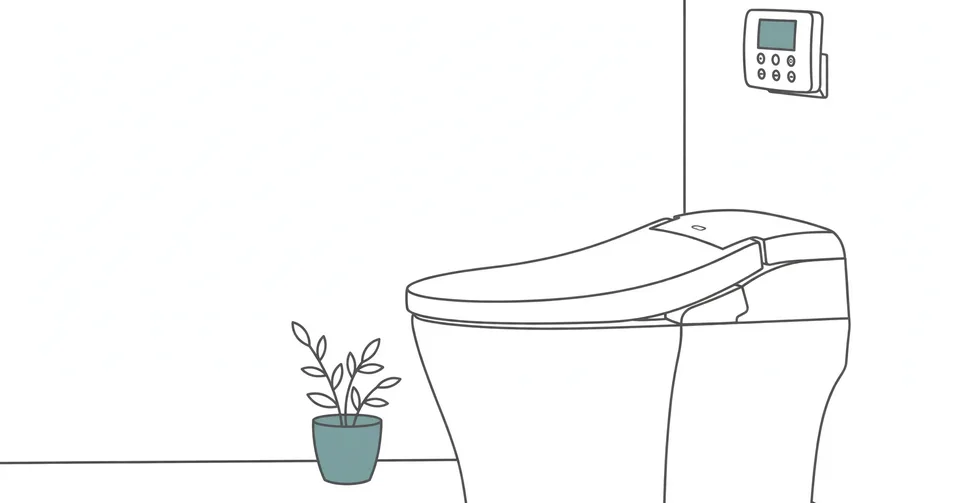
The first encounter is usually the confusing part. You walk into a spotless public restroom in Tokyo, sit down on a Japanese toilet, and face a panel of buttons covered in small symbols. Somewhere in there is a spray of warm water, a heated seat, and a button that plays the sound of flushing water to cover your own noise. It feels excessive until you use it once, and then the ordinary toilet back home feels unfinished.
This article explains how the Japanese toilet got that way, what each feature actually does, and what it says about a culture that treats cleanliness as a form of respect. The story starts, oddly enough, in America.
A short history of the Japanese toilet
The warm-water bidet seat was originally invented in the United States. It arrived in Japan in the 1960s, imported mostly for hospitals and care facilities, where warm-water washing was a matter of hygiene and dignity for patients who could not easily clean themselves. Few people at the time would have guessed that a medical device would end up as the Japanese toilet in nearly every home.
Japanese companies saw the potential that others missed. TOTO, the company that still leads the market today, launched its Washlet in June 1980, and INAX developed competing models of its own. The idea was simple: take the bidet, which in Europe was a separate fixture that took up a whole corner of the bathroom, and build it into the toilet seat itself. Add a heater for the seat, a dryer for afterwards, and controls that let each person adjust the water to their liking. What had been a hospital device became the mainstream Japanese toilet.
The adoption figures tell the rest of the story. A Japanese government survey cited by TOTO found that 80.3 percent of regular households had a washlet-style seat in 2021. That number is worth pausing on. It means the high-tech Japanese toilet is not a luxury for the wealthy or a novelty for hotels. It is the normal Japanese toilet, the one in ordinary apartments, offices, schools, and train stations. When a technology reaches four out of five homes, it has stopped being a product and become part of how a country lives.
What makes a Japanese toilet different
A modern Japanese toilet does several jobs at once, and each one is easy to understand on its own. The seat is heated, which matters more than it sounds on a cold winter morning. A nozzle under the seat sprays warm water, and you can adjust its temperature, pressure, and angle. The nozzle rinses itself before and after each use. An air dryer finishes the job, so toilet paper becomes optional rather than essential. The lid opens and closes by itself when you approach and leave. A deodorizer handles smells, and the Otohime feature plays a gentle flushing sound so that nobody outside the stall has to hear anything at all.
- A heated seat that warms to near body temperature
- A warm-water spray with adjustable temperature, pressure, and angle
- A nozzle that cleans itself before and after every use
- Warm-air drying, automatic lid, and deodorizer
- Otohime, the privacy sound that masks noise
None of these features is complicated by itself, and that is the point. The Japanese toilet is not impressive because it has a computer in it. It is impressive because someone sat down and listed every small discomfort of using a toilet, then solved them one by one. The cold seat, the rough paper, the awkward noise, the dirty nozzle: each has an answer. There is a quiet respect in that approach, a belief that even the least glamorous moments of the day deserve to be comfortable.
Japan has a habit of taking ordinary things and refining them until they feel considered. It does the same with convenience stores, which are destinations in their own right rather than just shops, and with vending machines, which sell hot soup on a winter street corner. The Japanese toilet is the same instinct applied to the most private room in the house. Once you notice the pattern, you start seeing it everywhere in Japan: no detail is too small to improve.
The eight symbols everyone had to agree on
There is one honest problem with the Japanese toilet, and the industry itself admitted it: the buttons confuse people. By the 2010s, control panels had grown so elaborate, with so many functions and so many different icons from different makers, that visitors often could not tell which button did what. Some pressed the wrong one and got a surprise spray. Others gave up and used nothing at all.
In 2017, the Japan Sanitary Equipment Industry Association stepped in. Its members, including TOTO, Panasonic, and Toshiba, agreed on eight standard pictograms for control panels, so that the same symbol would mean the same thing on every Japanese toilet. It is a small story, but it says a lot. An industry does not negotiate a shared visual language for a product unless that product has become complicated enough to need one, and the fact that rival companies sat down together to fix the confusion, rather than each guarding its own symbols, is very Japanese in itself. Clarity, in this case, was treated as a shared responsibility, not a competitive advantage.
Less water, less paper
The Japanese toilet is also a quiet environmental success, and the numbers are striking. In 1975, the average toilet sold in Japan used 13 litres of water per flush. Today, it takes only about 4.8 litres, thanks to bowl design, a special glaze, and whirlpool flushing.
Toilet paper use falls for a related reason. When warm water and warm air do the cleaning and drying, paper becomes a finishing touch instead of the main tool. Many households use far less of it, which is a small saving multiplied across millions of homes. It is a rare and pleasant case where comfort and conservation point in the same direction. Usually, making something nicer means using more resources. Here, the nicer version uses less water and less paper than the plain one it replaced, and nobody had to give anything up to get there.
Cleanliness as a culture, not a feature
None of this makes sense without the culture underneath it. Japanese ideas about cleanliness run deep, and they are tied to older beliefs about purification, including the Buddhist tradition of washing before entering sacred spaces and the bathing culture that survives today in the onsen hot springs. A bath in Japan is not just about getting clean. It is a ritual of warming, soaking, and resetting, and the Japanese toilet belongs to the same way of thinking: the body deserves care, and shared spaces deserve respect.
That respect shows up in the details. The nozzle cleans itself not only for your sake but for the next person. The Otohime sound exists so that strangers in a public restroom do not have to feel embarrassed. The public toilets themselves are cleaned with a seriousness that surprises visitors, and some of the most famous ones are treated almost as public art. In a Tokyo park, architect Shigeru Ban designed transparent-walled toilets that turn opaque when the door locks, a playful piece of design that also answers a practical question: you can see from outside that the stall is clean before you enter. The toilets appear in Wim Wenders' film "Perfect Days", which follows a Tokyo toilet cleaner who takes visible pride in his work. The film treats that pride as completely natural, and in Japan, it is.
Who benefits most
For elderly and disabled users, the Japanese toilet is more than a comfort. The bidet function means less reaching and twisting, the automatic lid and flushing remove small physical struggles, and the heated seat is gentler on stiff joints. Care facilities were where the technology started, and in a sense it never left that purpose behind. A device that helps a hospital patient wash with dignity helps everyone else too, which is often how good design works: solve the hardest case well, and the easy cases take care of themselves.
Travelers notice the other side of the same coin. Public restrooms in Japan are generally free, clean, and equipped with the same features as the ones at home, which is far from normal in most countries. It is one of those things visitors remember long after the trip, alongside the trains and the food, and it shapes how they describe Japan to friends: a country where even the Japanese toilets are kind to you.
The quiet lesson of the Japanese toilet
In the end, the Japanese toilet is not really about toilets. It is about a country that decided no daily experience was too small to improve, and then kept improving it for more than forty years, from a hospital import to a fixture in four out of five homes. The heated seat, the warm water, the clean nozzle, and the polite little sound are all answers to the same question: how do we make this moment slightly better for the person using it, and slightly better for the person who comes next?
That is a generous way to design anything, and it is worth borrowing. Most of us cannot rebuild our bathrooms tomorrow, and that is fine. The lesson travels better than the hardware. Pay attention to the small discomforts, fix them one at a time, and treat shared spaces as if the next person matters as much as you do. A Japanese toilet that does all of that is not a joke about buttons. It is a small, working model of consideration, and it flushes with only 4.8 litres of water.
More in Life & Style
Latest posts
- Love Live Sunshine and How Anime Changed Numazu
- Numazu Deep Sea Aquarium and the Creatures of Suruga Bay
- Numazu Himono and the Art of Dried Fish
- Numazu Imperial Villa and Japan's Seaside Imperial Retreat
- Numazu Port and the Freshest Seafood in Shizuoka
- Disaster Vending Machines in Japan That Give Their Drinks Away
- The E33G Remote Worker Visa and How to Legally Work from Bali
- Wabi-Sabi and the Japanese Beauty of Imperfect Things
- Bullet Climbing Mount Fuji, the Overnight Ascent Japan Is Trying to Stop
- Women Only Train Cars in Japan and the Problem They Answer
- Climbing Mount Semeru, Java's Highest Volcano
- Maneki Neko and Japan's Beckoning Lucky Cat
- Tamago Sando and Japan's Konbini Egg Sandwich
- The Baduy People and Life Without Modern Technology
- The Salaryman and Japan's Loyal Office Culture