Anak Krakatau, the Child of Krakatoa That Keeps Growing
· 8 min read
Anak Krakatau rose from the sea inside the caldera left by the 1883 Krakatoa eruption, grew for almost a century, then lost two thirds of its height in the collapse of 2018. This is the story of anak krakatau, the child volcano that caused a deadly tsunami and has been growing back ever since.
Anak Krakatau is the volcano that grew out of the sea where Krakatoa once stood. In 1883, its parent exploded in the Krakatoa eruption heard around the world, a blast that killed more than 36,000 people and left an empty caldera under the waves. Less than half a century later a new cone pushed up through that same sea, and Indonesians named it anak krakatau, the Child of Krakatoa.
The worry around anak krakatau is not theoretical. On the night of 22 December 2018, the southwestern flank of the young volcano collapsed into the sea during an eruption, and the wave it pushed across the Sunda Strait killed 426 people along the coasts of Java and Sumatra. The mountain lost two thirds of its height in a single night. Then, within weeks, anak krakatau quietly started growing again.
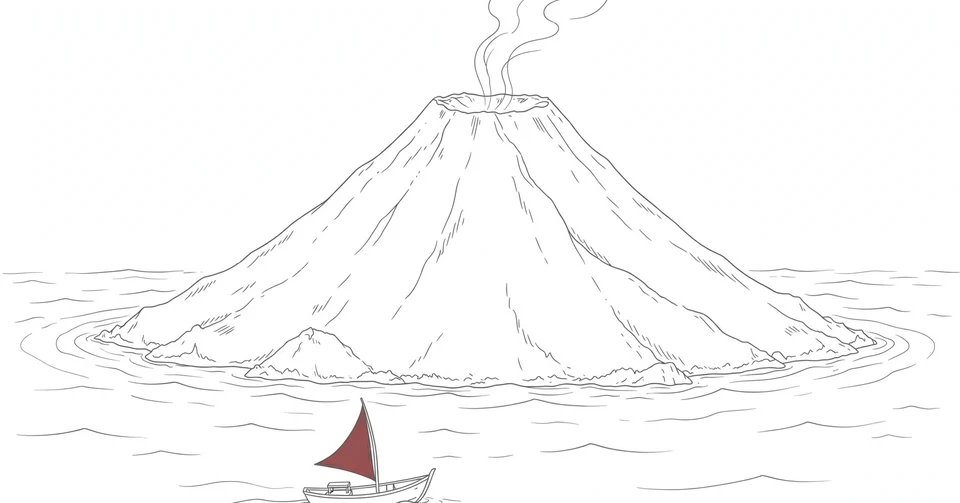
That stubborn regrowth is the heart of the story. Anak krakatau is not a finished mountain but a work in progress, assembled eruption by eruption on the rim of an old wound in the Earth. To understand the child volcano, you have to follow it from its first brief appearance in 1927, through almost a century of patient growth, to the collapse of 2018 and the rebuilding that continues today.
A volcano born inside the 1883 caldera
The 1883 eruption destroyed most of the old island of Krakatoa. In the power of that era it was second only to the eruption that changed the world, the 1815 explosion of Mount Tambora. What remained at Krakatoa was a flooded caldera, ringed by three leftover islands, and a volcanic system underneath that was very far from finished.
In late December 1927, eruptions began under the sea at the centre of that caldera, between the drowned cones of the old island. A small cone broke the surface, and the sea washed it away. It rose again and vanished again, several times over almost three years, as eruption and erosion fought over the same pile of ash and lava.
On 11 August 1930, the island finally stayed above water for good. Local people gave it the name it still carries: Anak Krakatau. From that date, anak krakatau has been the site of repeated eruptive episodes, more than 40 of them before 2018 alone, as the Smithsonian Institution's Global Volcanism Program records them. Few volcanoes on Earth have had their whole lives documented this closely, from birth certificate onwards.
How anak krakatau grew so fast
Growth at anak krakatau was never steady, but it was relentless. Eruption piled ash and lava onto the cone, and between eruptions the pile settled and hardened. On average, the summit climbed a few metres a year, which sounds gentle until you multiply it by a lifetime. By 2018, anak krakatau stood about 338 metres above the sea, a respectable mountain built from nothing in under 90 years.
Some of that growth was easy to see. In strong years, lava flows ran down the flanks of anak krakatau and reached the sea, extending the shoreline. The Smithsonian's reports describe flows in 2012 that added about 100 metres of new coast in a single episode. People crossing the strait by ferry could watch the island change shape from one season to the next.
The speed of that growth was also the problem. A cone built quickly from loose ash and lava, standing in deep water at the edge of a caldera, is not the most stable structure in nature. The flanks of anak krakatau were steep, young, and poorly held together. Scientists knew this in detail. Research published after the disaster notes that the failure of the western flank had been modelled years before it happened, and the flank that eventually fell was the one the models had pointed at.
Indonesia's volcanology agency, PVMBG, kept the volcano at Alert Level II, called Waspada, through most of this period, the second step on its four level scale. Activity resumed in June 2018 after a quiet spell, with explosions and ash plumes through the second half of the year. Nobody, on the coasts around the strait, treated the rumbling young volcano as an emergency. It had rumbled for decades.
The night the flank of anak krakatau fell in
On the evening of 22 December 2018, anak krakatau was erupting as it had for months. At about nine in the evening local time, during that eruption, a huge section of the southwestern flank, including the summit itself, gave way and slid into the sea. Indonesian officials later estimated that about 64 hectares of the island had collapsed into the ocean.
The sea did the rest. The sliding flank displaced an enormous volume of water, and a tsunami rolled outward across the Sunda Strait in the dark. It reached the coasts of Banten in Java and Lampung in Sumatra within roughly half an hour, arriving on a Saturday night when beaches and waterfront restaurants were busy.
The cruellest detail of the 2018 disaster is that the warning system never had a chance. Indonesia's tsunami buoys and alerts were built around earthquakes, and a landslide on anak krakatau produced no strong shaking to detect. Seismic studies later showed that the collapse generated only weak short period waves, the kind instruments are tuned to notice. The wave came out of a calm, ordinary night, with no earthquake to blame and no alarm to hear.
What the collapse took from anak krakatau
When scientists could finally measure the island, the change was shocking. Indonesia's Centre for Volcanology and Geological Disaster Mitigation reported that anak krakatau had lost between 150 and 180 million cubic metres of material, as reported at the time. The summit, 338 metres high before the collapse, now stood at about 110 metres. Two thirds of the mountain was simply gone, spread across the floor of the strait.
The human cost was heavier. The final official toll settled at 426 people dead and more than 14,000 injured, with thousands more driven from their homes along more than 300 kilometres of coastline. It was the deadliest volcanic tsunami in Indonesia since the waves of 1883, and it came from the same volcanic family, in the same narrow sea.
In the days after the collapse, the alert level for anak krakatau was raised to Level III, Siaga, and people were ordered to stay at least 5 kilometres from the crater. The main vent, suddenly open to the sea, erupted in violent steam driven bursts as seawater met rising magma. For a while, it was not clear that the island would survive at all.
Growing back since 2019
The island did survive, and it wasted no time. Satellite radar observations showed that by 10 January 2019, barely three weeks after the collapse, new material was already piling up inside the scar. The crater, which the sea had broken into, closed its rim above the water again, and through early 2019 anak krakatau continued to increase in height and remodel the ground it had lost.
Through the rest of 2019, the new crater kept erupting in steam driven bursts where rising magma met seawater, and by December of that year the explosions had built a fresh cone of loose volcanic rock inside the scar, around a small crater lake. On 25 March 2019, PVMBG had already lowered the alert level back to Level II. The rebuilding has continued in public view ever since. An eruption in April 2020 was heard in Jakarta, more than 150 kilometres away. In April 2022 the alert level was briefly raised to Level III again as explosions grew and a lava flow ran down the flank into the sea. The Smithsonian's bulletin reports record ash plumes and thermal activity at anak krakatau through 2023 and into 2024, the normal background noise of a young volcano getting on with its life.
I find something almost defiant in this. Anak krakatau lost its summit, its shape, and two thirds of its height in one night, and its response was simply to continue. The child of Krakatoa grows the only way it knows how, one eruption at a time, exactly as it did in 1930.
Why anak krakatau is watched so closely
Today, anak krakatau is monitored day and night by PVMBG, with an observatory on the Banten coast, seismic instruments, cameras, and satellites that can measure the island's shape through cloud and darkness. The 2018 collapse changed how seriously flank failure is taken, not just in Indonesia but at island volcanoes everywhere. A mountain does not need a giant eruption to kill. It only needs to fall into the sea.
The setting leaves no room for complacency. Anak krakatau grows in one of the busiest seaways in Indonesia, within sight of coasts where millions of people live, work, and holiday. The lesson of 1883 was that this volcano can change the weather of the whole planet. The lesson of 2018 was quieter and, in its way, harder: the danger does not need an explosion at all.
So the watching continues, and so does the growing. Anak krakatau is already far taller than the stump it was in January 2019, and there is no reason to think it will stop. Somewhere in the Sunda Strait, the child of the most famous eruption in history is rebuilding itself, patiently, a few metres at a time, while the people on the coasts around it learn to live with a mountain that is still being born.
More in Culture & Society
Latest posts
- Dashi, the Quiet Stock Under Almost Everything Japan Cooks
- Ayu, the Sweetfish That Rules Japan's Clear Rivers
- Gensen Kakenagashi, the Onsen Water That Never Circles Back
- Sumadori, Japan's Smart Drinking for People Who Do Not Drink
- Sake Kasu, the Sake Lees Japan Cooks With Instead of Throwing Away
- Bureiko, the Drinking Party Where Rank Is Left at the Door
- Kopi Tubruk and the Indonesian Way to Drink Coffee
- Capsule Hotels and Sleeping in a Pod in Japan
- Subak and the Rice Terraces of Bali
- Shinnenkai, Japan's New Year Parties That Start the Year Over
- Nara Deer and the Sacred Animals of the Old Capital
- Punakawan, the Clown Servants Who Steal Every Wayang Show
- Kashikiri, the Private Onsen Bath You Book by the Hour
- Nomi-Hara, When After-Work Drinks in Japan Turn Into Harassment
- Shio Koji, Japan's Salted Ferment That Seasons Everything