The Dalang, the Single Voice Behind Every Wayang Puppet
· 8 min read
A dalang performs an entire wayang show alone, voicing every puppet, singing the mood songs, and leading the gamelan until dawn. Here is how one person carries a whole theatre through the night.
A wayang show has kings, gods, demons, and clowns, sometimes more than a hundred characters in a single night. Every one of them speaks with the same throat. Sitting alone behind a lit screen, the dalang is the entire cast of Indonesia's shadow puppet theatre, and the show cannot start, pause, or end without him.
He arrives as one man with a wooden chest of leather puppets. By dawn he has been a lovesick prince, a raging giant, a gossiping servant, and the wise god who watches over them all. If you want to understand wayang, Indonesia's shadow puppet theatre, start with the dalang, because the puppets are only leather and paint until he picks them up.
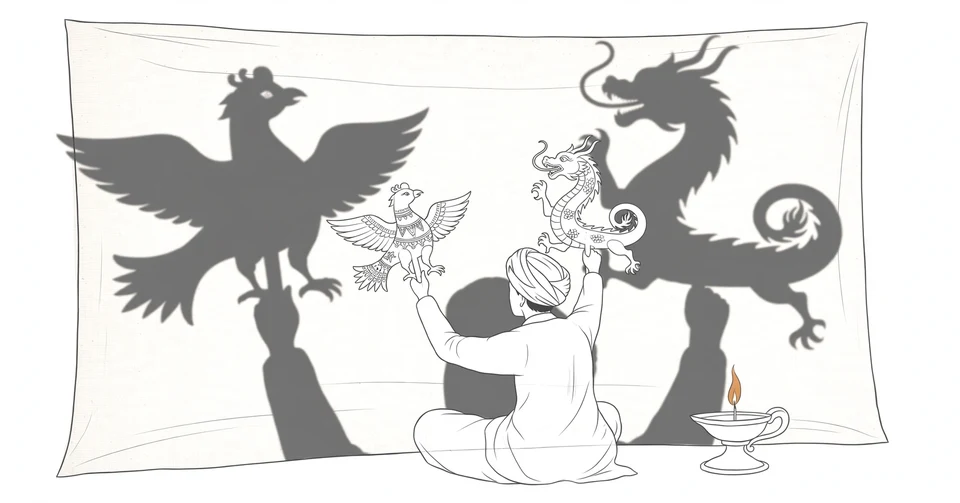
It is, to my mind, the most demanding job in traditional theatre. An opera spreads its work across singers, actors, an orchestra, and a conductor. The dalang does all of it himself, cross-legged, for eight or nine hours, in front of an audience that knows the story by heart and will notice every mistake.
A small stage built around one dalang
The dalang sits cross-legged on the floor behind the kelir, a wide cotton screen stretched on a wooden frame. Above his head hangs the blencong, traditionally an oil lamp, whose light throws the shadows that the audience watches from the other side. Many shows now use an electric lamp, but the arrangement has not changed: lamp, puppets, screen, crowd.
On each side of him, rows of puppets stand ready, their handles stuck into a soft banana trunk. The heroes gather on one side and their enemies on the other, so the geography of the coming war is laid out before the first line is spoken. Behind him sits the wooden chest that stores the full set, the same kind of box that holds the royal set now kept at the Yale University Art Gallery, where nearly 900 wayang kulit puppets survive as museum pieces.
At the centre of the screen stands the kayon, a leaf shaped puppet that represents the cosmic mountain and the tree of life. The dalang plants it to open the night, tilts it to raise a wind or a fire, and plants it again whenever one scene gives way to the next. It is the curtain, the scenery, and the full stop of wayang, all in one carved leaf.
A hundred voices in one throat
The first skill is the voice. A noble prince speaks slowly, in refined high Javanese, in words chosen for poetry as much as for meaning. A demon answers in a growl that seems to come from under the floor. An old king is thin and shaking, a young warrior bright and quick, and the dalang moves between them in mid sentence, without a pause for breath that the audience can hear.
UNESCO, which proclaimed wayang a Masterpiece of the Oral and Intangible Heritage of Humanity in 2003 before placing it on its Representative List, notes that master puppeteers are expected to memorise a vast repertory of stories and to recite ancient narrative passages and poetic songs in a witty and creative manner. There is no script on the floor beside him. The whole library sits in his memory, and the audience, who grew up on the same stories, is listening for how he tells it this time.
Then the language drops. The clown servants speak the plain everyday speech of the village, and through them the dalang can say things that no king on the screen would dare to say. I will come back to the clowns, because they are where the night stops being only a story.
Hands, feet, and a hidden orchestra
His hands never rest. The dalang holds the central rod of a puppet in one hand and works its jointed arms with thin sticks, as UNESCO describes it, making a figure bow, fight, dance, or tremble with fear. In a battle scene both hands are flying and two puppets clash and spin, and somehow the voices keep coming, each one in character.
His feet are working too. Against a set of small metal plates called kepyak, struck with his foot, he taps out signals that the musicians behind him read like a conductor's baton. A wooden knocker, the cempala, raps against the puppet chest to punctuate a blow, a slamming door, or a heartbeat. The musicians follow the dalang, never the other way round, which makes him the conductor of the gamelan ensemble as well as its lead performer.
And at quiet moments, he sings. The mood songs, called suluk, rise between scenes, short poetic passages sung to a few soft instruments rather than the full orchestra. In a long night the dalang may sing dozens of them. They are the breathing spaces of the show, the moments when the story slows and the audience feels the sadness, or the calm, before the next storm.
Old epics with new jokes inside
Almost every story the dalang tells comes from the Ramayana and the Mahabharata, the two great Indian epics that reached Java more than a thousand years ago and were rebuilt there. Kings go into exile, brothers go to war, and gods walk the earth in disguise. The outlines are fixed. What the dalang does inside them is not.
Java added its own invention to the epics: Semar and his sons Gareng, Petruk, and Bagong, the punakawan clown servants who attend the heroes. Around the middle of the night they take over the stage in scenes of open comedy, and here the dalang becomes a commentator on the world outside the screen. The price of rice, the behaviour of officials, the new road that floods every rainy season, all of it can surface in a clown's mouth, in plain language that everyone understands.
UNESCO makes the same point in more formal words: the comic characters, who represent the ordinary person, have long provided a vehicle for criticising sensitive social and political issues. That licence is one reason wayang has survived every age Java has known. The epic gives the dalang authority. The clowns give him freedom.
More than an entertainer
In the past, UNESCO notes, puppeteers were regarded as cultivated literary experts who transmitted moral and aesthetic values through their art. The dalang was hired for weddings, circumcisions, and village cleansing rites, and his presence was part of the blessing, not just the entertainment. People asked his advice, and some treated him as a spiritual figure, a man whose nights among gods and ancestors had taught him things.
This is the part of the job I find hardest to explain to anyone who thinks of puppetry as children's theatre. The dalang is closer to a travelling teacher who happens to be very funny. The stories he carries form a shared moral library, and the village hears its own dilemmas argued out by kings and clowns until dawn.
Learning to disappear into the puppets
Nobody becomes a dalang quickly. The repertory alone, hundreds of stories with their songs, voices, and puppet movements, takes years to absorb, and the tradition has historically passed down within the families of puppeteers, musicians, and puppet makers, as UNESCO records. A student begins by watching, night after night, then by handling minor puppets, then by performing small scenes while the master listens from the audience side of the screen.
Today there are also art schools and universities where the craft is taught formally, and the old apprenticeship survives beside them. What has not changed is the standard. A dalang is judged on the beauty of his puppet movement, the truth of his voices, the depth of his memory, and the sharpness of his jokes, all in the same night, and all before people who have watched wayang since childhood.
Fame, when it comes, is enormous. Stars such as Ki Nartosabdho and Ki Manteb Soedharsono drew crowds far beyond the village square, and collectors have long prized puppets that famous hands have used. Major collections hold sets that passed through the hands of celebrated puppeteers, which tells you something about the aura a great name leaves even on carved leather.
Why the night still belongs to the dalang
There is a quiet paradox at the centre of all this. The dalang spends the night making himself invisible, crouched behind a screen, lending his voice to leather figures, and yet everything the audience feels passes through him. When the kayon is planted for the last time and the lamp dims, the crowd has not really been watching puppets. It has been listening to one neighbour hold up a mirror made of old stories.
That, I think, is why the form endures. Empires, religions, and technologies have crossed Java, and the arrangement is still the same: a lamp, a screen, a chest of puppets, and a dalang willing to stay awake until dawn so that a whole world can speak.
More in Culture & Society
Latest posts
- Dashi, the Quiet Stock Under Almost Everything Japan Cooks
- Ayu, the Sweetfish That Rules Japan's Clear Rivers
- Gensen Kakenagashi, the Onsen Water That Never Circles Back
- Sumadori, Japan's Smart Drinking for People Who Do Not Drink
- Sake Kasu, the Sake Lees Japan Cooks With Instead of Throwing Away
- Bureiko, the Drinking Party Where Rank Is Left at the Door
- Kopi Tubruk and the Indonesian Way to Drink Coffee
- Capsule Hotels and Sleeping in a Pod in Japan
- Subak and the Rice Terraces of Bali
- Shinnenkai, Japan's New Year Parties That Start the Year Over
- Nara Deer and the Sacred Animals of the Old Capital
- Punakawan, the Clown Servants Who Steal Every Wayang Show
- Kashikiri, the Private Onsen Bath You Book by the Hour
- Nomi-Hara, When After-Work Drinks in Japan Turn Into Harassment
- Shio Koji, Japan's Salted Ferment That Seasons Everything