Shibuya Crossing, the Busiest Intersection on Earth
· 9 min read
Shibuya Crossing is the scramble crossing outside Shibuya Station in Tokyo, where as many as 3,000 people cross on a single green light. This is how it works, when to go, and the best way to see it.
Stand on the corner outside Shibuya Station in Tokyo and wait for the lights to change. When they do, the traffic stops in every direction at once, and a crowd steps off the curb from all sides, crossing diagonally, weaving past each other without stopping, and reaching the other side in under a minute. Then the cars move again, and a few seconds later another crowd forms. This is Shibuya Crossing, and it repeats all day, every day.
Shibuya Crossing is the scramble crossing outside the Hachiko exit of Shibuya Station, and it is widely described as the busiest pedestrian crossing in the world. The honest version of that claim is a little more careful than the postcards suggest, but the thing itself is real. Thousands of people cross here on a single green light, and hundreds of thousands pass through in a day. What makes Shibuya Crossing worth understanding is not just the size of the crowd. It is the way the crowd moves.
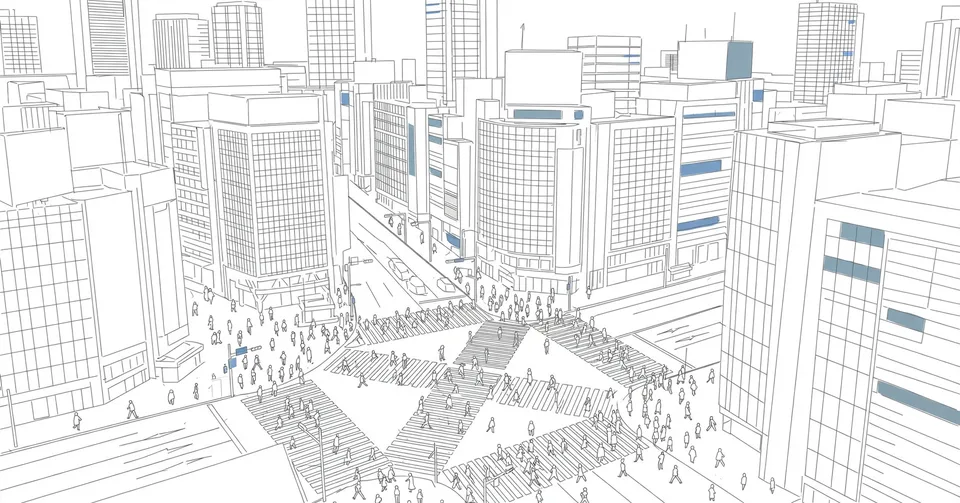
From the ground, Shibuya Crossing feels surprisingly calm for something with this reputation. Nobody shouts directions. Nobody holds up a sign. People walk at their own pace, adjust around each other, and arrive where they meant to go. The order is the interesting part. A crossing this busy should feel chaotic, and mostly it does not.
How a scramble crossing works
At an ordinary intersection, pedestrians cross one side at a time while cars turn across the other. At Shibuya Crossing, every traffic light turns red at the same time, and every crosswalk opens at once. People cross in all directions, including diagonally across the middle of the junction, which is what gives the place its name. The word scramble describes what it looks like from above, a crowd scattering in every direction at once.
The idea is older than Shibuya Crossing itself. Stopping all traffic so pedestrians can cross in any direction was tried in North American cities in the 1940s, where it was sometimes called a Barnes Dance after the traffic engineer who promoted it. Japan adopted the pattern in the decades that followed, and Shibuya became the famous one, partly because of where it sits. Shibuya Station is one of the busiest stations in the world, and the crossing sits directly outside its Hachiko exit, where commuters, shoppers, students, and tourists all pour out onto the same piece of pavement.
There are five crosswalks meeting at the junction, and the pedestrian phase is short, well under a minute. The lights release roughly every two minutes, so the rhythm of the place is a short burst of walking, a short wait, and another burst. If you stand and watch for ten minutes, you will see the pattern five times, and it never quite looks the same twice, because the mix of people changes every cycle.
Part of the reason Shibuya Crossing works is that it asks very little of the people using it. There is no ticket, no queue, and no instruction. You wait for the light, you walk, and you arrive.
The numbers behind Shibuya Crossing
Every guide to Shibuya Crossing quotes a figure, and not all of them mean the same thing. The most quoted number is that as many as 3,000 people cross on a single green light at peak times. That figure comes from Japanese press coverage and has been repeated for years. It is a fair description of the busiest moments, and it is also the number most likely to be quoted without its context.
A flow survey by the Shibuya Redevelopment Association estimated about 260,000 pedestrians on a weekday and 390,000 on a non-working day. Those are survey estimates, not turnstile counts, but they come from an actual count of people moving through the area, which makes them more solid than the round numbers that appear in most travel guides.
| Figure | What it counts | How solid it is |
|---|---|---|
| Up to 3,000 people | One green light, at peak | Widely quoted from Japanese press |
| About 260,000 people | Pedestrians on a weekday | Shibuya Redevelopment Association survey |
| About 390,000 people | Pedestrians on a non-working day | The same survey |
| Up to 500,000 people | The busiest days | An estimate, not a measured count |
The often quoted 500,000 a day figure belongs in the last row. It is an estimate for the busiest days, not a measured count, and it gets repeated as if it were a daily average. Tokyo's official tourism site is more careful, saying upwards of 1,000 people cross at once, which is true on almost any evening. The honest way to describe Shibuya Crossing is that it is routinely one of the busiest pedestrian crossings anywhere, with a few thousand people crossing at a time and hundreds of thousands passing through in a day.
Hachiko, the dog who waited
Beside Shibuya Crossing stands a small bronze statue of a dog, and it is almost as famous as the crossing itself. Hachiko was an Akita who met his owner, Professor Hidesaburo Ueno, at Shibuya Station every evening. When Ueno died in 1925, Hachiko kept coming to the station to wait for him, and he did so for about nine years, until his own death in 1935. The statue was first put up in 1934, while Hachiko was still alive.
Today the statue is the standard meeting point for the whole district. People say "meet at Hachiko" the way people in other cities say "meet at the station clock." The queue to take a photo with the statue can be long, especially in the evening, and that is part of the ritual now.
The best ways to see Shibuya Crossing
The simplest way to see Shibuya Crossing is to cross it. Walk it once at street level, in the middle of the crowd, and you will understand the place in a way no photograph can teach. It is free, it takes a minute, and it is the experience everyone else is having. Do it once in daylight and once after dark, because the two crossings feel like different places. In daylight you notice the scale. At night you notice the light, with the screens and the neon turning the whole junction into something brighter than the sky above it.
The best view from above is Shibuya Sky, the observation deck on top of the Shibuya Scramble Square building. Tickets cost ¥2,700 to ¥3,700, and the last entry is at 9:20pm. From the rooftop you can watch the crossing work as a pattern, the crowds moving in waves with each light change, and the whole district spread out behind it. Book ahead, because the sunset slots sell out, and the deck closes in bad weather.
A cheaper view is the rooftop of MAGNET by SHIBUYA109, now called MAG8, which looks straight down onto the crossing from a lower angle. The second floor of the Tsutaya building, where a well known coffee shop sits above the junction, offers another option. Buy a drink, take a window seat, and watch the crowd for as long as you like. It is not as high as Shibuya Sky, but it is closer to the noise and the movement, and it costs the price of a coffee.
Whichever viewpoint you choose, give yourself more than five minutes. Watch two or three cycles and you start to see the pattern in the crowd, the way people find their line through the junction. Five minutes is enough to say you have seen it. Fifteen minutes is enough to understand it.
When to go to Shibuya Crossing, and when not to
Shibuya Crossing is busiest on weekday evenings after work and on Friday and Saturday nights, roughly from six to nine in the evening. That is the best time to see it at full scale, and also the worst time to cross it in a hurry. If you want the biggest crowd, come then. If you want a photo with some space in it, come early in the morning, when the crossing is almost empty and the light is soft.
Halloween is the exception that proves the rule. The crowds around Shibuya Crossing on Halloween night grew so large that the ward began restricting access to the area from 2023 onward, with police and barriers keeping people out of the streets around the station. New Year's Eve brings a similar crush, with crowds gathering to count down in the open. Both are worth knowing about in advance, because the crossing on those nights is not the crossing you came to see. It is a crowd control problem with a famous address.
The rest of the year, Shibuya Crossing belongs to everyone, and that is the point. Commuters cross it twice a day without thinking about it. Tourists cross it once and remember it for years. The same piece of pavement serves both purposes without changing anything about itself. If you are planning a trip to Tokyo, the crossing is worth an evening of your time, not because it is a sight in the usual sense, but because it is the city working in public, in a way you can watch for free.
Before you go, stop at a konbini and pick up a drink for the walk. The convenience stores around the station are part of the same rhythm as the crossing, open all hours, full of people grabbing something on their way somewhere else. Then walk to the curb, wait for the lights, and cross with everyone else. The crowd will part around you, and a minute later you will be on the other side, wondering why something so ordinary felt worth remembering.
That is the quiet lesson of Shibuya Crossing. A city can build the biggest, brightest, busiest intersection on earth, and what people remember is not the size of it. It is the minute they spent inside the crowd, moving with strangers in the same direction, in a place where nobody needed to be told where to go.
More in Life & Style
- Onsen Tattoo Rules in Japan and How They Are Slowly Changing
- Sento, Japan's Everyday Public Bathhouse
- Jamu, Indonesia's Herbal Medicine in a Bottle
- Ryokan, Japan's Traditional Inns
- Why Japanese Toilets Are the Most Advanced in the World
- Chakubarai, the Japanese Way to Make the Receiver Pay for Delivery
Latest posts
- Love Live Sunshine and How Anime Changed Numazu
- Numazu Deep Sea Aquarium and the Creatures of Suruga Bay
- Numazu Himono and the Art of Dried Fish
- Numazu Imperial Villa and Japan's Seaside Imperial Retreat
- Numazu Port and the Freshest Seafood in Shizuoka
- Disaster Vending Machines in Japan That Give Their Drinks Away
- The E33G Remote Worker Visa and How to Legally Work from Bali
- Wabi-Sabi and the Japanese Beauty of Imperfect Things
- Bullet Climbing Mount Fuji, the Overnight Ascent Japan Is Trying to Stop
- Women Only Train Cars in Japan and the Problem They Answer
- Climbing Mount Semeru, Java's Highest Volcano
- Maneki Neko and Japan's Beckoning Lucky Cat
- Tamago Sando and Japan's Konbini Egg Sandwich
- The Baduy People and Life Without Modern Technology
- The Salaryman and Japan's Loyal Office Culture