Kamakura and the Samurai Capital That Time Forgot
· 11 min read
Kamakura was Japan's first samurai capital, and today its Great Buddha, Zen temples, and little coastal train make it the best day trip from Tokyo.
An hour south of Tokyo by train, the towers give way to wooded hills, temple roofs, and the sea. This is Kamakura, a small coastal city that was once the capital of Japan, and the place where the samurai first took power. Its Great Buddha has sat in the open air for more than 770 years, watching over a town that never quite let go of its past.
The city is not a museum. People surf at Yuigahama beach in the morning, school groups climb the stone steps of Tsurugaoka Hachimangu at noon, and the little Enoden train rattles past houses so close you could almost touch them. Temples and ordinary life share the same narrow streets here, and that closeness is exactly what makes the city worth a day of your time.
This guide covers the city that matters: the Buddha, the shrine, the Zen temples, the train along the coast, and the seasons that change the city completely. Everything here fits into one day from Tokyo, on foot and on one small railway line.
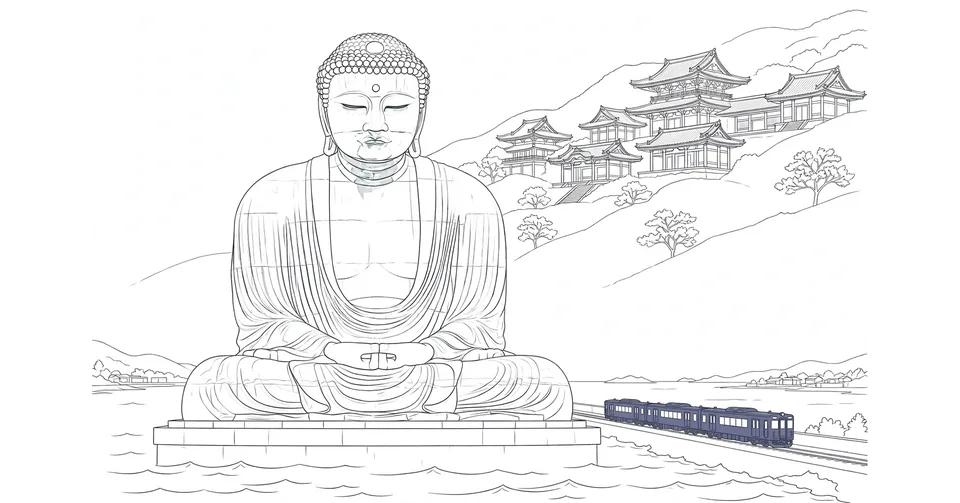
Kamakura Was Japan's First Samurai Capital
Kamakura became the political center of Japan in 1185, when the warrior Minamoto no Yoritomo set up the first shogunate here. For the next century and a half, until 1333, the city was where Japan was actually ruled, while the emperor's court in Kyoto kept the ceremonies and lost the power. The shogunate built temples, shrines, and warrior residences in the valleys around the town, and the town grew into a city of soldiers, monks, and craftsmen.
The samurai government fell in 1333, when the forces of Nitta Yoshisada attacked the city and the Hojo regents who ruled in the shogun's name were wiped out. The city shrank back into a quiet provincial town, and for centuries it stayed that way. What saved it was what it had built: the temples and shrines were too important to abandon, and the town around them never grew large enough to swallow them. That is why the city still feels like a former capital rather than a suburb of Tokyo. It did not rebuild itself into a metropolis. It kept its hills, its lanes, and its slow pace, and the history stayed visible in the streets.
The Great Buddha of Kamakura
The symbol of the city is the Great Buddha at Kotoku-in temple, a bronze statue of Amida Buddha that has sat outdoors for centuries. Work on the statue began in 1252, during the height of the Kamakura shogunate, and the figure measures 11.31 meters tall, or 13.35 meters including its pedestal. It weighs about 121 tons, and it was cast in roughly 30 separate sections that were joined on site. The seams are still visible if you look closely. The statue was designated a National Treasure of Japan in 1958.
The Buddha was not always outdoors. It once stood inside a great wooden hall, but a tsunami swept the hall away at the end of the 15th century, and the statue has sat in the open air ever since. Rain, wind, and earthquakes have passed over it for more than 500 years, and it has not moved. There is something reassuring about that. Most famous sights in Japan are kept behind glass or rope. The Great Buddha simply sits there, in the weather, at human scale, and you can walk right up to it.
Admission to Kotoku-in is 300 yen for adults and 150 yen for children aged 6 to 12, and preschool children enter free. For an extra 50 yen you can step inside the hollow statue and see the casting joints and support brackets. The temple is open from 8:00 to 17:30 from April to September, and from 8:00 to 17:00 from October to March. Go early in the morning if you can. The courtyard is quiet before the tour groups arrive, and the light on the bronze is at its best. The full visiting details are kept up to date in this Great Buddha guide.
Hasedera and the Hillside Above the Bay
A few minutes on foot from the Great Buddha stands Hasedera, a hillside temple founded in 736, centuries before the samurai arrived. Its main hall holds a gilded wooden statue of the eleven-headed Kannon, about 9 meters tall, one of the largest wooden Buddhist statues in Japan. From the terrace in front of the hall you can look out over Yuigahama beach and Sagami Bay, and on a clear winter day you can see Mount Fuji across the water.
Hasedera is also the temple that defines the city in June. Its hillside hydrangea path holds about 2,500 plants, and when they bloom the whole slope turns blue and pink. The path is so popular in June that the temple sells timed tickets for it, and the queues can be long on weekends. If you visit in June, book an early slot and come on a weekday. There is also a small cave on the grounds, the Benten-kutsu, carved with figures of the goddess Benten. It is dark, low, and easy to miss, and it is one of the most atmospheric corners of the city.
Tsurugaoka Hachimangu, the Shrine at the Heart of Kamakura
Every road in the city center seems to lead to Tsurugaoka Hachimangu, the great shrine of the Minamoto clan. The shrine was founded in 1063 and moved to its present site by Yoritomo in 1180, at the head of the broad Wakamiya-oji avenue. A raised stone path called the Dankazura runs up the middle of the avenue toward the shrine, lined with cherry trees that bloom around late March. The shrine itself stands at the top of a long flight of stone steps, and from the terrace you can see straight down the avenue toward the sea.
The shrine grounds are free to enter, and they are the living center of the city. More than two million people visit over the New Year holidays, one of the largest crowds at any shrine in the Kanto region. On an ordinary day it is calmer: students praying before exams, couples taking wedding photos, and old men feeding the doves by the pond. The cherry blossoms along the Dankazura are among the best in the region, and the timing usually matches the cherry blossom season in Japan in late March and early April.
The Zen Temples of Kita-Kamakura
North of the city center, around Kita-Kamakura Station, sits a cluster of Zen temples that feel like a different world from the busy streets of Hase. Kencho-ji, founded in 1253, was the first Zen training monastery in Japan, and its great wooden halls still host morning meditation sessions that visitors can join. Engaku-ji, founded in 1282, climbs a wooded hillside in a series of quiet terraces, and it is one of the best places in Kamakura to sit still for a while.
Meigetsu-in, a small temple nearby, is known as the hydrangea temple. Its garden fills with blue flowers in June, and its round window frames the inner garden like a painting. These temples are quieter than the famous sights, and they reward the visitor who arrives early and walks slowly. Zen came to Japan through this city, and the Japanese tea ceremony that grew out of Zen practice still carries the same spirit of attention to one thing at a time.
Riding the Enoden Along the Coast
The Enoden, short for the Enoshima Electric Railway, is the small train that ties the town together. It runs from Kamakura Station to Fujisawa, 15 stops in about 34 minutes end to end, passing through Hase, the beaches, and the coast road to Enoshima. The ride to Hase takes only a few minutes and costs 200 yen, and a one-day pass costs about 800 yen. You can pay with an IC card such as Suica, and the Suica card guide explains how the cards work for visitors.
The Enoden is part of the experience, not just transport. The single-track line squeezes between houses, crosses roads at street level, and runs along the shore with the sea on one side. At Kamakura-Kokomae Station, the level crossing in front of the sea became famous around the world as the opening scene of the basketball anime Slam Dunk, and fans still gather there to take the same photo. From the train you can hop off at Yuigahama or Shichirigahama for the beach, or ride on to Enoshima, the small island at the end of the line, joined to the mainland by a long bridge. Enoshima has a shrine, sea caves, and a tower with a view back along the coast to the city.
When to Visit Kamakura
The city is good all year, but each season looks different, and the crowds follow the seasons. The city is at its busiest in June, during hydrangea season, and around New Year, when the shrine fills with visitors. Weekends are crowded in every season. A weekday visit makes a real difference.
| Season | Months | What to see |
|---|---|---|
| Plum blossom | February | Early blossoms at the temples |
| Cherry blossom | Late March to early April | The Dankazura path at Tsurugaoka Hachimangu |
| Hydrangea | June | The Hasedera path and Meigetsu-in |
| Beach season | July and August | Yuigahama and Shichirigahama |
| Autumn leaves | Late November to early December | Kita-Kamakura temples and Hasedera evenings |
June is the most photogenic month here and also the most crowded, since it falls in the rainy season and the hydrangeas draw visitors from all over Japan. Late November into early December is the quieter choice, when the maple leaves turn and Hasedera opens in the evenings with its trees lit up. Winter is the clearest season for views of Mount Fuji from the coast, and the beaches are empty enough to walk for an hour without meeting anyone.
How to Get to Kamakura From Tokyo
The simplest route is the JR Yokosuka Line from Tokyo Station or Shinagawa, which reaches Kita-Kamakura and then the city in about an hour. The Shonan-Shinjuku Line runs from Shinjuku and Shibuya on a similar schedule. From Shinjuku you can also take the Odakyu Line to Fujisawa and change to the Enoden for the coastal ride into the city. Odakyu sells an Enoshima-Kamakura Freepass that bundles the round trip with unlimited Enoden rides, which is worth comparing against IC card fares for your exact plan. The practical details, including current fares and the best times to travel, are covered in the Kamakura travel guide.
Once you arrive, the city is made for walking. The center, the shrine, and Komachi-dori, the shopping street that runs from the station toward the shrine, are all on foot. The Enoden covers everything west of the station. Local buses exist, but on a first visit you will not need them.
What a Day in Kamakura Costs
The city is one of the cheaper day trips from Tokyo. The shrine grounds are free, the beaches are free, and the paid sights are modest. These are the prices that matter for planning a day.
| Item | Cost |
|---|---|
| Kotoku-in, the Great Buddha | 300 yen for adults, 150 yen for children |
| Inside the Great Buddha | 50 yen extra |
| Enoden one-day pass | About 800 yen |
| Enoden, Kamakura to Hase | 200 yen |
| Enoden, Kamakura to Enoshima | 260 yen |
Add a train ticket from Tokyo and lunch on Komachi-dori, where the street food runs from a few hundred yen per snack, and a full day here costs far less than a day in the city. The temples that charge admission are the exception here, not the rule, and even the most famous sight in town costs less than a coffee in Tokyo.
A One-Day Route Through Kamakura
The best way to see the city in a day is to start in the north and walk south toward the sea. Begin at Kita-Kamakura Station with Kencho-ji and Engaku-ji, while the temples are still quiet. Walk south past the smaller temples to Tsurugaoka Hachimangu, then drift down Komachi-dori for lunch. From Kamakura Station, take the Enoden to Hase for the Great Buddha and Hasedera, and finish on the beach at Yuigahama as the sun goes down. If you have energy left, ride on to Enoshima for the evening view.
Leave gaps in the plan. The city rewards the visitor who stops for a second look at a side street, a small shrine, or a shop selling pickles that has been there for a century. The city was a capital once, but it never learned to hurry, and the best way to understand it is to match its pace. The Great Buddha has waited more than 770 years. It can wait while you take the slow train.
More in Food & Travel
- Nikko and the Shrines Hidden in the Cedar Forest
- The Orangutan and the Vanishing Forests of Borneo
- Hozomon Guards the Treasure House Behind Senso-ji's Main Hall
- Nakamise Is the Shopping Street That Has Fed Pilgrims for Centuries
- Kaminarimon Is the Thunder Gate That Opens Asakusa to the World
- Kit Kat Japan, the Flavours You Will Not Find Anywhere Else
Latest posts
- An Engawa Is Neither Inside nor Outside, and That Is the Point
- Minka Are the Folk Houses Japan Built Around the Hearth
- Miyadashi Is the Moment the God Leaves Home
- Otabisho Is Where the God Rests on the Way Through Town
- Mikoshi Are the Portable Shrines Japan Carries on Its Shoulders
- Sanja Matsuri Turns Asakusa Into Tokyo's Loudest Weekend
- Waraji Straw Sandals Walked Japan for a Thousand Years
- Sony, the Tokyo Workshop That Taught the World to Listen
- Fujin Carries the Wind That Arrives Before the Thunder
- Raijin Is the Thunder God Behind Japan's Summer Storms
- Tengu Is the Mountain Goblin Japan Still Meets on the Trail
- Kappa Is the River Imp Japan Still Warns Its Children About
- Calonarang Is the Night Rangda and Barong Finally Meet
- Yamata no Orochi Was Never Just a Monster to Slay
- How Susanoo Slew the Eight-Headed Serpent and Won a Bride