The Dohyo-Iri Gives a Yokozuna Three Minutes to Own the Ring
· 12 min read
The yokozuna dohyo-iri is the short ceremony before the top division bouts when a grand champion enters the ring alone, wearing a great white rope, and turns a few claps and leg stamps into the most anticipated minutes of a sumo day.
Late in a tournament afternoon, after the crowd has settled and the undercard divisions have finished, the arena changes mood. The top division wrestlers have already paraded in and gone. Then the lights seem to narrow to a single aisle, a referee steps out, and one very large man follows him wearing a rope thick enough to moor a boat. For the next few minutes he will not fight anyone. He will clap, spread his arms, and stamp the clay. This is the yokozuna dohyo-iri, the grand champion's own ring entering ceremony, and it is the moment many spectators have really come to see.
The dohyo-iri lasts only a few minutes, roughly three by most watches, yet sumo treats those minutes as the summit of its ceremonial day. Everything about them is deliberate. The rope, the apron, the two attendants, even the order in which the champion's hands open, all of it was settled long ago and is repeated without hurry. Nothing in the performance asks for applause, and the crowd gives it anyway, usually at the final stamp.
Part of the power of the dohyo-iri is how little actually happens in it. A man walks to the middle of a clay ring, performs a short sequence of movements that a child could copy, and walks out again. But by the time he leaves, the ring feels claimed. The bouts that follow belong to the whole division. Those few minutes belonged to one person.
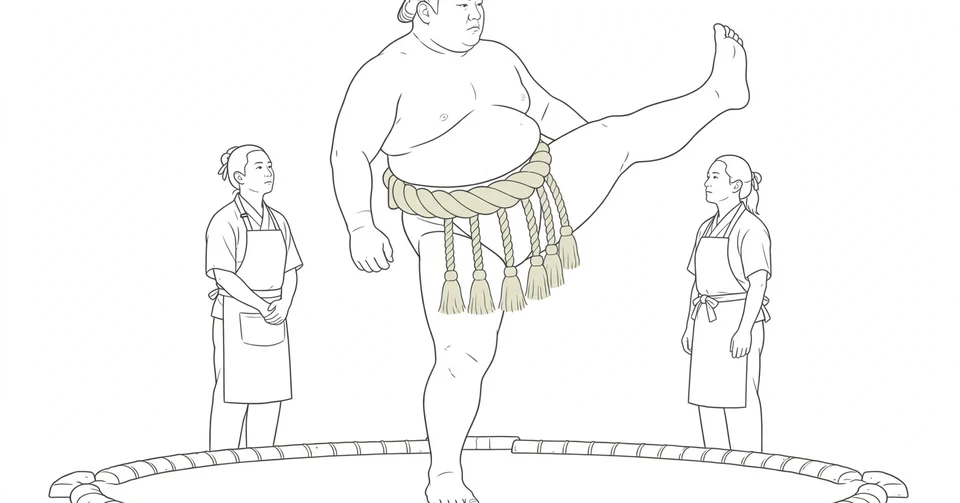
To understand why the champion gets this private stage, it helps to remember that the dohyo-iri was never only an introduction. It is closer to a consecration, a way of presenting the wrestlers to the gods and the audience at once, and the yokozuna version is the fullest form of it.
What a dohyo-iri is
Dohyo-iri simply means entering the ring, and in principle it is a ceremony shared by every wrestler in the two salaried divisions, juryo and makuuchi. Before their bouts begin, the wrestlers of each division file in by east and west sides, mount the ring in their ceremonial aprons, and perform a brief sequence of gestures together. It introduces them, yes, but it also purifies the space and declares, in the old language of ritual, that what happens next will be done openly and fairly.
The yokozuna stands apart from this shared routine. He does not join the circle of his own division. Being the highest rank in the sport, and in some sense a living focus of its sacred side, a grand champion receives a separate dohyo-iri of his own, performed alone after the group has finished. If there are two yokozuna, each performs his own. The separation is the point. The group ceremony says these are the wrestlers. The solo ceremony says this one carries something more.
That something more is written into the history of the rank itself. The separate entrance appears to be one of the original reasons the yokozuna rank took formal shape in the eighteenth century, a way of letting the very best stand visibly apart from the rest of the top division. Sumo has always been as much ritual as contest, a point worth holding onto when reading about sumo, Japan's oldest sport, and the dohyo-iri is where that double nature is easiest to see.
The group entrance comes first
The makuuchi group dohyo-iri, which precedes the yokozuna's own entrance, is worth watching in its own right. Led by a referee, the wrestlers come down the aisle in ascending order of rank, the lowest first, each announced by name, birthplace and stable as he steps up onto the clay. They wear kesho-mawashi, heavy silk aprons embroidered with crests, landscapes or sponsors' designs, garments so ornate that they are closer to court dress than sports kit. Aprons like these are often gifts from supporters and can cost a great deal of money.
Once the last man, usually an ozeki, closes the formation, the wrestlers stand in a circle facing out toward the audience. Then they turn inward and, together, clap once, raise the right hand, lift the front of their aprons slightly with both hands, and raise both arms high. The whole sequence takes seconds. Its meanings are old ones. The clap calls the attention of the gods. The raised, empty hands show that no one is carrying a weapon. The lifted apron is a small gesture of purification, shaking out whatever might cling to the wrestler before he fights.
The juryo division performs the same ceremony earlier in the day, before its own bouts, so a full tournament day holds several dohyo-iri of this shared kind. But the crowd's attention sharpens noticeably for the last one of all, because everyone in the building knows who is missing from the makuuchi circle, and why.
The rope, the apron and the two attendants
A yokozuna enters his dohyo-iri attended, but the attendants are not the story. The rope is. Around his waist he wears the tsuna, a great braided rope of white hemp from which the title yokozuna itself takes its name, yoko meaning the rope's wide span. The tsuna can weigh as much as twenty kilograms, and it is freshly made at his stable for each tournament by the younger wrestlers. It closely resembles the shimenawa, the sacred ropes hung at Shinto shrines and around sacred trees, and it does the same work: it marks off and purifies whatever it surrounds. From the front of the rope hang shide, zigzag streamers of white paper of the kind used in shrine ritual, which swing gently as the champion moves.
Under the rope he wears a kesho-mawashi like the other top wrestlers, an embroidered silk apron, and his two attendants wear aprons from the same matching set, a small detail that quietly presents the three men as one unit. The attendants are top division wrestlers themselves, usually from the yokozuna's own stable or its wider group of allied stables, chosen for seniority and trust.
The first to appear is the tsuyuharai, the dew sweeper, who walks ahead of the champion as a herald walks ahead of a lord, clearing the path in symbolic terms. Behind the yokozuna comes the tachimochi, the sword bearer, carrying a Japanese sword that marks the champion's samurai standing. The tachimochi is always the more highly ranked of the two attendants, and his role is considered the greater honour. A senior referee walks with them, and the four men take their places around the ring with the unhurried precision of people who have rehearsed this since boyhood, which, in sumo's live in stable system, is very nearly true.
The steps of the dohyo-iri
Once the yokozuna has climbed onto the clay and taken his place at the centre, the dohyo-iri proper begins, and it is built from the same gestures the whole division performed together, slowed down and magnified until they fill the arena.
He squats and claps his hands, a sharp sound meant to summon the attention of the gods, the same clap heard before prayer at a shrine. He rises and extends his arms wide with the palms turned upward, the old demonstration that he carries no hidden weapon, only now it is held a moment longer and aimed at every side of the hall. Then comes the shiko, the great leg stamp at the heart of sumo ritual, each leg raised high in turn and brought down hard onto the clay to drive out whatever evil might be hiding in the ground. The stamp is the same one wrestlers repeat hundreds of times in morning training, as a look at shiko, the leg stamp explains, except that here it is performed by one man, alone, in complete silence except for the sound of foot meeting earth.
There is a rising and sinking rhythm to the sequence, the body gathering down into a crouch and then unfolding upward, the arms opening and closing around it. The attendants mirror small parts of the posture from their stations. When the final stamp lands, the champion turns, descends from the ring with his attendants, and the dohyo-iri is over. From aisle to aisle the whole thing has taken only a few minutes.
Those minutes also echo forward into the bouts themselves. Every top division wrestler, before fighting, repeats a shortened private version of the same vocabulary in the ring: the clapping, the open palms, the leg stamps, folded into the pre bout rituals alongside the salt throwing. The yokozuna's dohyo-iri is therefore not a separate performance bolted onto the sport. It is the source text of gestures that the rest of the day keeps quoting.
Unryu and Shiranui, two ways to fill the ring
A yokozuna does not invent his dohyo-iri. When he is promoted he adopts one of two established styles and performs it, with only small personal inflections, for the rest of his career. The choice is announced at his promotion and is watched closely by enthusiasts, because the two styles give the same sequence of movements noticeably different characters.
The Unryu style is the more reserved of the two. Through the central rising movement, one arm stays bent across the body while the other extends, a posture traditionally read as defensive, the champion guarding himself as he stamps. The Shiranui style is its opposite in feeling. Both arms sweep out wide and open, an expansive, attacking posture that offers the whole ring to view and dares it to look. Spectators who know the difference can name a yokozuna's style from the top row of the arena, and also from behind, since the rope itself is tied differently for each style, with a different arrangement of loops at the back. A full account of the two forms can be found in the Dohyo-iri reference at Wikipedia, which also explains how the group and solo ceremonies divide the day.
The styles carry the names of Unryu Kyukichi, the tenth yokozuna, and Shiranui Koemon, the eleventh, both men of the Edo period. Here the honest version of the story gets interesting, because there is no solid historical proof that either man actually performed the dance now attached to his name. The forms appear to have been fixed later, reconstructed from celebrated images and statues of the two champions, and some scholars suspect that early historians may even have mixed the two men up, attaching each style to the wrong name. Sumo, a sport that guards its traditions fiercely, thus performs its most sacred dohyo-iri in styles named for men who may never have danced them, which somehow makes the tradition more human rather than less.
In recent decades, Hakuho, the most successful yokozuna in history by tournament titles, performed the Shiranui style, all reach and openness. Asashoryu, the fiery champion who preceded him, performed Unryu, compact and guarded. Fans read character into the choice, fairly or not, and a new yokozuna knows that whichever style he picks will be quoted back at him for the rest of his life.
Why a few quiet minutes hold an arena
It is worth pausing on the strangeness of the thing. A sumo tournament day runs for hours. There are dozens of bouts, some of them superb. And yet for many spectators, and certainly for the television cameras, the emotional peak arrives before the top division fighting even starts, in a dohyo-iri where nobody wins anything.
My own view, watching from Shizuoka with no family loyalty to any stable, is that the dohyo-iri works because it is a portrait of power behaving itself. The largest, strongest man in the building walks into the middle of the ring and spends his moment of glory doing a slow, exact, self effacing sequence of gestures about purity and openness. He shows his empty hands to the crowd. He stamps the ground clean, not in anger but as a kind of housekeeping for the spirit world. Then he leaves so that others can fight. The ceremony guides at SumoSumoSumo make the same point from the ritual side: none of this is showmanship bolted onto the sport, it is liturgy the sport has carried for centuries.
The ceremony also bookends a career in a way few sports manage. A new yokozuna performs his first dohyo-iri at Meiji Shrine in Tokyo, in front of the public, within weeks of his promotion, a debut as watched as any bout. And when a retired yokozuna turns sixty, tradition invites him back into the ring one more time for a kanreki dohyo-iri, wearing a red rope in celebration of his long life, to perform the same claps and stamps with an old man's body. The same few movements, at the beginning of the reign and near the end of the life.
Television understands this instinctively. Broadcasts linger on the dohyo-iri, commentators fall quiet for it, and replays of famous champions are as likely to show a great dohyo-iri as a great throw. Foreign visitors with no Japanese and no knowledge of the sport, the people most likely to be lost during the tactical bouts, are rarely lost here. A giant in a white rope, alone in a ring of clay, raising one leg to the height of his own shoulder: that needs no translation at all.
A short ceremony with a long shadow
Three minutes is not much. A train between two stations in Tokyo takes longer. But the dohyo-iri shows how sumo measures time differently from other sports: not by duration, but by weight. A clap that has been repeated for centuries, an open palm that still means what it meant to samurai, a stamp that shakes a little dust off the clay. The yokozuna does not own the ring for long. He just borrows it, cleans it, and hands it back, and in sumo that has always been enough.
More in Culture & Society
Latest posts
- Every Prefecture Argues About What Goes in Ozoni
- KRL Commuterline and the Trains That Move Jakarta
- Kecap Manis and the Sweet Soy Sauce of Indonesia
- In Mamoiada, Two Hundred Families Still Make Wine at Home
- Shochu and the Quiet Spirit of Japan
- A Dried Shiitake Is Louder Than a Fresh One
- Loma Linda's Long Lives Run on Saturdays
- Maruten Numazu and the Towering Kakiage Bowl of the Port
- The Three Sisters Grow Better Together
- Tatamiishi Terraces Filter a River Through Stone
- Wasabi-Zuke Puts the Whole Plant in Sake Lees
- Konyoku Is Still Out There, Past the Last Train Station
- Dry January Lasts a Month on Purpose
- Ikaria Runs on Island Time
- Why Nicoya Cooks Its Corn in Lime